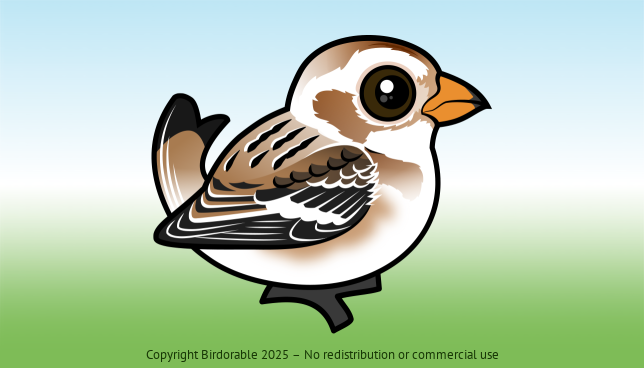
The Snow Bunting is a hardy songbird that breeds in the high Arctic tundra and spends winters in open fields and coastlines farther south. In flight, it flashes bold white wing patches that contrast sharply with its black wingtips. Males in breeding plumage are bright white with black on the back and wingtips, while females and winter birds (our Birdorable version) have more brownish tones for camouflage.
Unlike many songbirds, Snow Buntings breed in extremely cold climates. They nest in rock crevices or under boulders, using thick layers of moss and feathers to protect their young from freezing temperatures. Males arrive at the breeding grounds weeks ahead of females to establish territories, enduring temperatures well below freezing.
In winter, Snow Buntings gather in large flocks and forage for seeds on the ground, often in windswept areas with little snow cover. They are commonly seen along roadsides, fields, and coastal dunes. Their white-and-brown coloring helps them blend in with snowy and barren landscapes.
Despite their delicate appearance, they are extremely resilient birds adapted for life in some of the planet’s harshest climates.