


March is Women's History Month
Birds Named After Women: Honoring Female Naturalists & Explorers
Bird names often reflect the history of ornithology, with many species named after explorers, scientists, and historical figures. In recent years there has been a growing movement to remove honorific bird names altogether. Many of these names celebrate individuals with colonial ties or otherwise problematic pasts, and it is felt that birds should have names that reflect their appearance, behavior, or habitat -- instead of human figures. You can learn more about this movement at Bird Names for Birds. While the debate continues, some species still bear the names of remarkable women -- naturalists, illustrators, and explorers -- who made significant contributions to science. In honor of Women’s History Month, here’s a look at some birds named after female pioneers.
Koepcke’s Hermit
This species of hummingbird is named after Maria Koepcke, a German ornithologist who made significant contributions to the study of Peruvian birds. She documented many species during her time working in Peru, including at least three new Peruvian endemic bird species (White-cheeked Cotinga; Russet-bellied Spinetail; and the Cactus Canastero) before her tragic death in a plane crash at 47. Three other bird species are named after Maria Koepcke: Koepcke's Screech-Owl, Koepcke's Caique; and the Sira Currassow (Pauxi koepckeae).
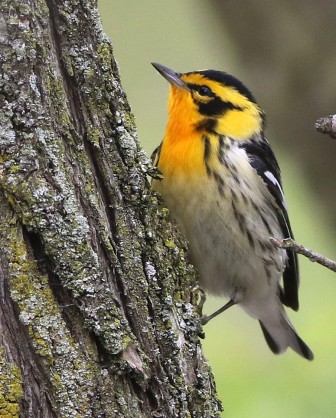
Blackburnian Warbler by fishhawk [CC BY 2.0]
Blackburnian Warbler
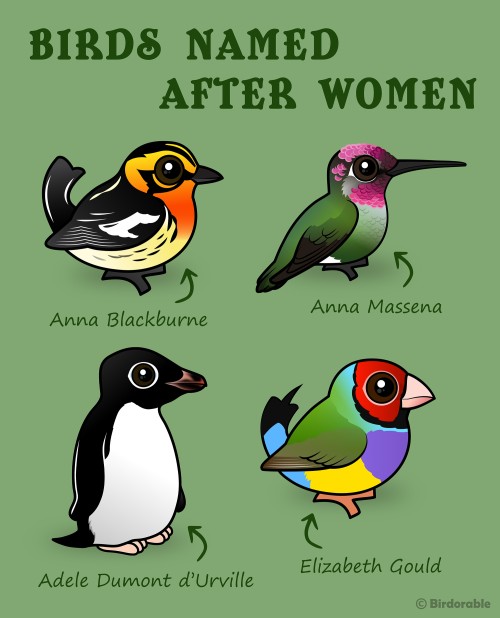
Named after Anna Blackburne, an English naturalist and botanist in the 18th century, the Blackburnian Warbler is known for its brilliant orange throat and contrasting black-and-white markings. Blackburne was an avid collector of plants and animals, contributing significantly to natural history. A species of scarab beetle and a Pacific islands flowering plant were also named after Blackburne.
Gouldian Finch
The Gouldian Finch, a vividly colored Australian species, was named in honor of Elizabeth Gould, a 19th-century artist and illustrator. She was the wife of ornithologist John Gould and played a crucial role in illustrating his bird books, including The Birds of Australia, and other ornithological tomes. Despite her significant contributions, she often went uncredited during her lifetime. Mrs. Gould's Sunbird is also named after Elizabeth Gould.
Lady Amherst’s Pheasant
This strikingly patterned pheasant, native to China and Myanmar, was named after Sarah Amherst, an English naturalist and botanist. She was instrumental in collecting and documenting bird species from Asia, sending many specimens back to Europe for study. Lady Amherst’s Pheasant, with its striking long tail and metallic plumage, remains one of the most visually spectacular birds.
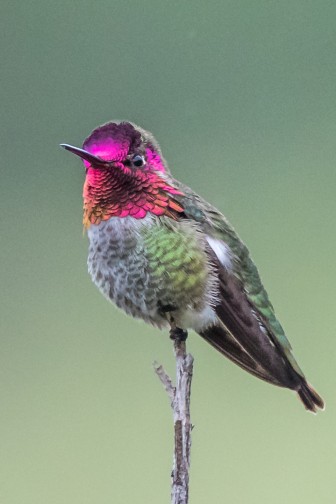
Anna's Hummingbird by Allan Hack [CC BY-ND 2.0]
Anna’s Hummingbird
This dazzling hummingbird, with its iridescent pink and green plumage, was named after Anna Masséna, Duchess of Rivoli. She was a 19th-century French noblewoman and an avid bird enthusiast. The species was described by René Primevère Lesson, a French naturalist who named it in her honor. Found along the western coast of North America, Anna’s Hummingbird is known for its spectacular aerial displays.
Lulu's Tody-Flycatcher
This small flycatcher species, endemic to Peru, was first discovered by science in 1970, and described as late as the early 1980s. Ornithologists Ned Johnson and Robert Jones gave the new species the name Lulu's Tody-Flycatcher to honor philanthropist Lulu May Von Hagen for her support of avian genetics and research. The bird is also known as Johnson's Tody-Tyrant.
Grace's Warbler
This warbler was named after Grace Darling Coues, the sister of American ornithologist Elliott Coues. The species was described by Spencer Fullerton Baird; Elliott was the finder and requested the name to honor his sister. Despite having a bird named in her honor, little is recorded about Grace Coues herself, highlighting how many women honored in bird names remain historically under-recognized. The following species were also named after women who did not have a direct recorded involvement in ornithology or natural studies.
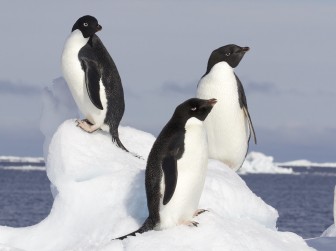
Adélie Penguins by Gregory "Slobirdr" Smith [CC BY-SA 2.0]
Adélie Penguin
This well-studied species of penguin was named after Adèle Dumont d'Urville, the wife of French explorer Jules Dumont d’Urville. In 1840, during an Antarctic expedition, d’Urville named both the Adelie Penguin and the Adélie Land (a region of Antarctica) in her honor. These charismatic black-and-white penguins are known for their incredible endurance in the harsh Antarctic environment. They rely on sea ice for survival, feeding primarily on krill and forming large, noisy colonies during the breeding season. While Adélaïde herself was not an explorer, her name is forever tied to one of Antarctica’s most iconic birds.
Virginia's Warbler
This small, gray-and-yellow warbler was named in honor of Virginia Anderson, the wife of Army surgeon and naturalist Dr. William Anderson. Ornithologist Spencer Fullerton Baird described the species in 1858 and honored the wishes of William, as the finder, to name the bird after his wife.
Adelaide’s Warbler
This bright yellow warbler, endemic to Puerto Rico, was named after Maria Antoinette Adelaide Florentia del Carmen Swift Washburne, the daughter of ornithologist Robert Swift. While little is known about Adelaide’s own contributions to ornithology, the warbler carries her name, making her one of the few women honored in bird nomenclature. Her father was the first to describe the species. Keen blog readers should know that this bird will be added to Birdorable very soon -- stay tuned!
Some other birds named after women under similar circumstances include Johanna's Sunbird (Johanna Verreaux, wife of naturalist Édouard Verreaux); Thekla's Lark (Thekla Brehm, deceased sister of zoologist Alfred Edmund Brehm); Letitia's Thorntail (Letizia del Gallo Roccagiovine, granddaughter of ornithologist Charles Bonaparte); Lina's Sunbird (Lina Rabor, wife of ornithologist Dioscoro S. Rabor); Winifred's Warbler (Winifred Muriel Moreau, wife of ornithologist Reginald Moreau); Mrs. Hume's Pheasant (Mary Ann Grindall Hume, wife of naturalist Allan Octavian Hume); Rachel's Malimbe (Rachel Cassin Davis, daughter of ornithologist John Cassin); and Lucy's Warbler (Lucy Hunter Baird, daughter of ornithologist Spencer Fullerton Baird). You can read more about these and other birds named after women here.
Historically, many birds were named after male explorers and scientists, despite the fact that many women played a crucial role in ornithology and conservation. While efforts are being made to rename some species to reflect more inclusive histories, for today these bird names remain as a reminder of the contributions of women in the field.


Comments
Leave a comment
Thank you!