Swallow-tailed Kites and their Acrobatic Flying Skills
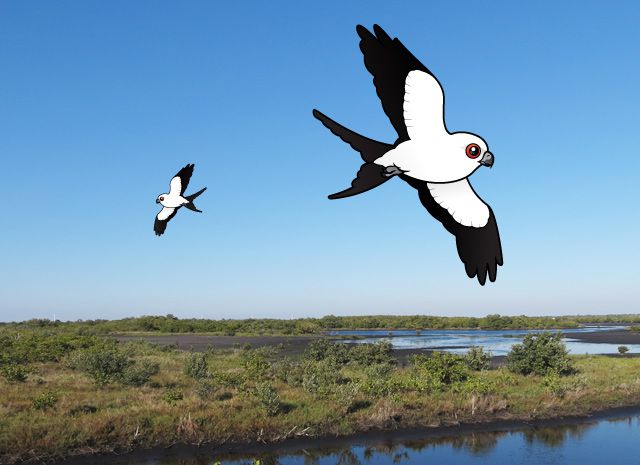
Birdorable Swallow-tailed Kites over Florida

It is a sure sign of spring, here in Florida, when the iconic outline of Swallow-tailed Kites can be seen overhead once again. These graceful black-and-white birds, with their deeply forked tails, breed near the coast from Texas to Florida and spend the winter in South America. They are just now starting to arrive in the United States again and we saw our first one this week.

Every morning they take to the sky on thermal drafts and never seem to land, always soaring like a kite and rarely flapping their wings. The bird is one of the most acrobatic flier of all raptors, being able to make sharp turns and quickly rotate its tail to trace tight circles in the sky. Swallow-tailed Kites need their mad flying skills to snatch small animals off the top of trees, which they frequently eat on the wing. In this way it catches most of its diet, which consists mainly of large insects and small birds, reptiles, mammals and amphibians who dare to sit in tree tops.

We love these beautiful birds and are looking forward to seeing them soar overhead in the coming months. Check out these cute Swallow-tailed Kite gifts from our Birdorable shop.
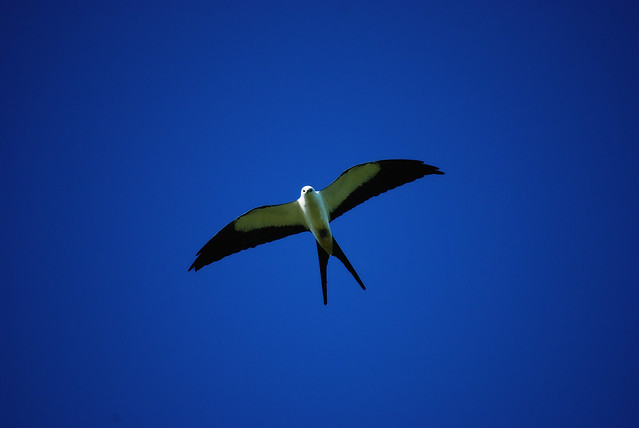
Swallow-tailed Kite
Photo by Artur Pedziwilk (CC BY 2.0)

Cute Swallow-tailed Kite Gifts

Comments

Harpy Eagle on July 4, 2017 at 10:50 PM wrote:
No Snail kites?
SPURWING PLOVER on March 8, 2024 at 4:35 AM wrote:
Just the Swallow Tailed Kind

Leave a comment

Comments with links or HTML will be deleted. Your comment will be published pending approval.
Your email address will not be published
You can unsubscribe from these communications at any time. For more information on how to unsubscribe, our privacy practices, and how we are committed to protecting and respecting your privacy, please review our Privacy Policy. By clicking submit below, you consent to allow Birdorable to store and process the personal information submitted above to provide you the content requested.

Busting a Bird Myth: Touching Baby Birds and Parental Abandonment

One of the most pervasive myths about birds is that they will abandon their babies if humans touch them. This belief often deters well-meaning individuals from assisting fledglings that appear to be in distress or have fallen from their nests. However, this myth is largely unfounded. Understanding the...

Is It Pileated... or Pileated Woodpecker? A Playful Twist on a Special Bird

We’re excited to shine the spotlight on one of our favorite new funny Birdorable designs, featuring our Pileated Woodpecker. The design is based on its well-known pronunciation diversity: is it PIE-lee-ated or PILL-ee-ated? This striking design is sure to delight bird lovers, word nerds, and woodpecker fans alike. The Pileated...

Bird Term: Sexual Dimorphism

Sexual dimorphism refers to observable differences between males and females of the same species. In basic terms, it means that a male of a species is easily distinguished from a female. In birds this usually means differences in size or in...

Beyond Two Parents: Unraveling Bird Rearing Techniques

When it comes to raising their young, birds exhibit a fascinating array of parenting strategies. One common myth about bird parenting is that it always requires two parents — one male and one female — to successfully raise their young. While this is true for many bird species, it's not...