Bird Myth: Hummingbirds Migrate on the Backs of Geese

No, Hummingbirds Don’t Ride on the Backs of Geese
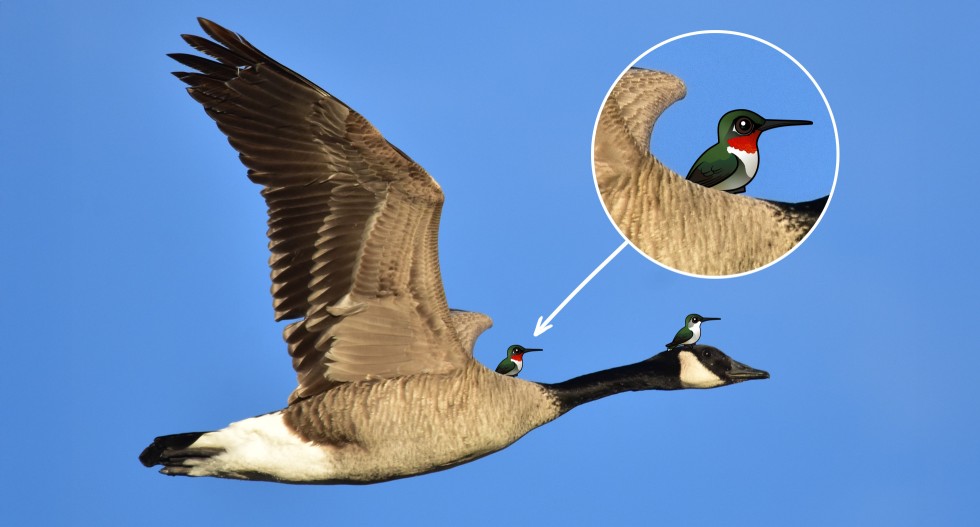
An illustrated Ruby-throated Hummingbird perched on the back and neck of a Canada Goose in flight against a blue sky.

A Ruby-throated Hummingbird hitching a ride on a Canada Goose is the image behind one of the most common pieces of migration folklore, even though no hummingbird has ever needed a lift.

Every fall, big V-shaped skeins of honking Canada Geese pass overhead. Every fall, hummingbirds vanish from the feeders just as quietly as they arrived. Put those two things side by side and you get one of the most repeated pieces of nature folklore in North America: that a hummingbird, too small to possibly manage the long migration journey on its own, saves its strength by hitching a ride on a goose’s back.

It is a lovely image, but it isn’t what happens.

Where the Idea Comes From

The geese-taxi myth is genuinely widespread. The reasoning behind it is almost always the same: a bird that weighs about as much as a nickel seems like it shouldn’t be able to fly hundreds or thousands of miles under its own power, so people fill in the gap with an explanation that feels physically sensible. A goose is big, a goose is strong, a goose is clearly capable of long-distance flight. Why not let it do the work?

The trouble is that Canada Geese and hummingbirds are not even on the same schedule. They leave at different times, follow different routes, and head to different places. There is no shared flight path for a hummingbird to climb aboard in the first place.

They Fly It Themselves, From the Very First Day

Here is the detail that makes the myth almost backward: geese are one of the few kinds of birds where the young genuinely do get guided south, flying in family groups behind experienced adults who know the route. Hummingbirds get none of that. A young Ruby-throated Hummingbird that hatched earlier that same summer sets off on its first migration completely alone, often after its parents have already left. It has never made the trip before, has no one to follow, and still has to find its way to Mexico or Central America and back using nothing but instinct.

If any bird in this story needed a ride, logic says it should be the one with zero experience and no escort. Instead, it is the one that manages entirely alone.

The Fuel-Up Before the Flight

What a hummingbird actually does, instead of hitching a ride, is eat like a champ in the days before it leaves. Researchers studying Ruby-throated Hummingbirds found that individuals following a “fatten up first” strategy can pack on as much as 35 to 40 percent of their body mass in just four days, feeding heavily through the days leading up to the start of their migration. That extra weight is pure fuel: fat reserves the bird burns steadily over the coming flight.

Not every bird fuels up the same way, though. Some hummingbirds pack on that weight and go the distance in one push. Others take a different approach entirely, covering shorter stretches and refueling along the way rather than loading up beforehand. Either way, nobody is carrying anything for them. They are building their own gas tank.

The Gulf Crossing Is Not Quite the Legend Either

The fact that usually replaces the geese myth, once people learn it is false, is that every Ruby-throated Hummingbird crosses the Gulf of Mexico in one nonstop overnight flight, a genuinely remarkable feat that can cover roughly 475 to 640 miles of open water depending on where a bird launches from, taking somewhere around 18 to 22 hours of continuous wingbeats with no chance to land, drink, or rest.

That flight is real, and the hummingbirds absolutely make it in one go. But researchers who tracked individual young hummingbirds departing from the Alabama coast with radio tags found something more complicated: 77 percent of those juveniles oriented themselves parallel to the coastline rather than straight out over open water, following what scientists describe as a “fly-and-forage” strategy, moving along the shore and stopping to feed rather than launching into a single overwater sprint. A related study of stopover behavior found that older, more experienced birds carried larger fuel reserves, had longer flight ranges, and shorter stopovers than the younger birds passing through the same site, which lines up neatly with the fattening research above: the birds with the biggest fuel tanks are the ones most likely to attempt the open-water route.

Either Way, Nobody Gave Them a Ride

So the honest version of this story has two migration strategies instead of one tidy heroic flight, and scientists are still working out exactly how common each one is. What does not change between them is the part that actually answers the myth: whether a hummingbird crosses the Gulf in a single overnight dash or spends days picking its way up the coastline one meal at a time, it is doing all of the flying, all of the navigating, and all of the food finding by itself. Nobody, and certainly no goose, is doing any part of that trip for it.

An Even Wilder Number

Here's another staggering migration statistic. Skip the Gulf crossing and look west. The Rufous Hummingbird does not cross the Gulf of Mexico at all. Instead it flies a clockwise loop between Mexico and as far north as Alaska and back, a one-way trip of about 3,900 miles. The American Bird Conservancy did the math on what that means relative to the bird’s own body: about 78.4 million body lengths, which is proportionally farther than the Arctic Tern’s famous 11,000-mile migration, the animal kingdom’s usual gold standard for long-distance travel.

Small birds do sometimes cross open water in the loose company of other migrants heading the same direction, but that is a shared destination, not a shared ride. As the same American Bird Conservancy article puts it plainly: hummingbirds “do not migrate on the backs of geese or other birds.”

Which Strategy Impresses You More?

There is something about a bird that hatched a few months ago picking its way along hundreds of miles of unfamiliar shoreline, stopping to refuel at spots it has never seen and will never be shown by a parent, that feels like the harder trick to pull off. But an unbroken overnight flight across open ocean, powered by a body that packed on nearly 40 percent of its own weight in four days, is hard to argue with too. Which one would you bet on if you were the hummingbird?

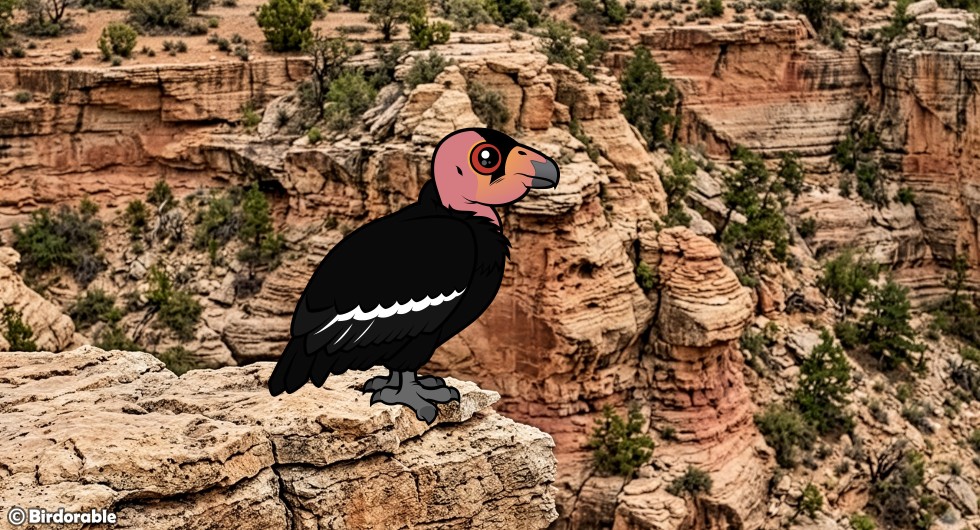
In 1982 you could have counted every California Condor alive on the planet without running out of fingers and toes. There were 23. That wasn't 23 in California, and it wasn't 23 in captivity. That was the entire species: every single condor left on Earth, all twenty-three of them.

This is a bird with a three meter wingspan, the widest of any bird in North America, a bird that can weigh as much as a small dog, and live for sixty years. Its kind had flown these skies since the Ice Age, when the genus ranged across the Americas and condors soared over what is now Florida. It was down to two dozen individuals, and something had to be done.

The Decision Nobody Wanted to Make

By the mid 1980s the wild birds were dying faster than they were breeding, and biologists faced a stark choice: leave the last few free and hope, or catch every single one and try to breed them in captivity.

The argument ended up in court, where the National Audubon Society sued to stop the Fish and Wildlife Service from capturing every remaining wild bird, arguing some condors should stay free to guide any captive-bred birds released later. A district court agreed and blocked the captures, but in June 1986 the appeals court overturned that ruling, finding the decision to take in the remaining condors "manifestly defensible."

On Easter Sunday 1987, a biologist named Jan Hamber tracked the last free-flying California Condor to a trap site in southern California. The bird was known as AC-9. When he was carried away, the species existed only in captivity. A species that had ridden thermals over that landscape for tens of thousands of years was, as of that afternoon, entirely in human hands.

Puppets

The recovery worked because of a quirk of condor biology. A pair normally raises a single chick, but if the egg is lost early, the female will often lay another. Biologists exploited this by taking the first egg and letting the parents lay a replacement, doubling the output of every pair.

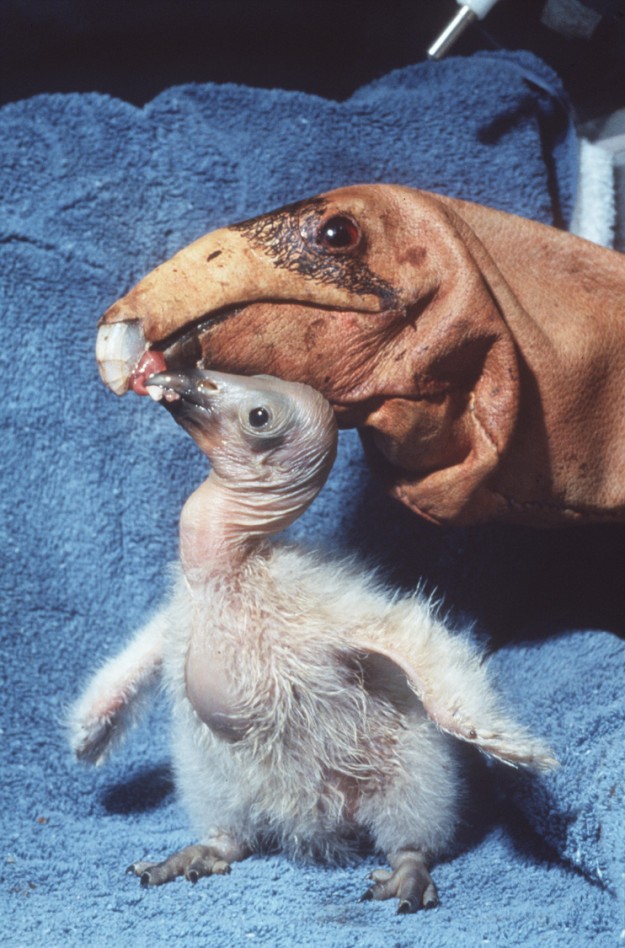
That created a new problem. A chick raised by people grows up thinking it is a person, which is fatal for a bird that needs to find its own food and live wild with its own kind. So the eggs taken away were hatched and fed using hand puppets shaped and painted like the head of an adult condor, so that a growing chick would not learn to associate food with people.

Look closely, that "adult bird" is actually a hand puppet! (source: U.S. Fish and Wildlife Service, public domain) 

Back to the Sky

The first captive-bred condors were released in 1991 and 1992, at Big Sur, Pinnacles and Bitter Creek National Wildlife Refuge in California. Arizona followed in 1996, at the Vermilion Cliffs near the Grand Canyon. Later came a site in the Sierra de San Pedro Martir in Baja California, Mexico.

And in May 2002, after fifteen years in captivity, biologists opened a pen at Hopper Mountain and let AC-9 go. The last wild condor became a wild condor again. He was given a new number, 21, and he went on to nest in the Sespe Condor Sanctuary and raise chicks of his own in the open air. He died in the wild on June 29, 2016, by then the oldest bird in the southern California flock.

Prey-go-neesh Comes Home

In 2022 condors returned to a part of their range that had been empty for a century, and they did it because the Yurok Tribe spent years making it happen.

To the Yurok, the condor is prey-go-neesh, among the first beings of the world and the one that carries prayers to the Creator. Condor feathers and condor songs are part of the World Renewal ceremonies, including the White Deer Skin Dance and the Jump Dance. Restoring the bird was not only an ecological project. It was the return of a relative.

The Yurok Condor Restoration Program began releasing birds in Redwood National Park in 2022, and by late 2024 eighteen had been freed there. In May 2026 a two-year-old female called B9 left the redwoods and flew a 380-mile loop over four days, crossing into Oregon and getting within a few miles of Medford before turning for home. She was the first California Condor recorded in Oregon since 1904.

Continued Threats to Condors

The condor is not out of trouble, and the reasons are worth knowing, because most of them are fixable.

Lead poisoning remains the number one known cause of death. A rifle bullet fragments when it hits, and a condor feeding on a carcass or a discarded gut pile swallows the pieces. A 2012 study in the Proceedings of the National Academy of Sciences traced the metal and found that 79 percent of free-flying condors carried a lead signature matching ammunition. Without constant intervention to find and treat poisoned birds, the study concluded, the wild population would slide back toward extinction. California banned lead ammunition within condor range starting in 2008.

The leading killer of condor nestlings is not a predator, it's trash: small fragments of bottle caps, glass, wire, and plastic that parents pick up and carry back to the nest. Condors naturally feed bone chips to their chicks for calcium, and they cannot always tell the difference. A study of nests in southern California found junk in almost every one, in larger amounts than in historic condor nests, and concluded it's now the leading cause of nest failure in the reintroduced population.

In 2023, highly pathogenic avian influenza reached the Arizona and Utah flock. By the middle of April the Fish and Wildlife Service had recorded 20 dead condors there, with the virus confirmed in half of them. The response was unprecedented: an emergency vaccine trial, tested first on American Black Vultures standing in for their rarer cousins, then extended to condors themselves. By February 2024, 94 condors had received at least a first dose.

Where Things Stand

On December 31, 2025, the US Fish and Wildlife Service counted 607 California Condors in the world. Of those, 392 were flying free, in flocks across California, Arizona, Utah and Baja California, and 215 were in captive breeding programs.

Twenty-three birds, all of them in cages, became 607 birds, most of them wild. It took nearly forty years, an enormous amount of money, hand puppets, and the patience of people who knew they might be doing all of it for nothing.

It's worth remembering this on a day set aside for vultures, because the news about vultures is mostly bad. Species are collapsing across Africa and Asia, and the causes are poison, persecution, habitat loss. The condor is the counterexample. It is proof that the decline is not a law of nature. 

What Would You Bring Back?

If you could return one bird to a place it used to live, which would you choose, and where? Tell us in the comments below!

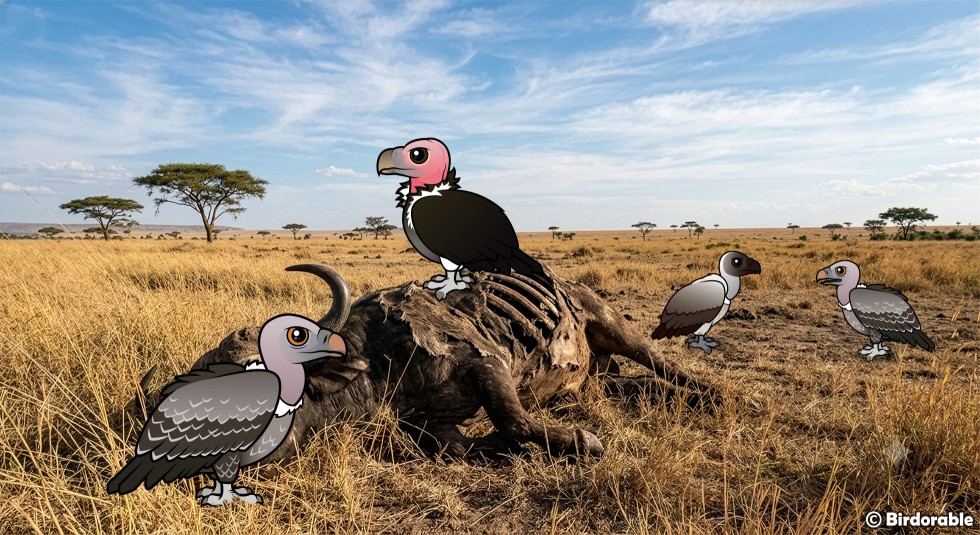
Illustration of Birdorable vultures at a carcass on the African savanna: a Lappet-faced Vulture with a pink head stands on top of the carcass while a Rüppell's Vulture waits beside it and a White-backed Vulture and a second Rüppell's Vulture look on from the dry grass nearby.

Picture a vulture in your mind. You might imagine a large dark bird, a raptor-shaped bird soaring on thermals, or a group of bald-headed birds sitting on a carcass. 

Here's the strange part: that vision of a 'vulture' can't be found on one branch of the bird family tree. It's a specific environmental niche, and nature has handed it out at least three separate times, to birds that are not each other's close relatives.

The Shared Design

Filling this role, no matter which branch of the family tree you climbed down from, comes with the same unusual requirements. You have to find animals that have died somewhere across an enormous landscape, with no way of knowing in advance where, and cover huge distances doing it on very little fuel. And whatever you find, you have to be able to eat it, even long after it would make almost anything else sick.

Birds that solve this problem end up looking alike whether they're related or not: long broad wings built for riding warm air instead of flapping, a bare or nearly bare head, and a life spent high up, watching.

Biologists call this convergent evolution: when separate lineages run into the same problem and arrive at the same answer, independently of one another. This is how sharks and dolphins both ended up being torpedo-shaped swimmers despite not being closely related. When it comes to convergent evolution, vultures are one of the best examples there is, because it happened more than twice.

Three Separate Inventions

In the Americas, vultures belong to a family all their own, the Cathartidae. Among them are the Turkey Vulture, the Black Vulture, the spectacular King Vulture, and the two condors.

Note: Today, there are no vulture species in Australia. Fossils point to at least one vulture species flying over Australian skies in the past; this was likely a Cathartidae species. The vulture probably went extinct after massive marsupials of Australia died off. Today, other species fill the scavenger niche on the continent, including eagles, ravens, and large lizards.

In Europe, Africa and Asia, the birds we call vultures sit inside Accipitridae, the big family that also contains the hawks and eagles. But they don’t form a single group there either. They appear to fall into two clusters that aren’t closely related to one another. One holds the Lammergeier, the Egyptian Vulture and the Palm-nut Vulture. The other holds the griffons, the Cinereous Vulture and the Lappet-faced Vulture. The first group appears to have evolved with the honey buzzards. The second sits with the true eagles.

So the vulture way of life evolved separately at least three times over: once in the Americas, and twice more, separately, among the hawks and eagles of the Old World.

How You Can Tell They Aren’t the Same

One striking difference between the two groups is in their senses of smell. Old World vultures find carcasses exclusively by sight, while some New World vultures find them by scent instead. The Turkey Vulture has an unusually large olfactory bulb and forages by flying low, picking up ethyl mercaptan, a gas given off in the earliest stages of decay. Black Vultures, King Vultures and condors can’t manage this at long range, so they do the next best thing and follow Turkey Vultures to dinner.

That ability once had a very practical use. In 1938 an oil company with unfindable leaks in 42 miles of gas pipeline solved the problem by pumping a carcass-scented chemical into the line and watching for circling Turkey Vultures. It worked, and it went on to settle a scientific argument that had been running for more than a century. 

New World vultures also can't vocalize, at least not the way most birds do. They have no syrinx, the vocal organ most birds sing with, so a condor can only hiss or grunt, and that is its entire repertoire. Old World vultures aren't known for singing beautiful songs, but they are able to screech, croak, and produce alarm calls when danger is near. Bearded Vultures have a flight call that sounds like this.

There's another difference between New and Old World vultures that you can see: nasal cavities. You can look  straight through a New World vulture's nostrils. Its nasal passage isn't divided by a wall of bone, as it is in other birds, so from the side you can look in one nostril and out the other.

New World vultures have a unique self-cooling strategy: on hot days they defecate down their own legs, and the evaporation cools them. The name for this is urohidrosis, and this behavior did not develop in the Old World birds. 

Vultures That Don’t Behave Like Vultures

Among the Old World vultures, there are some outliers that don't chow down on carrion like most vultures.

The Lammergeier, also called the Bearded Vulture, lives on bone. Between 70 and 90 percent of its diet is bone, which makes it the only vertebrate known to eat this way. Bones too big to swallow are carried up to somewhere between 50 and 150 meters and dropped onto rock until they shatter. It can achieve flight while carrying a bone weighing more than 4 kilograms. Young birds are clumsy at it, and the skill can take up to seven years to master. 

The Palm-nut Vulture, on the other hand, barely bothers with meat at all. Palm fruit makes up more than 60 percent of an adult’s diet, and more than 90 percent of a youngster’s, comprised mostly of oil palm and raffia. It’s the smallest Old World vulture, and its range across Africa follows the palms it depends on.

The Egyptian Vulture uses tools. Faced with an ostrich egg too tough to break open, it picks up a stone, carries it over in its bill, and throws it down onto the shell with a swing of the neck, again and again, until the egg cracks. The birds prefer smooth rounded pebbles to jagged ones.

Vultures in Trouble Everywhere

Despite evolving independently, vultures are facing conservation challenges, and many for the same reasons, including habitat loss, poisoning, and persecution. 

In the 1980s, India was home to an estimated 40 million vultures. Then, within a decade, the population collapsed. Between 1993 and White-rumped Vulture population fell by 99.7 percent. The populations of the Indian Vulture and the Slender-billed Vulture each fell by 97.4 percent.

The cause turned out to be a cheap anti-inflammatory drug called diclofenac, given to sick cattle. It was beneficial to the cows, but fatal to any vulture that fed on a treated carcass afterward. It was banned across South Asia by 2010.

By then the scavengers were mostly gone. Carcasses were left to rot, feral dog numbers climbed, and economists Eyal Frank and Anant Sudarshan later compared human death rates in Indian districts that had lost their vultures against those that never had many. Mortality rose by roughly 4.7 percent in the districts that lost them. Their estimate, published in the American Economic Review, works out to more than 100,000 additional human deaths a year. It's a statistical estimate, not a body count, but the scale of it is striking.

In Africa, the White-backed Vulture and the Hooded Vulture are both listed as Critically Endangered, driven largely by carcasses deliberately poisoned to kill mammal predators, with vultures dying as collateral damage.

And by 1982, just 23 California Condors were left alive anywhere in the world. Today the population is back over 607 condors, most of them flying free. Lead poisoning from ammunition is still the leading cause of death, so the comeback isn't finished, but a species once down to 23 birds now flies over four states on the widest wings of any bird in North America.

Next Time You See One

The next time you see a vulture drifting overhead, think about the role it plays in nature. No matter where you are, that bird evolved to fit a niche in its environment. Nature's clean up crew is on duty!

What’s Your Favorite Vulture?

Ours might be the Lammergeier. Dropping bones off cliffs for seven years until it gets the knack shows some serious dedication. Which one would you pick? Tell us in the comments below!

International Vulture Awareness Day

International Vulture Awareness Day takes place on the first Saturday of September each year. In 2026, we'll be celebrating this special day on September 5th.