


Vulture Week 2026
Are All Vultures Related? Not Even Close! Learn About Convergent Evolution
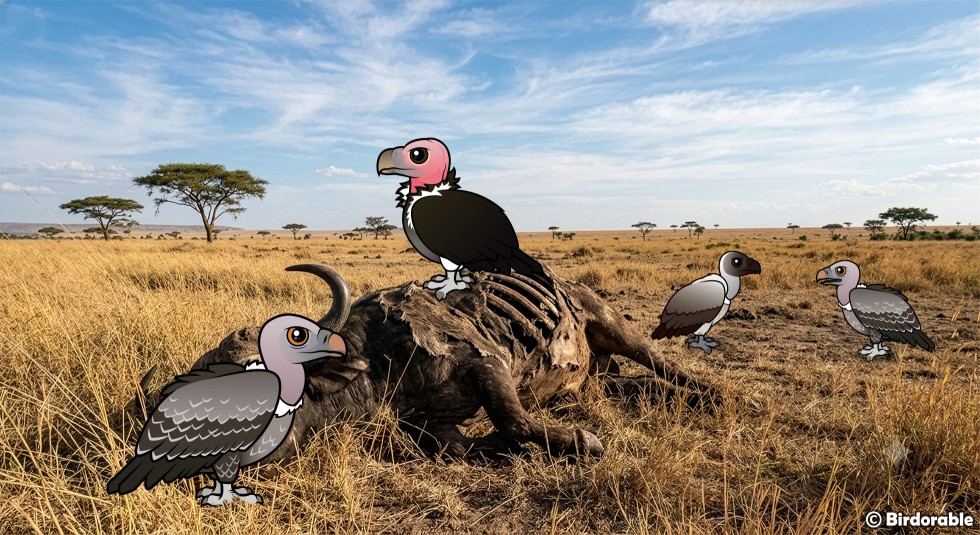
Picture a vulture in your mind. You might imagine a large dark bird, a raptor-shaped bird soaring on thermals, or a group of bald-headed birds sitting on a carcass.
Here's the strange part: that vision of a 'vulture' can't be found on one branch of the bird family tree. It's a specific environmental niche, and nature has handed it out at least three separate times, to birds that are not each other's close relatives.
The Shared Design
Filling this role, no matter which branch of the family tree you climbed down from, comes with the same unusual requirements. You have to find animals that have died somewhere across an enormous landscape, with no way of knowing in advance where, and cover huge distances doing it on very little fuel. And whatever you find, you have to be able to eat it, even long after it would make almost anything else sick.
Birds that solve this problem end up looking alike whether they're related or not: long broad wings built for riding warm air instead of flapping, a bare or nearly bare head, and a life spent high up, watching.
Biologists call this convergent evolution: when separate lineages run into the same problem and arrive at the same answer, independently of one another. This is how sharks and dolphins both ended up being torpedo-shaped swimmers despite not being closely related. When it comes to convergent evolution, vultures are one of the best examples there is, because it happened more than twice.
Three Separate Inventions
In the Americas, vultures belong to a family all their own, the Cathartidae. Among them are the Turkey Vulture, the Black Vulture, the spectacular King Vulture, and the two condors.
Note: Today, there are no vulture species in Australia. Fossils point to at least one vulture species flying over Australian skies in the past; this was likely a Cathartidae species. The vulture probably went extinct after massive marsupials of Australia died off. Today, other species fill the scavenger niche on the continent, including eagles, ravens, and large lizards.
In Europe, Africa and Asia, the birds we call vultures sit inside Accipitridae, the big family that also contains the hawks and eagles. But they don’t form a single group there either. They appear to fall into two clusters that aren’t closely related to one another. One holds the Lammergeier, the Egyptian Vulture and the Palm-nut Vulture. The other holds the griffons, the Cinereous Vulture and the Lappet-faced Vulture. The first group appears to have evolved with the honey buzzards. The second sits with the true eagles.
So the vulture way of life evolved separately at least three times over: once in the Americas, and twice more, separately, among the hawks and eagles of the Old World.
How You Can Tell They Aren’t the Same
One striking difference between the two groups is in their senses of smell. Old World vultures find carcasses exclusively by sight, while some New World vultures find them by scent instead. The Turkey Vulture has an unusually large olfactory bulb and forages by flying low, picking up ethyl mercaptan, a gas given off in the earliest stages of decay. Black Vultures, King Vultures and condors can’t manage this at long range, so they do the next best thing and follow Turkey Vultures to dinner.
That ability once had a very practical use. In 1938 an oil company with unfindable leaks in 42 miles of gas pipeline solved the problem by pumping a carcass-scented chemical into the line and watching for circling Turkey Vultures. It worked, and it went on to settle a scientific argument that had been running for more than a century.
New World vultures also can't vocalize, at least not the way most birds do. They have no syrinx, the vocal organ most birds sing with, so a condor can only hiss or grunt, and that is its entire repertoire. Old World vultures aren't known for singing beautiful songs, but they are able to screech, croak, and produce alarm calls when danger is near. Bearded Vultures have a flight call that sounds like this.
There's another difference between New and Old World vultures that you can see: nasal cavities. You can look straight through a New World vulture's nostrils. Its nasal passage isn't divided by a wall of bone, as it is in other birds, so from the side you can look in one nostril and out the other.
New World vultures have a unique self-cooling strategy: on hot days they defecate down their own legs, and the evaporation cools them. The name for this is urohidrosis, and this behavior did not develop in the Old World birds.
Vultures That Don’t Behave Like Vultures
Among the Old World vultures, there are some outliers that don't chow down on carrion like most vultures.
The Lammergeier, also called the Bearded Vulture, lives on bone. Between 70 and 90 percent of its diet is bone, which makes it the only vertebrate known to eat this way. Bones too big to swallow are carried up to somewhere between 50 and 150 meters and dropped onto rock until they shatter. It can achieve flight while carrying a bone weighing more than 4 kilograms. Young birds are clumsy at it, and the skill can take up to seven years to master.
The Palm-nut Vulture, on the other hand, barely bothers with meat at all. Palm fruit makes up more than 60 percent of an adult’s diet, and more than 90 percent of a youngster’s, comprised mostly of oil palm and raffia. It’s the smallest Old World vulture, and its range across Africa follows the palms it depends on.
The Egyptian Vulture uses tools. Faced with an ostrich egg too tough to break open, it picks up a stone, carries it over in its bill, and throws it down onto the shell with a swing of the neck, again and again, until the egg cracks. The birds prefer smooth rounded pebbles to jagged ones.
Vultures in Trouble Everywhere
Despite evolving independently, vultures are facing conservation challenges, and many for the same reasons, including habitat loss, poisoning, and persecution.
In the 1980s, India was home to an estimated 40 million vultures. Then, within a decade, the population collapsed. Between 1993 and White-rumped Vulture population fell by 99.7 percent. The populations of the Indian Vulture and the Slender-billed Vulture each fell by 97.4 percent.
The cause turned out to be a cheap anti-inflammatory drug called diclofenac, given to sick cattle. It was beneficial to the cows, but fatal to any vulture that fed on a treated carcass afterward. It was banned across South Asia by 2010.
By then the scavengers were mostly gone. Carcasses were left to rot, feral dog numbers climbed, and economists Eyal Frank and Anant Sudarshan later compared human death rates in Indian districts that had lost their vultures against those that never had many. Mortality rose by roughly 4.7 percent in the districts that lost them. Their estimate, published in the American Economic Review, works out to more than 100,000 additional human deaths a year. It's a statistical estimate, not a body count, but the scale of it is striking.
In Africa, the White-backed Vulture and the Hooded Vulture are both listed as Critically Endangered, driven largely by carcasses deliberately poisoned to kill mammal predators, with vultures dying as collateral damage.
And by 1982, just 23 California Condors were left alive anywhere in the world. Today the population is back over 607 condors, most of them flying free. Lead poisoning from ammunition is still the leading cause of death, so the comeback isn't finished, but a species once down to 23 birds now flies over four states on the widest wings of any bird in North America.
Next Time You See One
The next time you see a vulture drifting overhead, think about the role it plays in nature. No matter where you are, that bird evolved to fit a niche in its environment. Nature's clean up crew is on duty!
What’s Your Favorite Vulture?
Ours might be the Lammergeier. Dropping bones off cliffs for seven years until it gets the knack shows some serious dedication. Which one would you pick? Tell us in the comments below!
International Vulture Awareness Day
International Vulture Awareness Day takes place on the first Saturday of September each year. In 2026, we'll be celebrating this special day on September 5th.


Comments
Be the first to comment
Thank you!