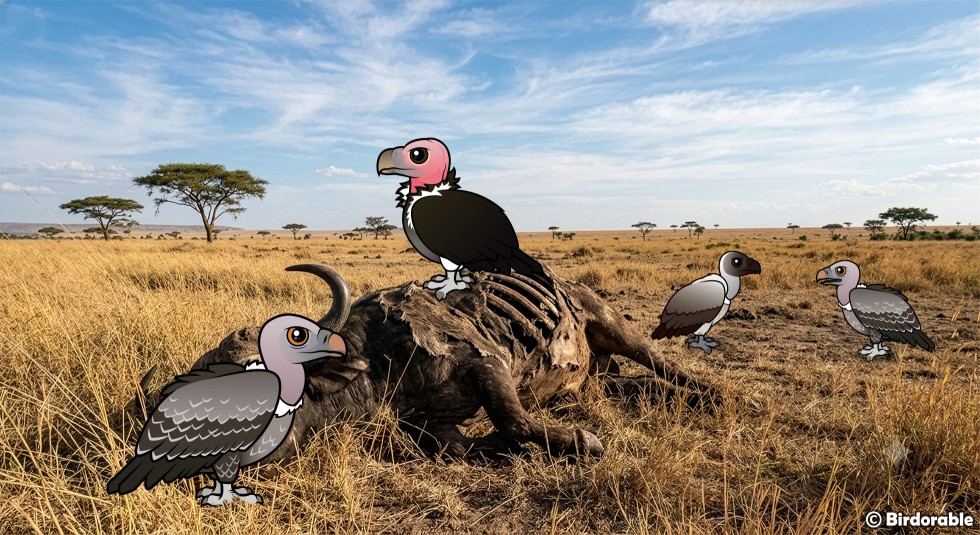
Illustration of Birdorable vultures at a carcass on the African savanna: a Lappet-faced Vulture with a pink head stands on top of the carcass while a Rüppell's Vulture waits beside it and a White-backed Vulture and a second Rüppell's Vulture look on from the dry grass nearby.

Picture a vulture in your mind. You might imagine a large dark bird, a raptor-shaped bird soaring on thermals, or a group of bald-headed birds sitting on a carcass. 

Here's the strange part: that vision of a 'vulture' can't be found on one branch of the bird family tree. It's a specific environmental niche, and nature has handed it out at least three separate times, to birds that are not each other's close relatives.

The Shared Design

Filling this role, no matter which branch of the family tree you climbed down from, comes with the same unusual requirements. You have to find animals that have died somewhere across an enormous landscape, with no way of knowing in advance where, and cover huge distances doing it on very little fuel. And whatever you find, you have to be able to eat it, even long after it would make almost anything else sick.

Birds that solve this problem end up looking alike whether they're related or not: long broad wings built for riding warm air instead of flapping, a bare or nearly bare head, and a life spent high up, watching.

Biologists call this convergent evolution: when separate lineages run into the same problem and arrive at the same answer, independently of one another. This is how sharks and dolphins both ended up being torpedo-shaped swimmers despite not being closely related. When it comes to convergent evolution, vultures are one of the best examples there is, because it happened more than twice.

Three Separate Inventions

In the Americas, vultures belong to a family all their own, the Cathartidae. Among them are the Turkey Vulture, the Black Vulture, the spectacular King Vulture, and the two condors.

Note: Today, there are no vulture species in Australia. Fossils point to at least one vulture species flying over Australian skies in the past; this was likely a Cathartidae species. The vulture probably went extinct after massive marsupials of Australia died off. Today, other species fill the scavenger niche on the continent, including eagles, ravens, and large lizards.

In Europe, Africa and Asia, the birds we call vultures sit inside Accipitridae, the big family that also contains the hawks and eagles. But they don’t form a single group there either. They appear to fall into two clusters that aren’t closely related to one another. One holds the Lammergeier, the Egyptian Vulture and the Palm-nut Vulture. The other holds the griffons, the Cinereous Vulture and the Lappet-faced Vulture. The first group appears to have evolved with the honey buzzards. The second sits with the true eagles.

So the vulture way of life evolved separately at least three times over: once in the Americas, and twice more, separately, among the hawks and eagles of the Old World.

How You Can Tell They Aren’t the Same

One striking difference between the two groups is in their senses of smell. Old World vultures find carcasses exclusively by sight, while some New World vultures find them by scent instead. The Turkey Vulture has an unusually large olfactory bulb and forages by flying low, picking up ethyl mercaptan, a gas given off in the earliest stages of decay. Black Vultures, King Vultures and condors can’t manage this at long range, so they do the next best thing and follow Turkey Vultures to dinner.

That ability once had a very practical use. In 1938 an oil company with unfindable leaks in 42 miles of gas pipeline solved the problem by pumping a carcass-scented chemical into the line and watching for circling Turkey Vultures. It worked, and it went on to settle a scientific argument that had been running for more than a century. 

New World vultures also can't vocalize, at least not the way most birds do. They have no syrinx, the vocal organ most birds sing with, so a condor can only hiss or grunt, and that is its entire repertoire. Old World vultures aren't known for singing beautiful songs, but they are able to screech, croak, and produce alarm calls when danger is near. Bearded Vultures have a flight call that sounds like this.

There's another difference between New and Old World vultures that you can see: nasal cavities. You can look  straight through a New World vulture's nostrils. Its nasal passage isn't divided by a wall of bone, as it is in other birds, so from the side you can look in one nostril and out the other.

New World vultures have a unique self-cooling strategy: on hot days they defecate down their own legs, and the evaporation cools them. The name for this is urohidrosis, and this behavior did not develop in the Old World birds. 

Vultures That Don’t Behave Like Vultures

Among the Old World vultures, there are some outliers that don't chow down on carrion like most vultures.

The Lammergeier, also called the Bearded Vulture, lives on bone. Between 70 and 90 percent of its diet is bone, which makes it the only vertebrate known to eat this way. Bones too big to swallow are carried up to somewhere between 50 and 150 meters and dropped onto rock until they shatter. It can achieve flight while carrying a bone weighing more than 4 kilograms. Young birds are clumsy at it, and the skill can take up to seven years to master. 

The Palm-nut Vulture, on the other hand, barely bothers with meat at all. Palm fruit makes up more than 60 percent of an adult’s diet, and more than 90 percent of a youngster’s, comprised mostly of oil palm and raffia. It’s the smallest Old World vulture, and its range across Africa follows the palms it depends on.

The Egyptian Vulture uses tools. Faced with an ostrich egg too tough to break open, it picks up a stone, carries it over in its bill, and throws it down onto the shell with a swing of the neck, again and again, until the egg cracks. The birds prefer smooth rounded pebbles to jagged ones.

Vultures in Trouble Everywhere

Despite evolving independently, vultures are facing conservation challenges, and many for the same reasons, including habitat loss, poisoning, and persecution. 

In the 1980s, India was home to an estimated 40 million vultures. Then, within a decade, the population collapsed. Between 1993 and White-rumped Vulture population fell by 99.7 percent. The populations of the Indian Vulture and the Slender-billed Vulture each fell by 97.4 percent.

The cause turned out to be a cheap anti-inflammatory drug called diclofenac, given to sick cattle. It was beneficial to the cows, but fatal to any vulture that fed on a treated carcass afterward. It was banned across South Asia by 2010.

By then the scavengers were mostly gone. Carcasses were left to rot, feral dog numbers climbed, and economists Eyal Frank and Anant Sudarshan later compared human death rates in Indian districts that had lost their vultures against those that never had many. Mortality rose by roughly 4.7 percent in the districts that lost them. Their estimate, published in the American Economic Review, works out to more than 100,000 additional human deaths a year. It's a statistical estimate, not a body count, but the scale of it is striking.

In Africa, the White-backed Vulture and the Hooded Vulture are both listed as Critically Endangered, driven largely by carcasses deliberately poisoned to kill mammal predators, with vultures dying as collateral damage.

And by 1982, just 23 California Condors were left alive anywhere in the world. Today the population is back over 607 condors, most of them flying free. Lead poisoning from ammunition is still the leading cause of death, so the comeback isn't finished, but a species once down to 23 birds now flies over four states on the widest wings of any bird in North America.

Next Time You See One

The next time you see a vulture drifting overhead, think about the role it plays in nature. No matter where you are, that bird evolved to fit a niche in its environment. Nature's clean up crew is on duty!

What’s Your Favorite Vulture?

Ours might be the Lammergeier. Dropping bones off cliffs for seven years until it gets the knack shows some serious dedication. Which one would you pick? Tell us in the comments below!

International Vulture Awareness Day

International Vulture Awareness Day takes place on the first Saturday of September each year. In 2026, we'll be celebrating this special day on September 5th.

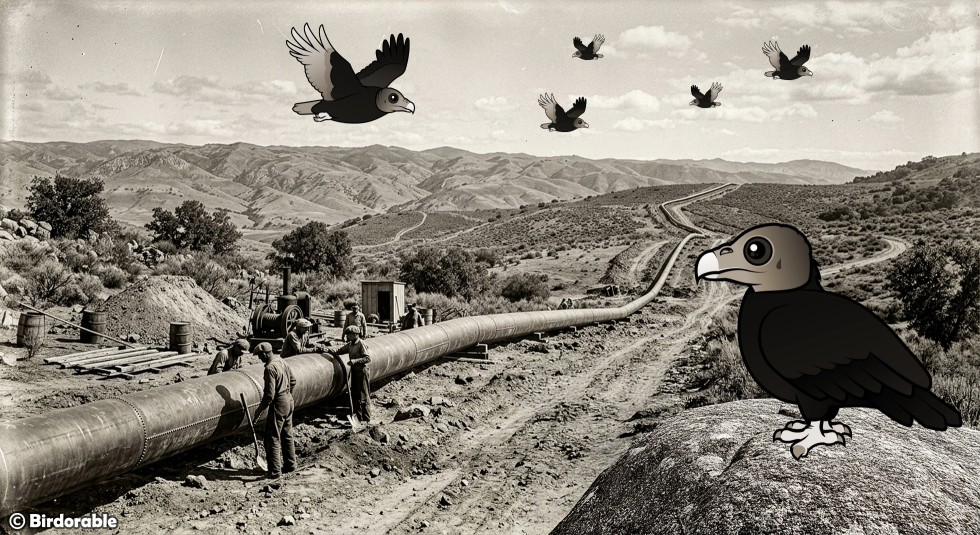
Vintage sepia photograph of workers laying a large steel gas pipeline across dry California hills, with cartoon Birdorable Turkey Vultures added: one perched on a boulder in the foreground and several more circling in the sky above.

Somewhere along 42 miles of pipe, gas was escaping, and the birds knew exactly where.

In 1938, the Union Oil Company of California had a problem it could not solve. A 42-mile natural gas line had sprung a leak, and finding the breach by walking the line across rough terrain would be difficult, if not nearly impossible.

Then an engineer in Texas came up with a plan that involved no equipment at all, only birds.

The Idea

The idea was simple: pump a heavy dose of a strong-smelling chemical called ethyl mercaptan into the pipeline, then drive along the route and watch the sky. Wherever the gas was escaping, Turkey Vultures would gather overhead.

And that is exactly what happened. As Union Oil's engineers later described it, Turkey Vultures were seen circling above the pipeline or sitting on the ground at several points along the line. The smell of mercaptan was strong at each of those spots, and every one of them turned out to be a real leak.

The company kept using the method for years afterward. As one of their field engineers later recalled, they had stumbled onto the fact that Turkey Vultures have a remarkably well-developed sense of smell.

Why It Worked

Natural gas has no smell of its own. Gas companies add a warning odor so that leaks can be noticed, and one of the compounds commonly used for that job is ethyl mercaptan.

Ethyl mercaptan also happens to be one of the gases given off by flesh in the earliest stages of decay.

So to a Turkey Vulture, a leaking gas pipeline does not smell like an industrial accident. It smells like dinner, in this case it was spread out across 42 miles of hilly California countryside.

Meanwhile, Scientists Were Still Debating It

Here is the interesting part: while an oil company was quietly using vultures as leak detectors, scientists were still debating whether birds could smell at all, a question that had been open for over a century.

The argument began with a famous shot across the bow. In 1826, John James Audubon published a paper in the Edinburgh New Philosophical Journal with a title that left no doubt about his intentions: "Account of the habits of the turkey buzzard, particularly with the view of exploding the opinion generally entertained of its extraordinary power of smelling."

Audubon meant to demolish the idea, and for a long time he was widely believed. The naturalist Charles Waterton fought back in print through the 1830s with a series of rebuttals, one of them aimed squarely at Audubon's paper, and John Bachman published a defense of Audubon in response. The dispute rolled on without resolution, and a long succession of loosely controlled field tests followed over the next hundred years without settling anything definitvely.

The Conversation That Solved It

In the late 1950s, an ornithologist at the Los Angeles County Museum named Kenneth Stager was talking with field engineers at Union Oil when a retired engineer named Ralph Openshaw told him the story of the pipeline.

Stager realized he was being handed the answer to a question ornithologists had been arguing over for more than a century, so he set out to test it properly.

The Experiments

Stager's problem was that it was known vultures have superb eyesight, so any test where the bird could see the food would prove nothing, so everything he built was designed to remove sight from the equation.

First he built a machine that could produce a smell with nothing to see. A four-bladed, 20-inch exhaust fan mounted in a wooden housing pushed the odor of fresh and decomposing animal tissue out onto known air currents, with nothing visible at the site, and vultures responded to the scent alone.

Next he hid food in boxes instead. Perforated cardboard cartons were loaded with decomposing fish, abalone, ground squirrels, kangaroo rats, a domestic cat, and snakes, then concealed at test sites, and the vultures found every one of them. In one case a bird came down a canyon on a downwind course, landed, and stood motionless facing upwind toward a bait chamber hidden 75 yards away in a dense grove of pepper trees.

Finally he ran the experiment that settled the matter. Stager set out a mounted, taxidermied yearling mule deer as a purely visual decoy, and no vultures came. He then replaced the mount with a fresh deer carcass of identical size and appearance, and the vultures responded quickly, although they still did not gather to feed until they had picked up the smell.

The deer was the same shape, the same size, and in the same place as the mount before it. The only difference was odor, and odor turned out to be the thing that mattered most.

The Experiment on Old World Vultures

The most interesting part of Stager's work may be the test he ran on the other side of the world, where the study on Old World vultures produced very different results.

In early 1959, on a museum expedition to the Balaghat Forest District of Madhya Pradesh in central India, Stager found himself camped among roughly 150 Old World vultures, drawn in by the skinning of large mammal specimens. Most were White-rumped Vultures, with a scattering of Egyptian Vultures and Red-headed Vultures.

He asked the skinners to set aside more than 200 pounds of muscle from a tiger specimen, then waited until ten o'clock at night, so that no vulture could possibly have watched him do it. He and two assistants carried the meat onto a raised platform in an open, dry paddy field and buried it under a ten-inch layer of thatching straw, and each night afterward he checked that the straw had not shifted enough to expose anything.

The bait rotted, and the smell, Stager wrote, became overpowering, noticeable at a considerable distance even to the relatively weak nose of a human being.

For eleven days the vultures swarmed the camp and the surrounding fields, and not one of the three species gave the slightest sign of noticing a quarter of a ton of tiger meat sitting in the open a short walk away.

On the night before the twelfth day, Stager pulled the thatch off, and the next morning a Red-headed Vulture spotted it at once, dropped onto the platform, and started eating.

Old World vultures find their food by sight, and they are superb at it. Uncovered, the meat was spotted within hours, but smell simply does not come into play for these birds.

It Was Not the Flies, Either

There was a rival theory worth ruling out first. Some researchers had proposed that Turkey Vultures do not smell carrion at all, and instead spot the clouds of flies that gather above it.

The India experiment ruled that out too. The hidden bait was, in Stager's words, black with flies and other carrion insects, and the vultures still could not find it. If insects were the visual signal, those birds had it right in front of them for eleven days and never responded to it.

Conservation note: Around 95 percent of the vultures Stager was watching were White-rumped Vultures, then so abundant in India that they filled the great Sal trees around him day and night. Within a few decades the species had lost more than 99 percent of its population to a veterinary drug given to cattle. The flock that failed his experiment would be almost impossible to gather today.

Inside the Skull

Stager then studied vulture anatomy. Working from casts of the inside of vulture skulls, he compared the olfactory bulb, the part of the brain that processes smell, across species. The bulbs were relatively large in the New World vultures; the groups of Old World vultures had smaller bulbs.

Modern methods of study have since taken this theory further. A 2017 study measured vulture brains directly and found that a Turkey Vulture's olfactory bulbs are four times larger than a Black Vulture's, with twice as many of the output cells that carry smell signals onward, even though the Turkey Vulture's brain is about 20 percent smaller overall. These two birds share the same sky over much of the Americas, yet one of them is wired for a sense that the other barely has.

1938-1964

Stager published his study on June 30, 1964, in Contributions in Science, the journal of the Los Angeles County Museum. Sixty-three pages of experiments, results, and retesting finally closed an argument that had been running since 1826.

Union Oil's engineers had already found the answer back in 1938. They knew they were right, and they used that knowledge for years to keep a pipeline safe, even though it did not become part of ornithological knowledge for another couple of decades.

As for why New World vultures have such a strong sense of smell while their Old World cousins do not, that is a much older story. The vultures of the Americas and the vultures of Europe, Africa, and Asia are not actually close relatives at all. They arrived at the same way of life separately, and only in the Americas did any of them evolve a nose for the work, through a process called convergent evolution, which is a story for another day.

Now You Know What to Look For

The next time you see a Turkey Vulture flying low and unhurried over a field, rather than circling high on the warm air, there is a good chance it is working a scent, doing exactly what those engineers drove 42 miles of pipeline to watch for. Tell us where you have spotted one in the comments below!

International Vulture Awareness Day

International Vulture Awareness Day takes place on the first Saturday of September each year. In 2026, we'll be celebrating this special day on September 5th.
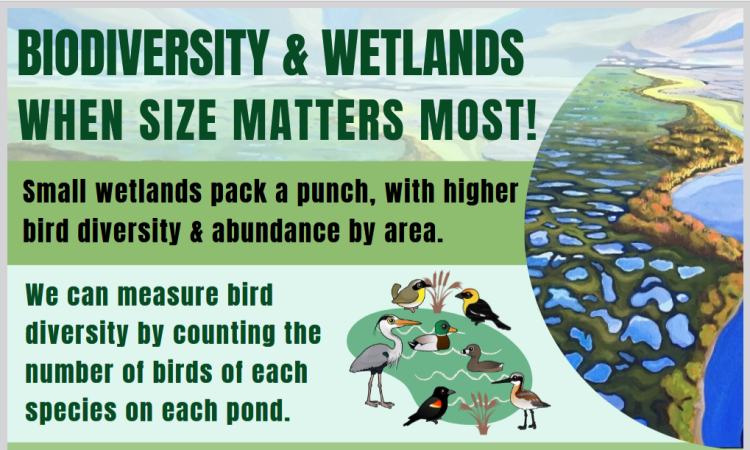
We’re thrilled to see Birdorable birds featured in a fun educational infographic related to an interesting study done by researchers at the University of Saskatchewan. The infographic is part of a public outreach effort to share results from a research project studying how wetlands in Prairie Pothole Regions support bird populations and biodiversity.

The study highlights how different types of wetlands provide essential habitat for a variety of bird species, and the special importance of small wetlands, which are unfortunately the type of wetland most vulnerable to degradation or loss. The research emphasizes how conserving a diversity of wetland types is key to supporting birds across the prairie landscape.

From dabbling ducks to shorebirds and secretive marsh birds, wetlands are home to some of our favorite Birdorable species—many of which make a cameo in the infographic! 

Here's a sneak peek of the infographic!

You can check out the full infographic here and peep some familiar feathered friends:
Biodiversity and Wetlands Infographic (PDF)

We're honored to have Birdorable birds helping to spread the word about conservation and the importance of wetland habitats.

A big thank you to the Prairie Water research team for using our artwork, and for giving Birdorable credit on the infographic. We love seeing our cute birds support science and learning! 

For more information on the study, follow these links:

Learn About the Birds Featured on the Infographic

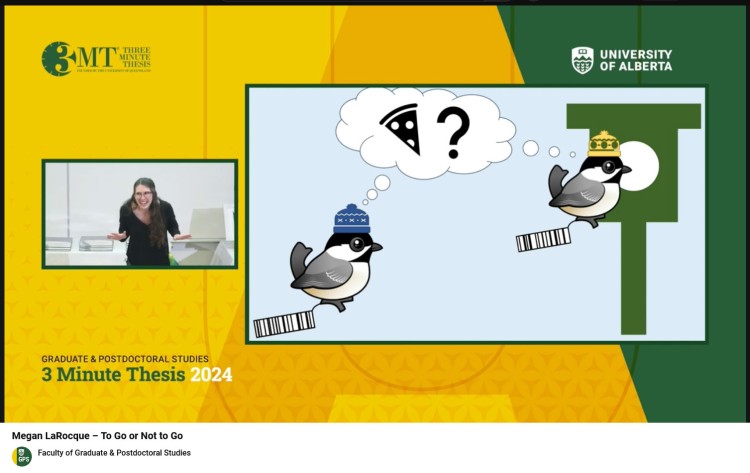
Birdorable loves birds, and we love when others share their passion for birds, too! Last year, we were interested to hear from Megan LaRocque, a Master of Science student at the University of Alberta in Canada. Megan reached out to us with a special request—she wanted to use one of our Birdorable illustrations in a special presentation about her research on Black-capped Chickadees. Of course, we said yes!

Megan’s research focuses on chickadee behavior, specifically whether these small songbirds use information from their flock mates when deciding whether or not to visit an empty feeder. Chickadees are highly social birds, and their ability to learn from each other is an interesting topic for scientists who study animal behavior.

As part of her studies, Megan participated in the Three Minute Thesis (3MT) competition. This event, originally developed by the University of Queensland in Australia and now part of institutions all over the world, challenges graduate students to present their research in just three minutes using a single static slide. The goal is to explain complex scientific work in a way that a general audience can understand—no easy task!

Megan competed against 50 other participants across different fields and made it to the Finals Round at the University of Alberta. 

Screenshot from Megan's Three Minute Thesis To Go or Not to Go

For her presentation, Megan wanted to include our Birdorable Black-capped Chickadee on her slide. We were honored to support her work and excited to see Birdorable featured in a scientific competition!

It's always rewarding to see Birdorable art used in meaningful ways, especially when it helps spread knowledge about birds and their behavior. We appreciate Megan for reaching out and wish her the best in her research and future competitions. If you’d like to see her presentation, you can check it out here: To Go or Not to Go.

Nature's Snowy Disguise: Turning White for Winter

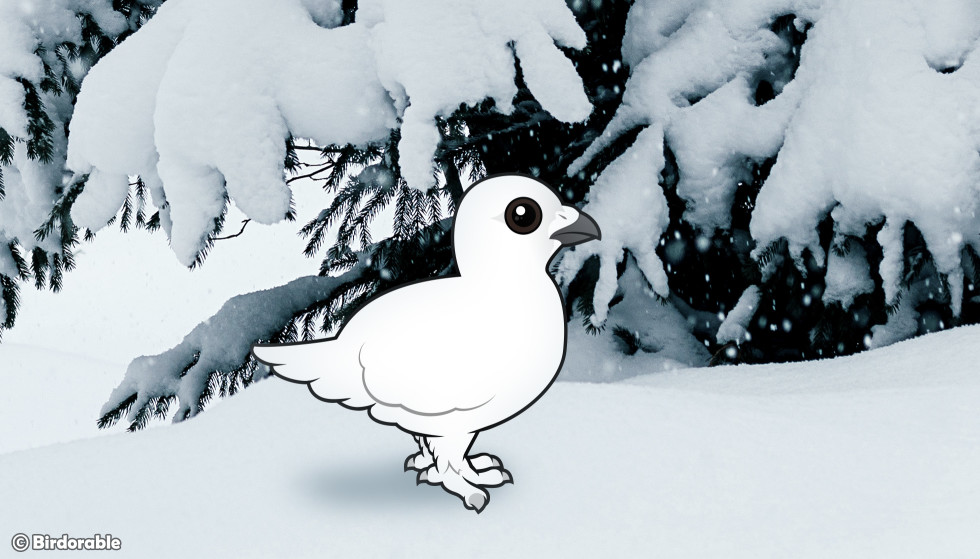
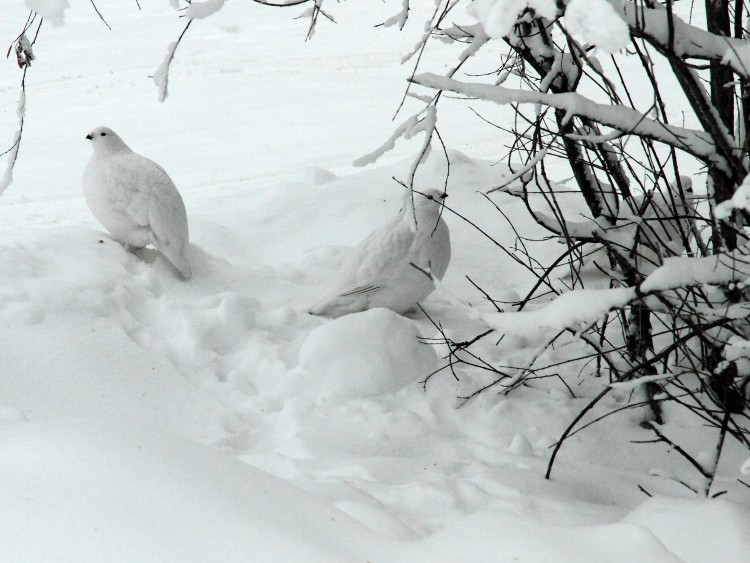
Birdorable Willow Ptarmigan in the snow

Some birds have an incredible trick for surviving the winter: they change the color of their feathers to blend in with snowy landscapes. This seasonal camouflage helps them avoid predators and stay warm in harsh environments. One of the most famous examples is the Rock Ptarmigan.

Rock Ptarmigans are experts at blending in. Found in Arctic and alpine regions, these birds molt twice a year. In summer, their mottled brown plumage blends with rocky terrain, while in winter, they switch to pure white feathers that match the snow. This transformation isn't just for looks—it also provides insulation, helping them conserve body heat in freezing temperatures.

The Willow Ptarmigan, closely related to the Rock Ptarmigan, also changes its feathers seasonally. Unlike its cousin, it has a thicker body and a reddish-brown upperparts on its summer coat. Males keep white underparts all year long; in winter, its white plumage extends over its whole body. Even its feet are feathered, acting like natural snowshoes to help it walk on snow.

Snow Buntings don’t turn entirely white, but develop paler plumage in winter. Though less dramatic than the ptarmigans' transformations, this subtle shift helps them better blend into frosty surroundings.

Willow Ptarmigans in winter by Mike Tidd [CC BY 2.0]

Birds aren’t the only animals with this winter wardrobe trick. The Arctic Fox is another master of disguise, trading its summer coat of brownish-gray for a thick, white pelt in winter. This helps it blend into snowy landscapes while staying warm. Similarly, the Snowshoe Hare transforms from brown to white, hiding from lynx and other predators. Even certain weasels, like the stoat or ermine, turn white in winter, retaining only a black-tipped tail.

Why do so many Arctic animals change color? It’s all about survival. Camouflage keeps predators and prey alike one step ahead in the harsh, unforgiving Arctic environment. As with birds, the transformation is linked to seasonal changes in daylight and temperature.

Unfortunately, climate change is disrupting this natural cycle. Warmer winters with less snow mean animals with white winter coats stand out against brown or gray backgrounds, making them easier to spot by predators. Protecting these species and their habitats is essential to help them continue thriving in a rapidly changing world.

The next time you see a photo of a perfectly camouflaged ptarmigan or a flock of Snow Buntings, remember the amazing adaptations that keep them safe and warm in winter’s harshest conditions.

Willow Ptarmigan Gifts from Birdorable

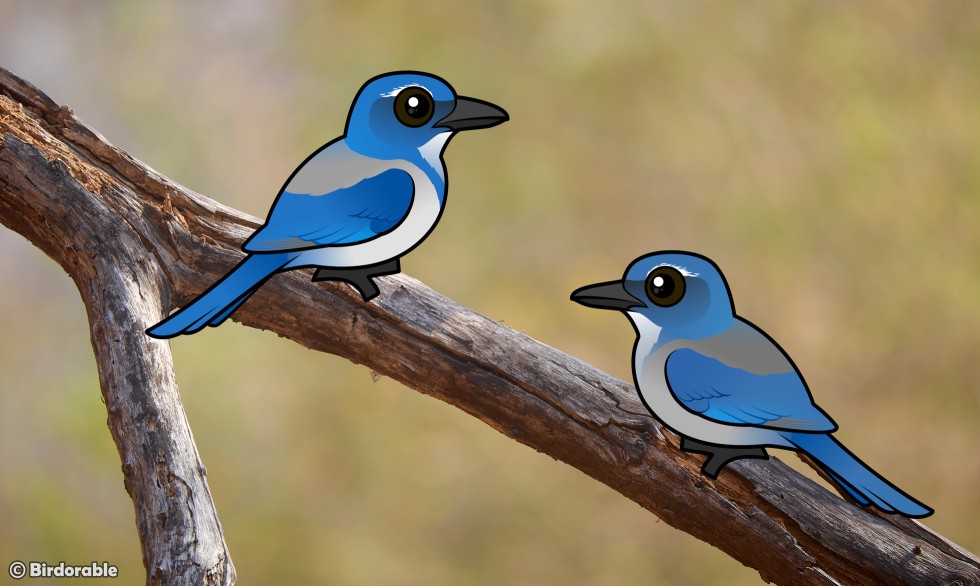
Birdorable California Scrub-Jay and Woodhouse's Scrub-Jay

The California Scrub-Jay (left) was split from the Woodhouse's Scrub-Jay (right); both were formerly lumped as the Western Scrub-Jay.

The number of bird species in the world has long been considered to be around 10,000—a nice, round figure repeated in birding guides and scientific references for decades. However, the real number is far from static. It fluctuates as scientists make new discoveries, reclassify known species, and adjust classifications based on evolving research methods. Bird species counts also depend heavily on which taxonomy system is followed, with different organizations maintaining their own species lists based on scientific consensus, research updates, and classification philosophies.

Taxonomy is the science of classifying organisms, and for birds, this is a constantly evolving field. Scientists might find that what was once thought to be a single species is actually two or more distinct species—a process called "splitting." This often happens when new genetic research reveals deep differences between populations that might look similar at first glance but are not interbreeding or have distinct behaviors or ranges. The opposite process, "lumping," occurs when two species thought to be separate are determined to be the same species after closer examination.

Recently, the Cornell Lab of Ornithology, through its birding resources like eBird, Merlin, and the Clements Checklist, updated its global bird taxonomy. Their latest count now recognizes 11,145 bird species worldwide. While this increase might sound like a sudden bird explosion, most of the changes come from taxonomic revisions rather than the discovery of entirely new birds.

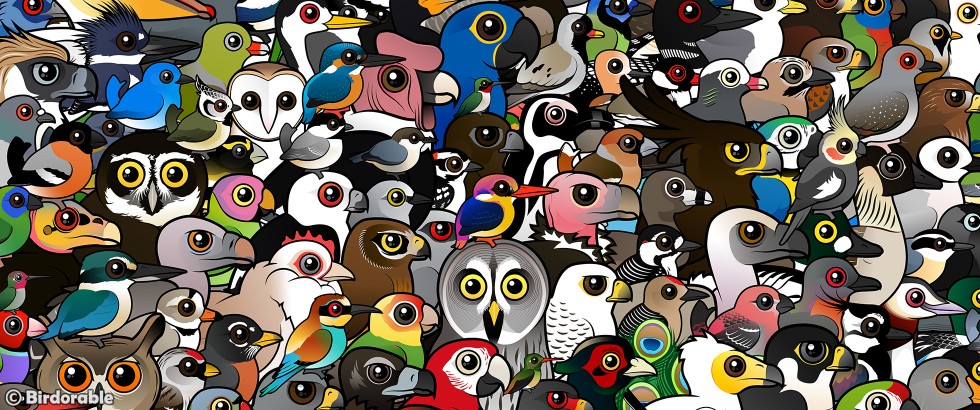
Birdorable crowd of cute birds

In the latest update, only three newly described bird species were added. The rest of the changes come from reclassifications. A significant 141 species were added due to "splitting," recognizing separate populations as distinct species. On the flip side, 16 species were "lumped," reducing the total number in those cases. These updates are based on cutting-edge research, including DNA analysis, field observations, and changes in understanding of bird distribution and ecology.

Taxonomic revisions are more than just paperwork for ornithologists. They have real-world implications for conservation efforts. When a species is split into multiple new species, each new species might have a much smaller population or range than previously thought, highlighting the need for more targeted conservation efforts. Similarly, newly described species might be at risk but previously overlooked because they were considered part of a more common species.

So, how many bird species are there? While the new figure from the Cornell Lab of Ornithology stands at 11,145, it’s safe to say the exact number will continue to change. Bird taxonomy is a dynamic field, constantly reshaped by new research, technological advancements, and even new discoveries in remote or understudied parts of the world. For birders and ornithologists, keeping up with the ever-changing bird list is just part of the fun!

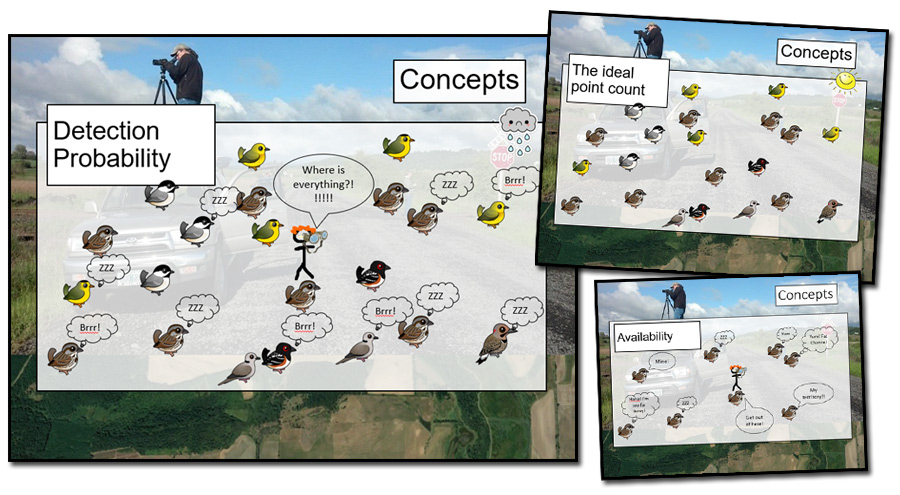
Researchers in Oregon are working on a huge survey of birds in the state: Oregon 2020. Data from field observations is being compiled to determine the abundance and distribution of Oregon's bird species.

The study in part uses data collected by citizen scientists who bird the state and enter their findings into eBird.

In a presentation given at a bird symposium last year, Birdorable cartoon birds were used to help visualize concepts in field observation data collection, like "imperfect detection" and "detection probability".

The project aims to compile its data on the birds of Oregon by the year 2020. While data collection occurs year-round, County Birding Blitzes are used to collect data in hotspots over a short period of time by a lot of different observers (kind of like Christmas Bird Counts).

To learn more about the project and maybe even contribute data, check it out at Oregon 2020.

Thank you to Tyler Hallman for sharing his presentation with us.

In a recent research study, it was discovered that cockatoos would exhibit self-control in order to receive a prized nut. Self-control was previously thought to be exclusively practiced by animals with larger brains.

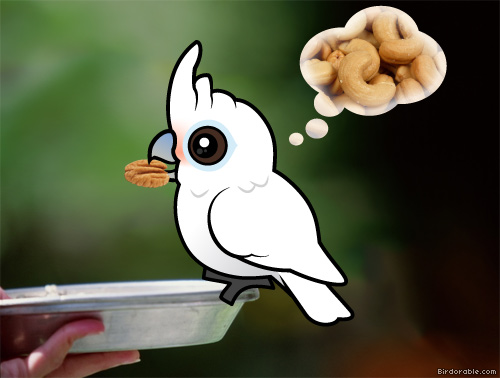
Birdorable Goffin's Cockatoo with nuts

Researchers at the University of Vienna gave Goffin's Cockatoos pecan nuts. The birds that waited up to 80 seconds were able to trade up for a more tasty prize: a cashew nut. Here is a video of one of the Goffin's Cockatoos that participated in the study, Muppet, impatiently waiting for his cashew. To learn more about the study, read further here: These bird brains exercise some self-control.

Jay Intelligence Measured in Quality of Gifts

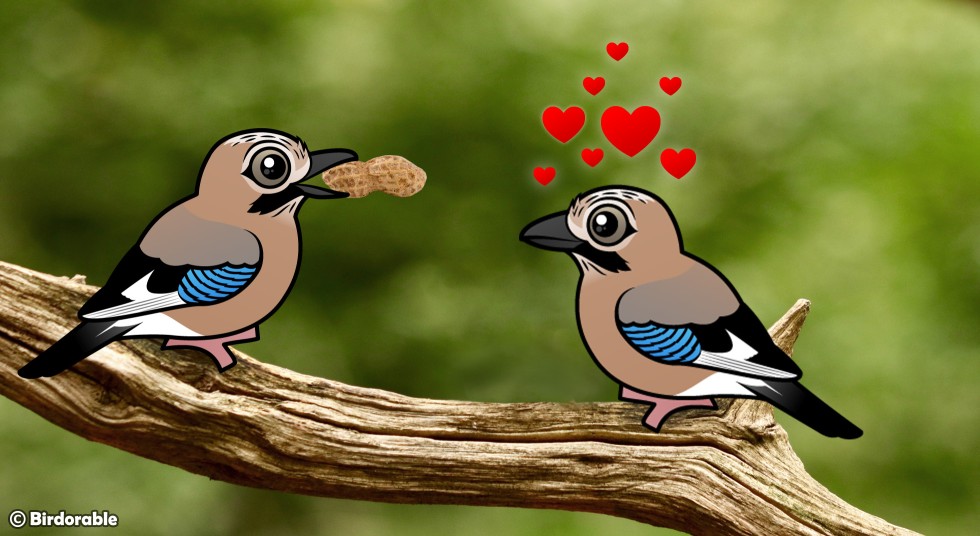
A recent study involving Eurasian Jays found that the birds, related to Blue Jays and crows, demonstrate an aspect of intelligence previously thought only to exist in humans. Male Eurasian Jays present their mates with gifts as part of their natural pair-bonding behavior. In the study, male jays were given the option to present their mates with a gift of a mealworm larvae or a moth larvae.

The male would observe the female bird eating either moth larvae or mealworm larvae, and depending on which the female had been eating, the male would offer her the other. The idea is that a "jay that’s gorged on moths will generally prefer to eat mealworms afterwards, and vice versa, just as a [human] satiated by chocolate will next take a slice of cake." This type of awareness of the feelings of others is called "theory of mind" and it was once believed that only humans had this kind of knowledge. You can read more about the study and see a short video of the experiment here: Gift-Giving Birds May Think Much Like People.

Give quality gifts like the Eurasian Jay