


There's No Such Bird as a Seagull
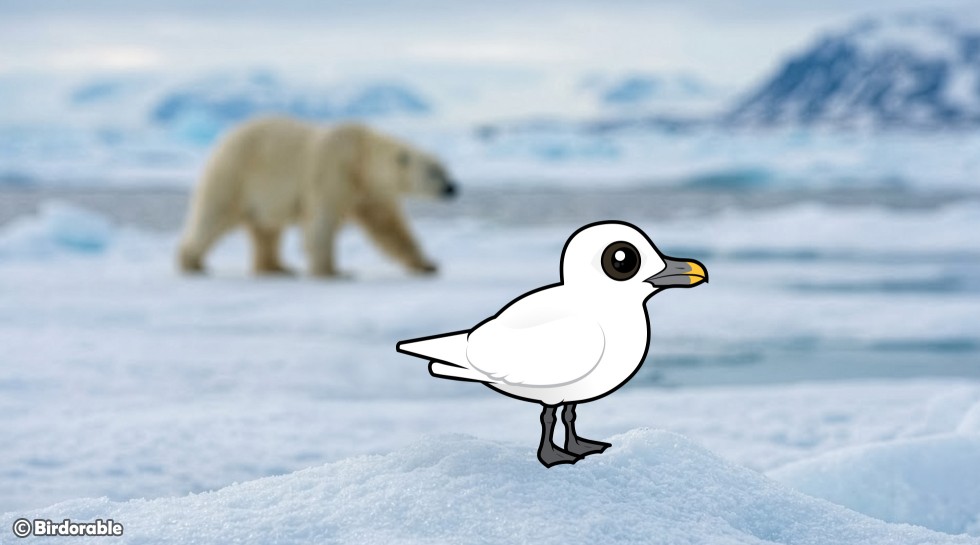
Ivory Gulls shadow polar bears across the pack ice, waiting for what's left of the kill.
Here’s a secret that will make you sound like an expert next time you’re at the beach: there is no such bird as a “seagull.”
Not one. Open any bird guide in the world and you won’t find the word. There are Herring Gulls and Ivory Gulls and Laughing Gulls, dozens of species in all, but not a single one of them is called a seagull.
Now, this is the point where a certain kind of birdwatcher gets smug about it, but that’s not what we’re here for. “Seagull” is a perfectly good everyday word, and nobody needs to be corrected while they’re eating an ice cream. But it is a word that hides something, and what it hides is genuinely interesting. Packed into those two little syllables are two mistakes, and the bird underneath is far more surprising than the word lets on.
Mistake One: Most of Them Aren’t Sea Birds
Let's start with “sea,” because that’s the half that goes wrong first.
Plenty of gulls hardly bother with the ocean at all. Franklin’s Gull nests in colonies on prairie lakes in the middle of Canada and the northern United States, building nests on the ground or floating them on the water. In spring, flocks feed on newly hatched insects over inland water bodies and across wet pastureland. Come autumn they leave the continent entirely for Argentina, Chile and Peru. It's only in the off-season that you'll find them on ocean coastlines.
And the gulls you do see at the seaside are often somewhere else the rest of the week. Black-headed Gulls spend much of the year hunting invertebrates in plowed fields. Gulls follow tractors, patrol reservoirs, roost on playing fields, and work landfills and supermarket parking lots a hundred miles from salt water.
If we’d named them for where most of them actually spend their time, we’d be calling them fieldgulls, parking-lotgulls, or landfillgulls.
Mistake Two: They’re Not All the Same Bird
The second mistake is sneakier. “Seagull” suggests a single generic bird: white, gray, noisy, and after your lunch. One word, one bird.
Let's consider a few of them side by side.
The Ivory Gull lives on the pack ice of the high Arctic and is pure white all over, with no gray back at all, a blue bill with a yellow tip, and black legs. It makes its living in a way no seaside scavenger would recognize: it follows polar bears across the ice and feeds on what is left of their kills. (It also eats polar bear droppings and seal placentas, which is the sort of fact that either delights you or does not.)
The Glaucous Gull is the second-largest gull on Earth, big enough to rival a Great Black-backed Gull, and it’s a serious Arctic predator that takes eggs, chicks and other birds. Nearly every gull has black wingtips; this one has no black anywhere at all, on wing or tail. It is a pale ghost of a bird.
The Slender-billed Gull of the Mediterranean has a long neck and a long tapering face, dark red bill and legs, and in the breeding season a soft pink blush across its white breast.
The Silver Gull is the bright-red-billed Australian that will absolutely steal your chips.
And the Black-headed Gull? Its head isn’t black. It’s chocolate-brown; it only looks black from a distance. The hood isn’t there most of the year either, appearing around March and fading by July. The rest of the time the bird has a white head with two dark smudges, one above and one behind the eye.
A polar-bear scavenger, an Arctic predator, a pink Mediterranean beauty, an Australian food thief, and a bird whose name is wrong twice over. That’s not one bird, a "seagull". That’s not even close.
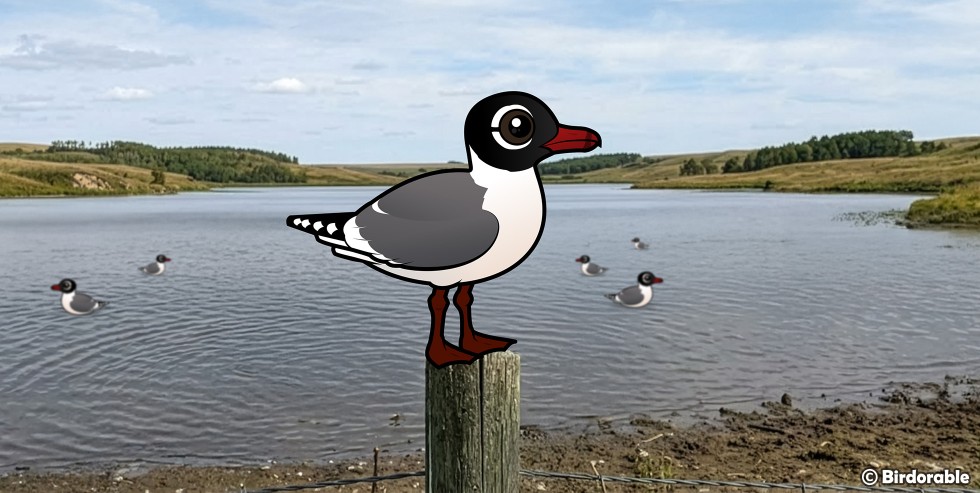
Not a beach in sight. A Franklin's Gull surveys its prairie lake, about as far from the sea as a "seagull" can get.
So Why Do Gulls Seem So Alike?
Partly because in most places the ones we see really are alike, and partly because lots of gulls are genuinely difficult to identify.
We tend to meet the same few species. The gulls that do well around people are a handful of big, adaptable ones. You could spend years visiting seaside towns in Britain or North America and mostly cross paths with only three or four species, all of them white and gray and much the same shape.
And gulls change their looks as they grow up. This is the part that catches nearly everyone out. Small gulls take about two years to grow into adult plumage, and the big ones like Glaucous, Caspian and Herring can take four. A young gull may be a mottled brown bird that looks nothing like its parents. So one flock might hold a single species wearing four different plumages, alongside several other species that closely resemble each other.
Experienced birdwatchers find this hard too. The Caspian Gull was taxonomically treated as a subspecies of the Herring Gull until relatively recently, and separating the two is one of birdwatching’s classic puzzles (in fact, the entire Herring Gull complex is somewhat fraught and complicated). The clues are all in the shape: a long slender bill, a sloping forehead, a small dark eye, long pale legs. Individuals may be carefully studied and still be noted by the birder as "probably.”
What the Word Costs
Here’s why it’s worth a bit of care.
The Herring Gull is the archetypal “seagull”: the big pink-legged one from the seaside, the one making lighthearted newspaper headlines about stolen food. It is also Red-listed in the UK, the highest level of conservation concern, after long-term declines estimated at around 60%. Britain and Ireland hold a substantial share of the entire world population.
Meanwhile, the Ivory Gull is classed as Near Threatened and falling, and the main reason is the loss of the sea ice its whole life is built around. The Canadian population dropped by roughly 80% between the 1980s and the early 2000s.
And the Silver Gull? Booming. It has adapted so well to towns and beaches that its numbers have risen wherever people gather.
Three birds. One collapsing, one in serious long-term trouble, one thriving. And one word, “seagull,” that flattens all three into the same slightly annoying bird at the beachside snack bar. When every gull is the same bird, a species quietly disappearing looks exactly like a species doing fine.
You Only Have to Learn One
You don’t need to identify every gull in the flock. Honestly, nobody does. But learning to name one can change how the rest look.
Start with what’s easy to see:
- Legs. Pink, yellow, red, or black? Often the fastest clue there is.
- Bill. A red spot, a black ring, a plain yellow bill, or bright red all over?
- Wingtips. How much black, or is there any at all?
- Size. Compare it to the gulls standing next to it, not to a bird in a book.
Pick the most distinctive bird in the flock and work out what it is. Next time, you’ll more easily spot it, and everything around it will suddenly look different by comparison.
That’s the whole trick. Not knowing every gull, just knowing that there’s something there to know.
What’s Your Favorite Gull?
Ours might be the Ivory Gull, following polar bears across the sea ice at the top of the world. Or the beautifully plumaged Heermann's Gull, with its subtle gray gradients. Which one would you pick? Tell us in the comments below!



Comments
Be the first to comment
Thank you!