


Birdorable Bonanza 2025 Bird #4
Meet the Endangered Indigo Macaw – Brazil’s Blue Beauty
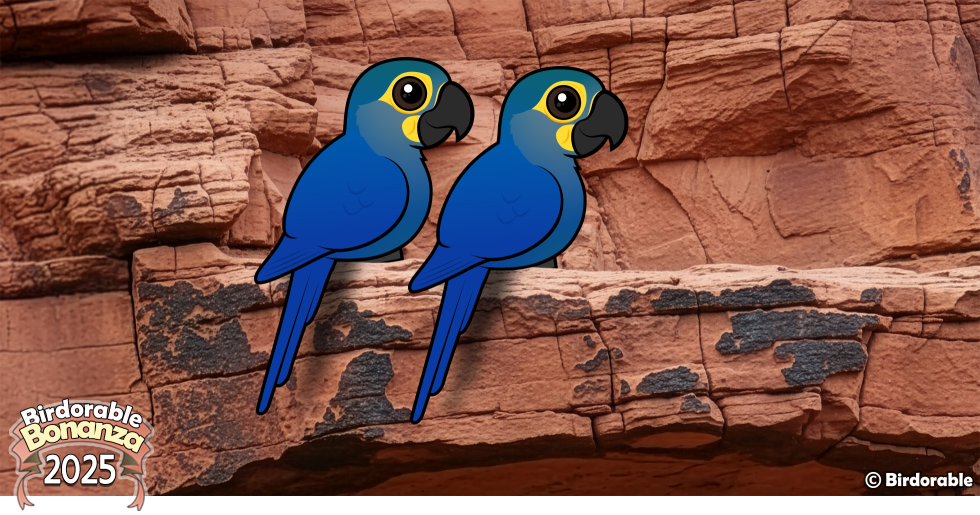
Today we’re excited to add a parrot to our family as part of our Bonanza. Help us welcome the Indigo Macaw to our parrot flock! This striking blue macaw, also known as Lear's Macaw, isn’t just a feast for the eyes, it also carries a fascinating story that makes it a perfect new addition to Birdorable.
The Indigo Macaw is one of the world’s rare blue macaws, a large parrot from northeast Brazil in South America. Its feathers are a deep metallic blue with a subtle greenish shade, and its head may appear slightly paler. A distinctive pale-yellow patch adorns the base of its strong black beak, and bright yellow eye-rings add a flash of contrast.
You might wonder about the Indigo Macaw's alternative common name. Why “Lear’s” Macaw? Who was Lear? The name honors Edward Lear, a 19th-century English poet, illustrator, and bird-lover. As a teen in the early 1830s, Lear published a book filled with drawings and paintings of parrots in captivity. One of those illustrations resembles what we now know as Lear’s Macaw, though at the time it was mistakenly labeled as a Hyacinth Macaw, another large blue beauty. It wasn’t until 1856 that the French ornithologist Charles Lucien Bonaparte formally described the species and gave it its scientific name, Anodorhynchus leari, in honor of Lear’s earlier work.
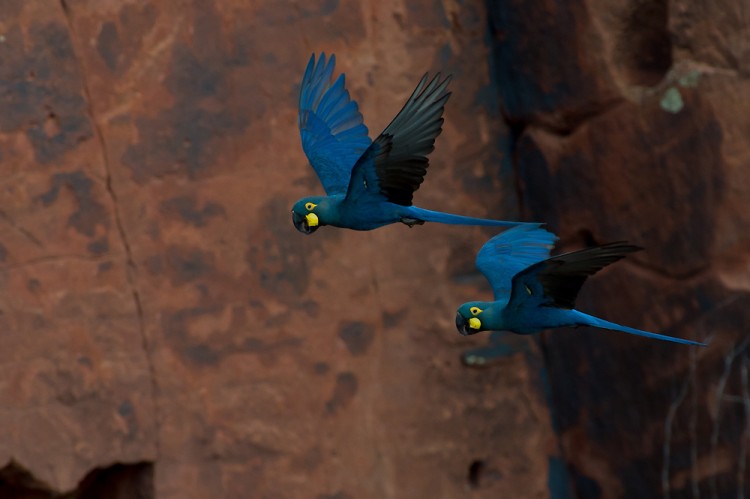
Indigo Macaws by Joao Quental [CC BY 2.0]
Despite appearing in art and captivity for many years, the real wild population of Indigo Macaws remained a mystery until 1978. That’s when the Brazilian ornithologist Helmut Sick located their home in a remote region of Bahia, Brazil, a dry, scrub-filled landscape known as the caatinga. There the birds roost and nest in sandstone cliffs, often in crevices high above the ground.
In the wild, Indigo Macaws mostly eat the hardy nuts from the licuri palm (a tree native to its region). As with many macaws, their diet helps disperse seeds, a natural way they are an important part of their ecosystem.
The story of the Indigo Macaw is also one of hope and conservation. For a long time the species was extremely rare and poorly understood. By the late 20th century, many thought it might even be extinct in the wild. But thanks to dedicated conservation efforts, including habitat protection and monitoring of cliff roosts, numbers have slowly increased.
Welcome to the Birdorable family, Indigo Macaw! We hope that sharing the beauty and background of this species will help draw attention to the amazing world of birds and the need to protect them.

Indigo Macaw Swag
You can find new Indigo Macaw swag in our Amazon and Zazzle shops, both linked in our Birdorable store here. Some items from both shops are shared below.
You can also find this dynamic & funny "macaw-some" design, exclusively in our Etsy shop. Shown here on a kid's shirt, you can also pick up this design on t-shirts for adults, and adult sized sweatshirts and hoodies. As always, if you'd like to see this design on a different garment or gift item, please let us know!


For tomorrow, get ready for a petite island endemic with a misleading name. This fisher is much more interested in frogs than fish. Any ideas?




Comments
Leave a comment
Thank you!