


Birds of the Outback: Who’s Surviving in the Red Centre?
Central Australia, referred to as the Red Centre, is the vast, dry, and rugged heart of the continent. It might seem inhospitable, but it’s home to an incredible range of birds uniquely adapted to survive extreme heat, long dry spells, and scarce resources. While team Birdorable will not be visiting this part of Australia during our October 2025 visit, it's worth learning about this unique environment. To learn more, we're sharing three tough birds that thrive in the Outback’s arid environments.
🐦 Zebra Finch
Zebra Finches are one of the most widespread birds across Australia's interior. These small finches are highly social, forming flocks near waterholes and desert grasses.
Despite living in dry environments, they’re incredibly resourceful breeders, sometimes laying eggs just days after rainfall, when food becomes available. Males are easy to spot with their orange cheek patches and black-and-white stripes.
We might be able to see Zebra Finches as they are widespread across the Red Centre as well as other parts of Australia where we will be visiting. Fingers crossed!
🪶 Fun Fact: Zebra Finches can survive on dry seeds for long periods by conserving water extremely efficiently.
🟢 Budgerigar
The Budgerigar, known worldwide as a popular pet, originated in the wild deserts of inland Australia. In the Outback, wild Budgies form large, noisy flocks that roam widely in search of water and food.
Their plumage is green and yellow with black barring, unique camouflage against dry grass and scrub. In wet years, their numbers explode, and mass flocks can number in the thousands.
We almost certainly do not have a chance to see wild Budgerigars during our trip, and that's a bummer! We'll have plenty of chances to see other charismatic parrot species, though!
🪶 Fun Fact: Budgerigars are nomadic. They follow unpredictable rainfall patterns, appearing and disappearing from regions depending on water availability.
🕊️ Spinifex Pigeon
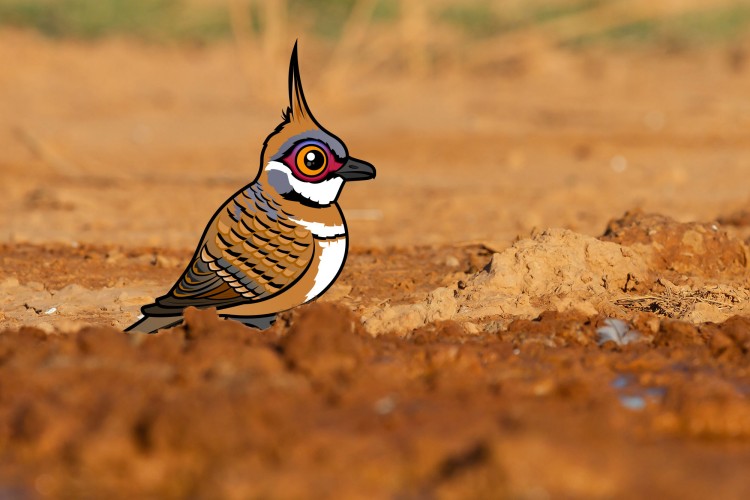
Spinifex Pigeons are one of Australia’s most Outback-specific birds. Found among rocky hills and spinifex grass, they’re instantly recognizable by their spiky head crest and rich rufous coloration.
They prefer to walk or run instead of flying and stay close to rocky shelter. They’re often spotted basking in the sun or darting into the shade to avoid predators and extreme heat.
Spinifex refers to a type of spiky and tough grass that thrives in arid inland Australia. Spinifex Pigeons are therefore named for part of their habitat.
We very certainly do not have a chance to see Spinifex Pigeons during our trip. Another bummer!
🪶 Fun Fact: Despite their arid habitat, Spinifex Pigeons need to drink daily and are never far from a water source, no matter how hidden.
💧 How Do These Birds Survive in the Outback?
Outback birds have evolved incredible adaptations for desert life:
-
Many can extract moisture from dry seeds.
-
They are opportunistic breeders, ready to nest after rare rain.
-
Flocking helps with predator detection and locating food or water.
-
Their plumage often provides camouflage in red soil and dry grasses.
Despite the harsh conditions, the Red Centre offers just enough resources for these resilient birds to not only survive, but thrive.
🌏 Visiting the Outback? Keep an eye (and ear) out at dawn and dusk near waterholes and rocky ranges. Many desert birds are most active during the cooler hours. We'll have to hit up this part of Australia on our next visit! 😉

Comments
Be the first to comment
Thank you!