


Vulture Week 2025
Survival Superpowers: How Vultures Are Built for the Job
International Vulture Awareness Day is coming up this Saturday, September 6, 2025. We've celebrated vultures here on the Birdorable blog before, and we're continuing the tradition with a Vulture Week series leading up to the big day. We're going to share new posts and reiterate essential vulture facts, aiming to share information and vulture love with faithful readers and newcomers to our blog alike.
Vultures aren’t just tough—they’re incredibly well-designed for the important job they do. Every part of their body and behavior is adapted to help them survive on a diet of carrion and thrive in environments where other animals would struggle. From disease-fighting guts to clever teamwork, vultures are full of surprises. Here are some of the coolest vulture adaptations that make these birds so remarkable.
Stomach of Mass Digestion
Vultures have one of the most acidic digestive systems in the animal kingdom. Their stomach acid is strong enough to break down rotting meat loaded with bacteria and viruses—things that would kill most other animals. This adaptation helps protect not just the vultures themselves, but the environment, too. By consuming carcasses that might otherwise spread diseases like anthrax, rabies, or botulism, vultures act like natural disinfectants.
Scents and Sensibility
Most birds rely on sight more than scent—but not all vultures. In the New World, especially, species like the Turkey Vulture have an incredible sense of smell. Their olfactory bulbs are unusually large for birds, allowing them to detect the scent of decaying animals from high in the air, even if the carcass is hidden under leaves or forest cover. This powerful nose helps them find food where others can’t.
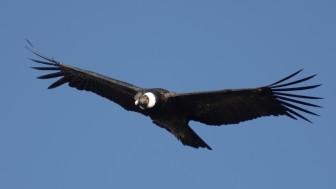
Soaring Andean Condor
Winging It
Vultures are masters of the air. Instead of flapping constantly, they use rising columns of warm air called thermals to glide for hours with minimal energy. This is especially useful for scavengers, who may need to cover wide territories to find food. Soaring lets them search efficiently, scan the ground below, and conserve energy all at once. Their large wingspans—some over 9 feet—make them some of the most graceful gliders in the sky.
The Bald and the Bacteria-less
One of the most recognizable vulture features is also one of the most useful. That bald, featherless head might look odd, but it serves an important purpose. When vultures feed, they often need to reach deep into carcasses. If their heads were covered in feathers, bacteria and decaying material would cling to them and cause infections. A bald head stays cleaner and dries quickly in the sun, reducing the risk of disease.
Scavenger Squad Goals
Different vulture species sometimes work together—intentionally or not—to get the job done. In parts of Central and South America, Lesser and Greater Yellow-headed Vultures use their keen sense of smell to locate a carcass. But they don’t have the strongest beaks. Enter the King Vulture, whose powerful bill can tear through thick hides and open the carcass for everyone else to join the feast. This is a team effort that benefits all. Vultures can be very social and in areas where multiple species share the same habitat, they may also amicably share a meal.
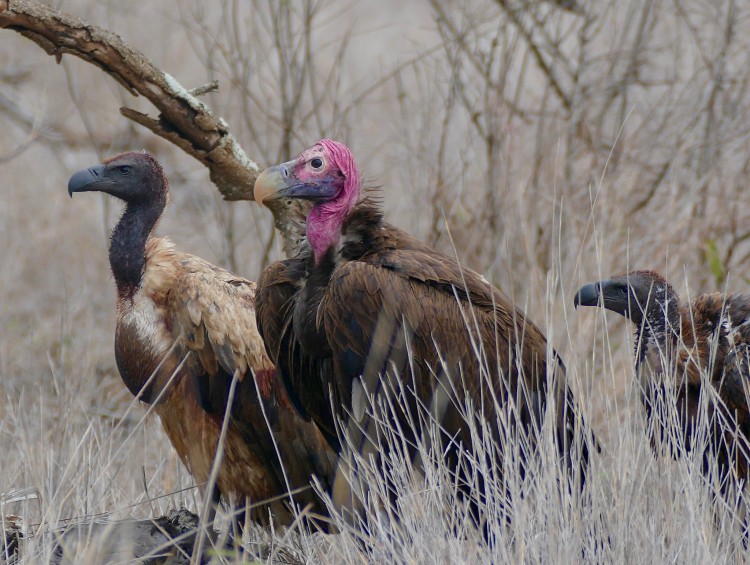
White-backed and Lappet-faced Vultures together by Bernard Dupont [CC BY-SA 2.0]
Silent But Deadly Efficient
Unlike most birds, vultures are almost completely silent—they don’t sing or call, and that’s because they lack a syrinx, the vocal organ responsible for bird song. But this isn’t a flaw—it’s another adaptation that fits their lifestyle. Vultures don’t need complex calls to attract mates or defend territory like songbirds do. They rely more on visual cues and body language. Staying quiet can also help them feed more stealthily at carcasses without alerting predators or competitors. And by skipping the energy cost of vocal communication, vultures can put more energy into soaring long distances in search of food.
These smart adaptations let vultures do a job that’s messy, dangerous, and absolutely critical. They’ve evolved not just to survive, but to keep ecosystems clean and balanced. As we approach International Vulture Awareness Day, it’s the perfect time to look beyond their misunderstood image and admire what makes vultures so uniquely suited to their role in the natural world.


Comments
Leave a comment
Thank you!