Bird Myth: Hummingbirds Migrate on the Backs of Geese
No, Hummingbirds Don’t Ride on the Backs of Geese
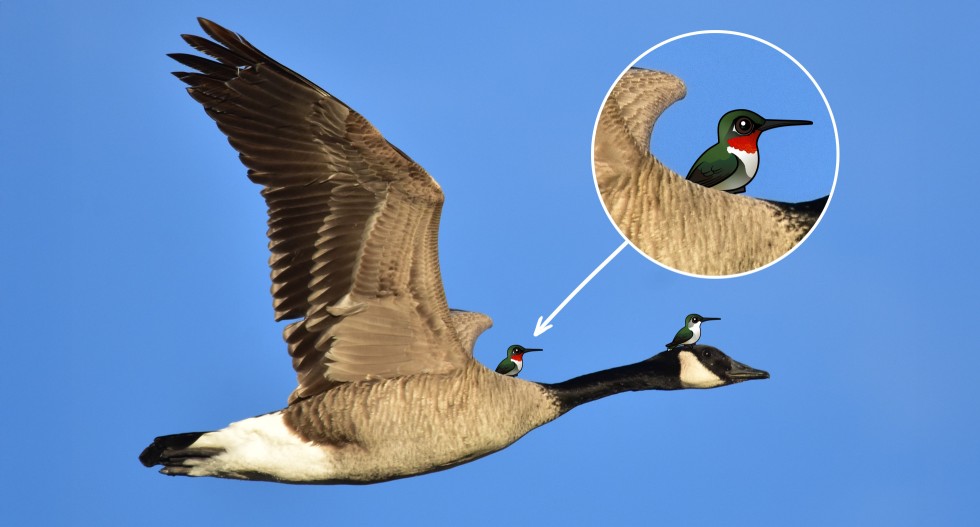
A Ruby-throated Hummingbird hitching a ride on a Canada Goose is the image behind one of the most common pieces of migration folklore, even though no hummingbird has ever needed a lift.
Every fall, big V-shaped skeins of honking Canada Geese pass overhead. Every fall, hummingbirds vanish from the feeders just as quietly as they arrived. Put those two things side by side and you get one of the most repeated pieces of nature folklore in North America: that a hummingbird, too small to possibly manage the long migration journey on its own, saves its strength by hitching a ride on a goose’s back.
It is a lovely image, but it isn’t what happens.
Where the Idea Comes From
The geese-taxi myth is genuinely widespread. The reasoning behind it is almost always the same: a bird that weighs about as much as a nickel seems like it shouldn’t be able to fly hundreds or thousands of miles under its own power, so people fill in the gap with an explanation that feels physically sensible. A goose is big, a goose is strong, a goose is clearly capable of long-distance flight. Why not let it do the work?
The trouble is that Canada Geese and hummingbirds are not even on the same schedule. They leave at different times, follow different routes, and head to different places. There is no shared flight path for a hummingbird to climb aboard in the first place.
They Fly It Themselves, From the Very First Day
Here is the detail that makes the myth almost backward: geese are one of the few kinds of birds where the young genuinely do get guided south, flying in family groups behind experienced adults who know the route. Hummingbirds get none of that. A young Ruby-throated Hummingbird that hatched earlier that same summer sets off on its first migration completely alone, often after its parents have already left. It has never made the trip before, has no one to follow, and still has to find its way to Mexico or Central America and back using nothing but instinct.
If any bird in this story needed a ride, logic says it should be the one with zero experience and no escort. Instead, it is the one that manages entirely alone.
The Fuel-Up Before the Flight
What a hummingbird actually does, instead of hitching a ride, is eat like a champ in the days before it leaves. Researchers studying Ruby-throated Hummingbirds found that individuals following a “fatten up first” strategy can pack on as much as 35 to 40 percent of their body mass in just four days, feeding heavily through the days leading up to the start of their migration. That extra weight is pure fuel: fat reserves the bird burns steadily over the coming flight.
Not every bird fuels up the same way, though. Some hummingbirds pack on that weight and go the distance in one push. Others take a different approach entirely, covering shorter stretches and refueling along the way rather than loading up beforehand. Either way, nobody is carrying anything for them. They are building their own gas tank.
The Gulf Crossing Is Not Quite the Legend Either
The fact that usually replaces the geese myth, once people learn it is false, is that every Ruby-throated Hummingbird crosses the Gulf of Mexico in one nonstop overnight flight, a genuinely remarkable feat that can cover roughly 475 to 640 miles of open water depending on where a bird launches from, taking somewhere around 18 to 22 hours of continuous wingbeats with no chance to land, drink, or rest.
That flight is real, and the hummingbirds absolutely make it in one go. But researchers who tracked individual young hummingbirds departing from the Alabama coast with radio tags found something more complicated: 77 percent of those juveniles oriented themselves parallel to the coastline rather than straight out over open water, following what scientists describe as a “fly-and-forage” strategy, moving along the shore and stopping to feed rather than launching into a single overwater sprint. A related study of stopover behavior found that older, more experienced birds carried larger fuel reserves, had longer flight ranges, and shorter stopovers than the younger birds passing through the same site, which lines up neatly with the fattening research above: the birds with the biggest fuel tanks are the ones most likely to attempt the open-water route.
Either Way, Nobody Gave Them a Ride
So the honest version of this story has two migration strategies instead of one tidy heroic flight, and scientists are still working out exactly how common each one is. What does not change between them is the part that actually answers the myth: whether a hummingbird crosses the Gulf in a single overnight dash or spends days picking its way up the coastline one meal at a time, it is doing all of the flying, all of the navigating, and all of the food finding by itself. Nobody, and certainly no goose, is doing any part of that trip for it.
An Even Wilder Number
Here's another staggering migration statistic. Skip the Gulf crossing and look west. The Rufous Hummingbird does not cross the Gulf of Mexico at all. Instead it flies a clockwise loop between Mexico and as far north as Alaska and back, a one-way trip of about 3,900 miles. The American Bird Conservancy did the math on what that means relative to the bird’s own body: about 78.4 million body lengths, which is proportionally farther than the Arctic Tern’s famous 11,000-mile migration, the animal kingdom’s usual gold standard for long-distance travel.
Small birds do sometimes cross open water in the loose company of other migrants heading the same direction, but that is a shared destination, not a shared ride. As the same American Bird Conservancy article puts it plainly: hummingbirds “do not migrate on the backs of geese or other birds.”
Which Strategy Impresses You More?
There is something about a bird that hatched a few months ago picking its way along hundreds of miles of unfamiliar shoreline, stopping to refuel at spots it has never seen and will never be shown by a parent, that feels like the harder trick to pull off. But an unbroken overnight flight across open ocean, powered by a body that packed on nearly 40 percent of its own weight in four days, is hard to argue with too. Which one would you bet on if you were the hummingbird?