


Brilliant Blue: Nature’s Trickiest Feather Color
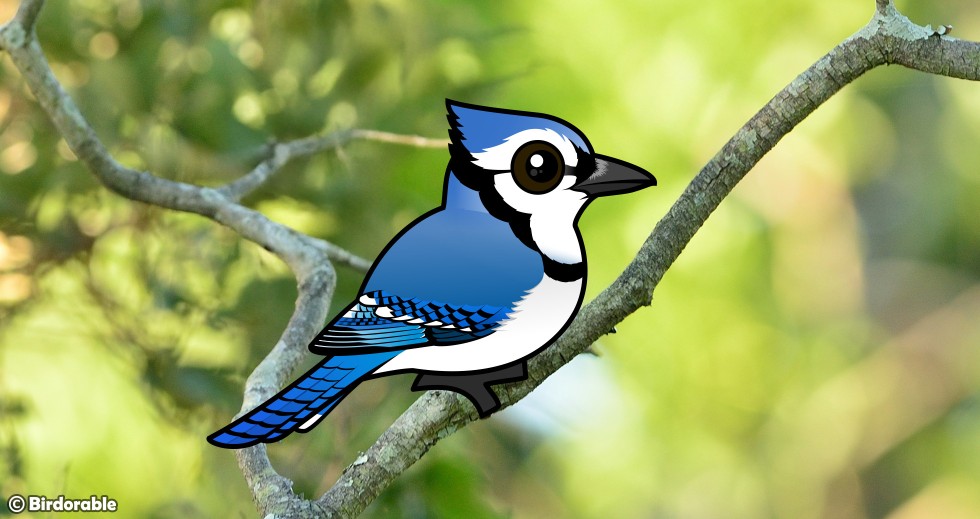
He looks blue. He's actually just very good at bouncing light.
A Blue Jay looks blue for the same reason a Northern Cardinal looks red, or so it seems. The cardinal’s red comes from pigment it picks up in its diet and stores in its feathers. Blue, you would guess, works the same way: some blue pigment tucked inside a seed or plant. It is a reasonable guess, but it happens to be wrong. No bird species on Earth has ever been shown to make blue pigment. Every blue feather out there, from a Blue Jay at a backyard feeder to a Spix’s Macaw newly returned to the wild in Brazil, is pulling off a physics trick, not a biological one.
The Physics Trick Hiding in Every Blue Feather
Feathers get most of their color from three families of pigment: carotenoids (the reds, oranges, and yellows birds absorb from food), melanins (blacks, grays, and browns), and porphyrins (found in turacos and a few other birds). None of them make blue. “Blue is different,” wildlife biologist Scott Sillett of the Smithsonian Migratory Bird Center has explained. “No bird species can make blue from pigments. The color blue that we see on a bird is created by the way light waves interact with the feathers and their arrangement of protein molecules, called keratin.” Blue, in other words, is a structural color: an optical effect built from the physical shape of the feather rather than a dye sitting inside it.
Here is the fun part. Inside every feather barb is a spongy layer of keratin, the same protein your fingernails are made of, packed with tiny air bubbles. Those bubbles are so small you could never see them, even with a magnifying glass. When light hits that bubbly maze, blue light bounces back out toward your eyes, while a layer of dark melanin hiding underneath soaks up the rest. It is actually the same basic trick that makes the sky blue: tiny things scattering light around until mostly blue makes it back to you, as Cornell Lab of Ornithology’s Bird Academy explains. That dark melanin backing matters just as much as the bubbly keratin. Without it soaking up the leftover light, the blue would wash out into a dull, milky gray.
Scientists proved this back in 1998, using a bird of the rainforest, a Plum-throated Cotinga. They studied its blue feathers under powerful microscopes, mapped out the tiny pattern of keratin and air bubbles inside, and showed that the pattern itself was what made the blue color happen. The study was published in the journal Nature by ornithologist Richard Prum and his colleagues. Since then, scientists have found the same trick in blue bird after bluebird, all over the world. The color is not painted onto the feather. It is built into it.
Proof You Can Hold in Your Hand
You do not need a lab to see this for yourself. Blue Jays molt often, and their barred blue-and-white wing and tail feathers turn up under trees year-round. Pick one up and hold it so the sun comes from behind it rather than in front. The blue disappears right in front of you, and the feather turns a flat brownish-gray, because the color only "works" when light bounces back toward you rather than passing through.
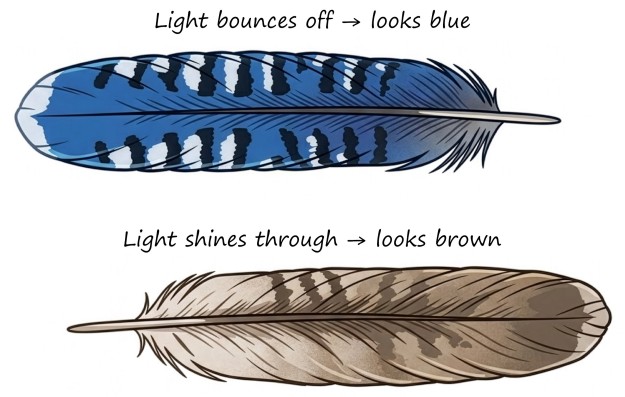
The same Blue Jay feather, lit two different ways.
Conservation scientist David Wiedenfeld of the American Bird Conservancy compares the structure to a prism: “In a prism you have colored light, and it refracts and divides the spectrum up. You get different colors coming out of different places. The way a bird’s feathers are, it absorbs all of the colors except for blue, which is refracted and comes back.” Blue Jays do carry melanin in their feathers, Wiedenfeld notes, but that melanin is brown, not black. “There are no blue pigments in birds,” he says flatly. Every blue feather on every bird is running some version of the same physics, even though the exact nanostructure differs from species to species.
The Same Trick, Four Times Over
What makes structural blue more than a fun demonstration is how many unrelated birds landed on the identical solution. A jay, a bunting, a kingfisher, and a macaw share almost nothing in body plan, diet, or closely related evolutionary history. What they share is a chemistry problem pigment cannot solve, and evolution found the same nanoscale workaround for each of them, independently.
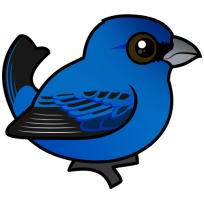
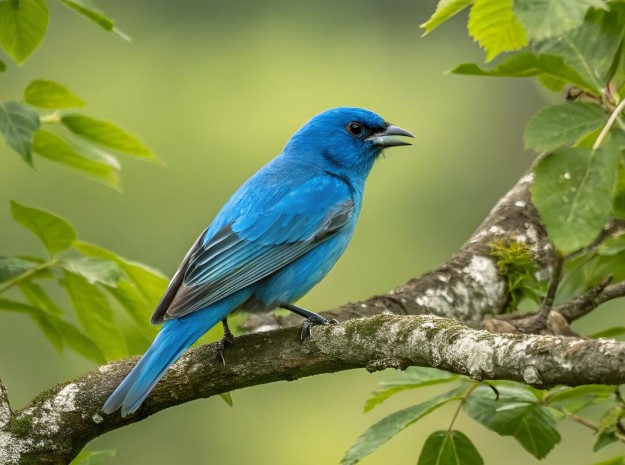
The Indigo Bunting shows how temporary the trick can be. A breeding male wears full structural blue only through spring and summer. By fall he has molted into mostly brown plumage, with just tinges of blue left in the wings and tail. Cornell’s All About Birds guide puts it plainly: “Like all other blue birds, Indigo Buntings lack blue pigment. Their jewel-like color comes instead from microscopic structures in the feathers that refract and reflect blue light... Bunting plumage does contain the pigment melanin, whose dull brown-black hue you can see if you hold a blue feather up so the light comes from behind it, instead of toward it.” A bird that is only “blue” for half the year, and only from the right angle, is about as clear a demonstration of structural color as nature offers.
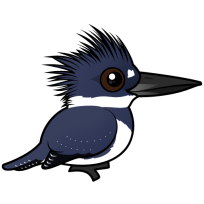
The Belted Kingfisher shows the trick is not limited to songbirds. Kingfishers belong to an entirely different order of birds than perching songbirds like jays and buntings, and their blue-gray plumage runs on the same keratin-and-air sponge. Researchers who examined the closely related Common Kingfisher of Europe and Asia found that its cyan and blue feathers are built from that same bubbly nanostructure, while its orange breast feathers get their color the ordinary way, from pigment sitting right next door on the very same bird.
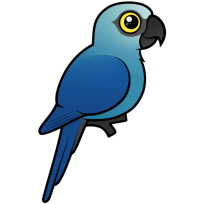
The Spix’s Macaw takes this trick to the extreme. A jay or a bunting mixes its structural blue with black, white, or brown, but a Spix’s Macaw is blue-gray from its head to the tip of its tail, with nothing else to hide behind. Scientists who studied its close cousin, the Scarlet Macaw, found a tangled 3D lattice of keratin rods inside its blue feathers, each rod only about 100 nanometers thick. That is roughly a thousand times thinner than a single human hair. It is the exact same trick as a Blue Jay’s feather, just built by a totally different kind of bird on the other side of the world.
Spix’s Macaws actually vanished from the wild completely around 2000, and the species was formally declared extinct in the wild in 2019. Then, starting in 2022, scientists began releasing macaws raised in captivity back into a forest in Brazil, and wild-hatched chicks have since taken flight there for the first time in decades. Every one of those famous blue feathers is running on the same tiny "nanotechnology" as a jay’s wing in a North American backyard.
What’s Your Favorite Structurally Blue Bird?
Ours might be the Indigo Bunting, a bird that spends half the year not even bothering to be blue. There's something almost funny about a color that only shows up when it's needed. What's yours?



Comments
Be the first to comment
Thank you!