


The Osprey’s Grip Has a Trick to It
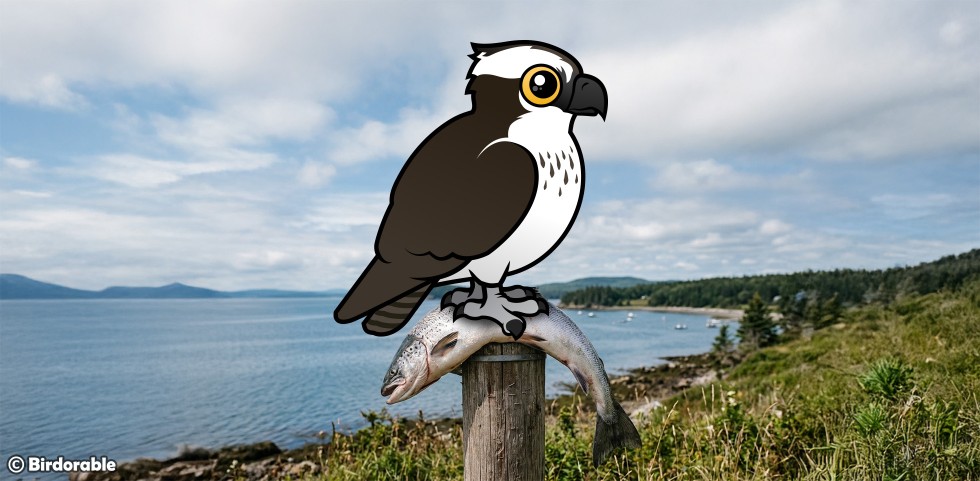
An Osprey folds its wings, drops feet-first into open water, and vanishes in a burst of spray. A second later it hauls itself back into the air, a fish gripped in its talons and turned to face forward, nose-first, like cargo lashed down for the flight home. It looks like something any hawk or eagle could do. It is not.
A Trick Almost No Other Raptor Has
Most birds of prey grab with a fixed foot: three toes forward, one back, built for pinning a squirrel or a rabbit to the ground. The Osprey has something different. According to the Cornell Lab of Ornithology, ospreys are “unusual among hawks in possessing a reversible outer toe that allows them to grasp with two toes in front and two behind,” and the soles of their feet carry barbed pads that dig into wet, muscled fish the way a fixed grip never could.
The University of Michigan’s Animal Diversity Web lists the full kit: unusually long legs for a raptor, those barbed footpads (called spicules), long curved claws, and the reversible outer toe, backed up by dense oily plumage and nasal valves that seal shut so no water gets in during a dive. None of it is decorative. Every piece exists to solve one problem: holding onto a live fish that does not want to be held.
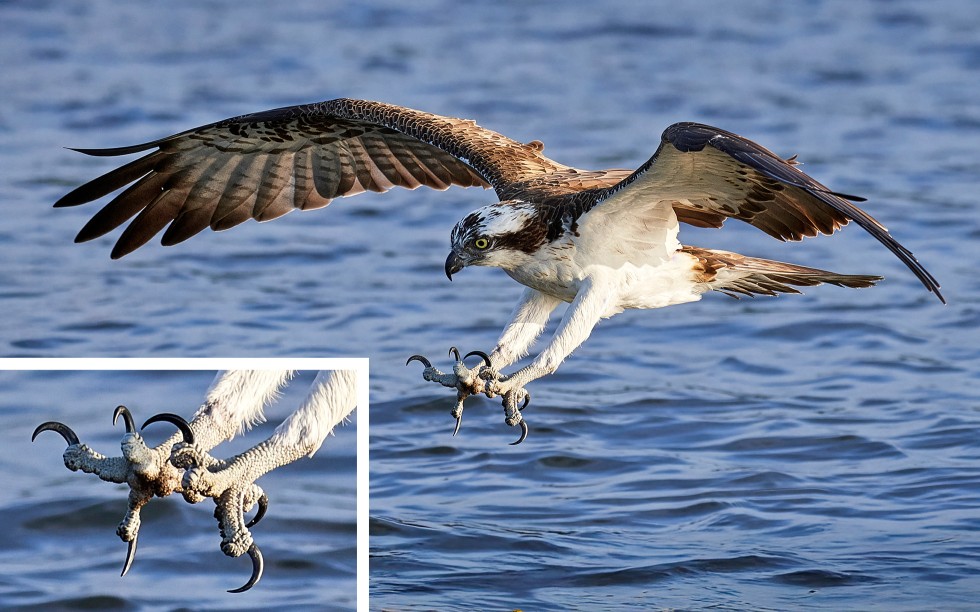
An Osprey lines up for a strike, talons spread and ready.
Built Around One Job
That foot is why the Osprey can do something almost no other raptor manages. Cornell calls it the only raptor of North America that eats almost exclusively live fish, and the numbers back that up: more than 80 fish species make up 99 percent of its diet. It hunts by hovering over shallow water, then plunging feet-first, reaching no more than about three feet below the surface. It does not always succeed, catching a fish on anywhere from roughly 1 in 4 dives to as many as 7 in 10, depending on conditions, after an average hunt of around 12 minutes. It is a specialist in a family of generalists, and that specialization is unusual enough that the Osprey was given its own taxonomic family, Pandionidae, entirely separate from every hawk and eagle around it.
The Relative Who Never Bothered
The Bald Eagle fishes the same bodies of water as the Osprey, but it didn't evolve the same fish-catching traits. No reversible toe, no spicules, just the standard-shaped raptor foot. So instead of building the gear, Bald Eagles frequently skip the work: they dive-bomb a fishing Osprey in midair and force it to drop its catch. According to the Adirondack Almanack, Benjamin Franklin watched this happen often enough that he wrote to his daughter in 1784 to complain about it: “He is a Bird of bad moral Character. He does not get his Living honestly. You may have seen him perched on some dead Tree near the River, where, too lazy to fish for himself, he watches the Labour of the Fishing Hawk (Osprey); and when that diligent Bird has at length taken a Fish, and is bearing it to his Nest for the Support of his Mate and young Ones, the Bald Eagle pursues him and takes it from him.” Franklin cited exactly this behavior as a reason he did not want the Bald Eagle representing the country.
Put the two birds side by side and the reputations flip. The eagle gets the seal, the currency, and the national holiday. The Osprey gets a toe that rotates and a patch of built-in sandpaper on its feet, and that is the actual reason one of them can fish and the other one, often enough, just waits for someone else to.
Team Osprey or Team Eagle?
Now that you know what is actually happening in that grip, does it change which bird you would put on the Great Seal of the United States?


Comments
Leave a comment
Thank you!