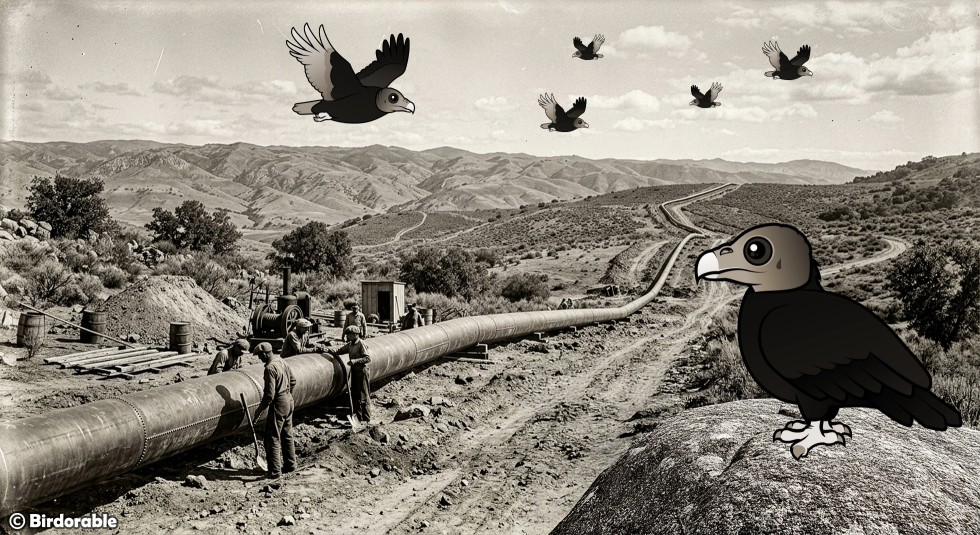
Vintage sepia photograph of workers laying a large steel gas pipeline across dry California hills, with cartoon Birdorable Turkey Vultures added: one perched on a boulder in the foreground and several more circling in the sky above.

Somewhere along 42 miles of pipe, gas was escaping, and the birds knew exactly where.

In 1938, the Union Oil Company of California had a problem it could not solve. A 42-mile natural gas line had sprung a leak, and finding the breach by walking the line across rough terrain would be difficult, if not nearly impossible.

Then an engineer in Texas came up with a plan that involved no equipment at all, only birds.

The Idea

The idea was simple: pump a heavy dose of a strong-smelling chemical called ethyl mercaptan into the pipeline, then drive along the route and watch the sky. Wherever the gas was escaping, Turkey Vultures would gather overhead.

And that is exactly what happened. As Union Oil's engineers later described it, Turkey Vultures were seen circling above the pipeline or sitting on the ground at several points along the line. The smell of mercaptan was strong at each of those spots, and every one of them turned out to be a real leak.

The company kept using the method for years afterward. As one of their field engineers later recalled, they had stumbled onto the fact that Turkey Vultures have a remarkably well-developed sense of smell.

Why It Worked

Natural gas has no smell of its own. Gas companies add a warning odor so that leaks can be noticed, and one of the compounds commonly used for that job is ethyl mercaptan.

Ethyl mercaptan also happens to be one of the gases given off by flesh in the earliest stages of decay.

So to a Turkey Vulture, a leaking gas pipeline does not smell like an industrial accident. It smells like dinner, in this case it was spread out across 42 miles of hilly California countryside.

Meanwhile, Scientists Were Still Debating It

Here is the interesting part: while an oil company was quietly using vultures as leak detectors, scientists were still debating whether birds could smell at all, a question that had been open for over a century.

The argument began with a famous shot across the bow. In 1826, John James Audubon published a paper in the Edinburgh New Philosophical Journal with a title that left no doubt about his intentions: "Account of the habits of the turkey buzzard, particularly with the view of exploding the opinion generally entertained of its extraordinary power of smelling."

Audubon meant to demolish the idea, and for a long time he was widely believed. The naturalist Charles Waterton fought back in print through the 1830s with a series of rebuttals, one of them aimed squarely at Audubon's paper, and John Bachman published a defense of Audubon in response. The dispute rolled on without resolution, and a long succession of loosely controlled field tests followed over the next hundred years without settling anything definitvely.

The Conversation That Solved It

In the late 1950s, an ornithologist at the Los Angeles County Museum named Kenneth Stager was talking with field engineers at Union Oil when a retired engineer named Ralph Openshaw told him the story of the pipeline.

Stager realized he was being handed the answer to a question ornithologists had been arguing over for more than a century, so he set out to test it properly.

The Experiments

Stager's problem was that it was known vultures have superb eyesight, so any test where the bird could see the food would prove nothing, so everything he built was designed to remove sight from the equation.

First he built a machine that could produce a smell with nothing to see. A four-bladed, 20-inch exhaust fan mounted in a wooden housing pushed the odor of fresh and decomposing animal tissue out onto known air currents, with nothing visible at the site, and vultures responded to the scent alone.

Next he hid food in boxes instead. Perforated cardboard cartons were loaded with decomposing fish, abalone, ground squirrels, kangaroo rats, a domestic cat, and snakes, then concealed at test sites, and the vultures found every one of them. In one case a bird came down a canyon on a downwind course, landed, and stood motionless facing upwind toward a bait chamber hidden 75 yards away in a dense grove of pepper trees.

Finally he ran the experiment that settled the matter. Stager set out a mounted, taxidermied yearling mule deer as a purely visual decoy, and no vultures came. He then replaced the mount with a fresh deer carcass of identical size and appearance, and the vultures responded quickly, although they still did not gather to feed until they had picked up the smell.

The deer was the same shape, the same size, and in the same place as the mount before it. The only difference was odor, and odor turned out to be the thing that mattered most.

The Experiment on Old World Vultures

The most interesting part of Stager's work may be the test he ran on the other side of the world, where the study on Old World vultures produced very different results.

In early 1959, on a museum expedition to the Balaghat Forest District of Madhya Pradesh in central India, Stager found himself camped among roughly 150 Old World vultures, drawn in by the skinning of large mammal specimens. Most were White-rumped Vultures, with a scattering of Egyptian Vultures and Red-headed Vultures.

He asked the skinners to set aside more than 200 pounds of muscle from a tiger specimen, then waited until ten o'clock at night, so that no vulture could possibly have watched him do it. He and two assistants carried the meat onto a raised platform in an open, dry paddy field and buried it under a ten-inch layer of thatching straw, and each night afterward he checked that the straw had not shifted enough to expose anything.

The bait rotted, and the smell, Stager wrote, became overpowering, noticeable at a considerable distance even to the relatively weak nose of a human being.

For eleven days the vultures swarmed the camp and the surrounding fields, and not one of the three species gave the slightest sign of noticing a quarter of a ton of tiger meat sitting in the open a short walk away.

On the night before the twelfth day, Stager pulled the thatch off, and the next morning a Red-headed Vulture spotted it at once, dropped onto the platform, and started eating.

Old World vultures find their food by sight, and they are superb at it. Uncovered, the meat was spotted within hours, but smell simply does not come into play for these birds.
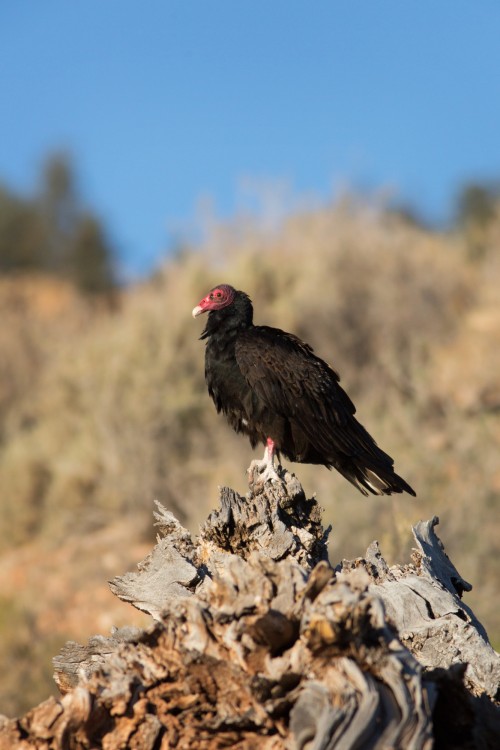
It Was Not the Flies, Either

There was a rival theory worth ruling out first. Some researchers had proposed that Turkey Vultures do not smell carrion at all, and instead spot the clouds of flies that gather above it.

The India experiment ruled that out too. The hidden bait was, in Stager's words, black with flies and other carrion insects, and the vultures still could not find it. If insects were the visual signal, those birds had it right in front of them for eleven days and never responded to it.

Conservation note: Around 95 percent of the vultures Stager was watching were White-rumped Vultures, then so abundant in India that they filled the great Sal trees around him day and night. Within a few decades the species had lost more than 99 percent of its population to a veterinary drug given to cattle. The flock that failed his experiment would be almost impossible to gather today.

Inside the Skull

Stager then studied vulture anatomy. Working from casts of the inside of vulture skulls, he compared the olfactory bulb, the part of the brain that processes smell, across species. The bulbs were relatively large in the New World vultures; the groups of Old World vultures had smaller bulbs.

Modern methods of study have since taken this theory further. A 2017 study measured vulture brains directly and found that a Turkey Vulture's olfactory bulbs are four times larger than a Black Vulture's, with twice as many of the output cells that carry smell signals onward, even though the Turkey Vulture's brain is about 20 percent smaller overall. These two birds share the same sky over much of the Americas, yet one of them is wired for a sense that the other barely has.

1938-1964

Stager published his study on June 30, 1964, in Contributions in Science, the journal of the Los Angeles County Museum. Sixty-three pages of experiments, results, and retesting finally closed an argument that had been running since 1826.

Union Oil's engineers had already found the answer back in 1938. They knew they were right, and they used that knowledge for years to keep a pipeline safe, even though it did not become part of ornithological knowledge for another couple of decades.

As for why New World vultures have such a strong sense of smell while their Old World cousins do not, that is a much older story. The vultures of the Americas and the vultures of Europe, Africa, and Asia are not actually close relatives at all. They arrived at the same way of life separately, and only in the Americas did any of them evolve a nose for the work, through a process called convergent evolution, which is a story for another day.

Now You Know What to Look For

The next time you see a Turkey Vulture flying low and unhurried over a field, rather than circling high on the warm air, there is a good chance it is working a scent, doing exactly what those engineers drove 42 miles of pipeline to watch for. Tell us where you have spotted one in the comments below!

International Vulture Awareness Day

International Vulture Awareness Day takes place on the first Saturday of September each year. In 2026, we'll be celebrating this special day on September 5th.

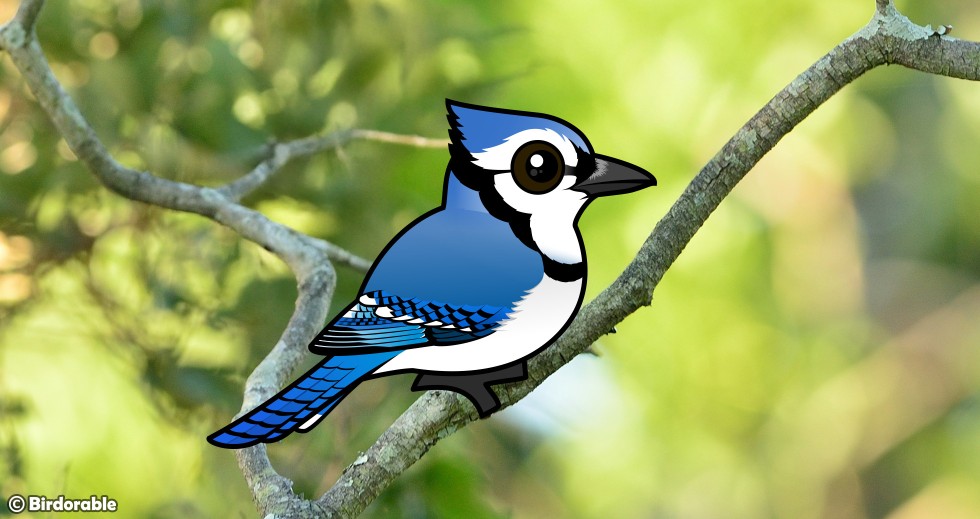
Birdorable Blue Jay perched on a tree branch

He looks blue. He's actually just very good at bouncing light.

A Blue Jay looks blue for the same reason a Northern Cardinal looks red, or so it seems. The cardinal’s red comes from pigment it picks up in its diet and stores in its feathers. Blue, you would guess, works the same way: some blue pigment tucked inside a seed or plant. It is a reasonable guess, but it happens to be wrong. No bird species on Earth has ever been shown to make blue pigment. Every blue feather out there, from a Blue Jay at a backyard feeder to a Spix’s Macaw newly returned to the wild in Brazil, is pulling off a physics trick, not a biological one.

The Physics Trick Hiding in Every Blue Feather

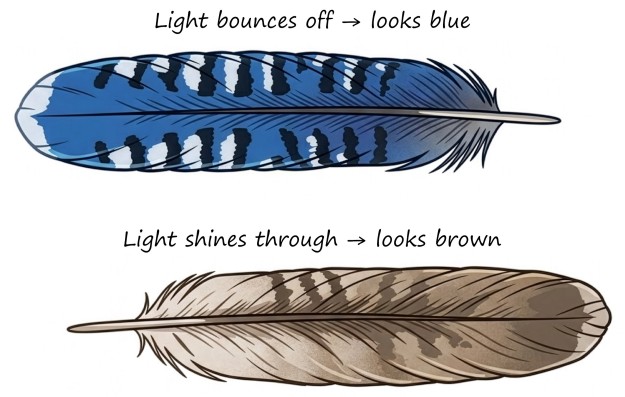
Feathers get most of their color from three families of pigment: carotenoids (the reds, oranges, and yellows birds absorb from food), melanins (blacks, grays, and browns), and porphyrins (found in turacos and a few other birds). None of them make blue. “Blue is different,” wildlife biologist Scott Sillett of the Smithsonian Migratory Bird Center has explained. “No bird species can make blue from pigments. The color blue that we see on a bird is created by the way light waves interact with the feathers and their arrangement of protein molecules, called keratin.” Blue, in other words, is a structural color: an optical effect built from the physical shape of the feather rather than a dye sitting inside it.

Here is the fun part. Inside every feather barb is a spongy layer of keratin, the same protein your fingernails are made of, packed with tiny air bubbles. Those bubbles are so small you could never see them, even with a magnifying glass. When light hits that bubbly maze, blue light bounces back out toward your eyes, while a layer of dark melanin hiding underneath soaks up the rest. It is actually the same basic trick that makes the sky blue: tiny things scattering light around until mostly blue makes it back to you, as Cornell Lab of Ornithology’s Bird Academy explains. That dark melanin backing matters just as much as the bubbly keratin. Without it soaking up the leftover light, the blue would wash out into a dull, milky gray.

Scientists proved this back in 1998, using a bird of the rainforest, a Plum-throated Cotinga. They studied its blue feathers under powerful microscopes, mapped out the tiny pattern of keratin and air bubbles inside, and showed that the pattern itself was what made the blue color happen. The study was published in the journal Nature by ornithologist Richard Prum and his colleagues. Since then, scientists have found the same trick in blue bird after bluebird, all over the world. The color is not painted onto the feather. It is built into it.

Proof You Can Hold in Your Hand

You do not need a lab to see this for yourself. Blue Jays molt often, and their barred blue-and-white wing and tail feathers turn up under trees year-round. Pick one up and hold it so the sun comes from behind it rather than in front. The blue disappears right in front of you, and the feather turns a flat brownish-gray, because the color only "works" when light bounces back toward you rather than passing through.

Illustration of a Blue Jay feather shown twice: lit normally on top, it looks bright blue with black and white barring; backlit on the bottom, the same feather looks plain brown.

The same Blue Jay feather, lit two different ways.

Conservation scientist David Wiedenfeld of the American Bird Conservancy compares the structure to a prism: “In a prism you have colored light, and it refracts and divides the spectrum up. You get different colors coming out of different places. The way a bird’s feathers are, it absorbs all of the colors except for blue, which is refracted and comes back.” Blue Jays do carry melanin in their feathers, Wiedenfeld notes, but that melanin is brown, not black. “There are no blue pigments in birds,” he says flatly. Every blue feather on every bird is running some version of the same physics, even though the exact nanostructure differs from species to species.

The Same Trick, Four Times Over

What makes structural blue more than a fun demonstration is how many unrelated birds landed on the identical solution. A jay, a bunting, a kingfisher, and a macaw share almost nothing in body plan, diet, or closely related evolutionary history. What they share is a chemistry problem pigment cannot solve, and evolution found the same nanoscale workaround for each of them, independently.

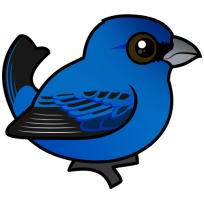
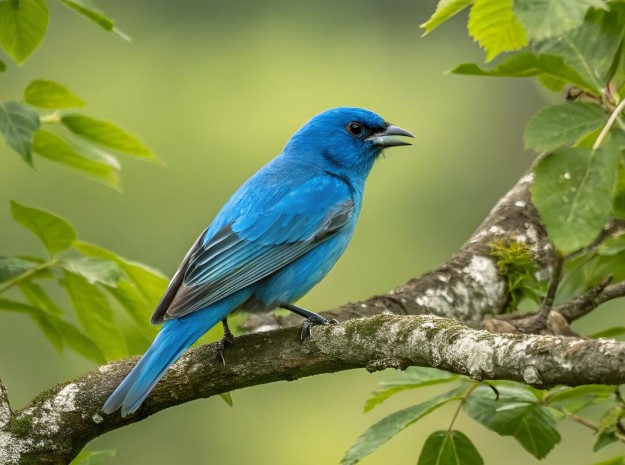
The Indigo Bunting shows how temporary the trick can be. A breeding male wears full structural blue only through spring and summer. By fall he has molted into mostly brown plumage, with just tinges of blue left in the wings and tail. Cornell’s All About Birds guide puts it plainly: “Like all other blue birds, Indigo Buntings lack blue pigment. Their jewel-like color comes instead from microscopic structures in the feathers that refract and reflect blue light... Bunting plumage does contain the pigment melanin, whose dull brown-black hue you can see if you hold a blue feather up so the light comes from behind it, instead of toward it.” A bird that is only “blue” for half the year, and only from the right angle, is about as clear a demonstration of structural color as nature offers.

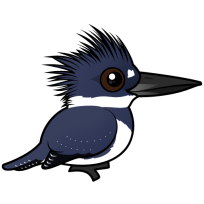
The Belted Kingfisher shows the trick is not limited to songbirds. Kingfishers belong to an entirely different order of birds than perching songbirds like jays and buntings, and their blue-gray plumage runs on the same keratin-and-air sponge. Researchers who examined the closely related Common Kingfisher of Europe and Asia found that its cyan and blue feathers are built from that same bubbly nanostructure, while its orange breast feathers get their color the ordinary way, from pigment sitting right next door on the very same bird. 

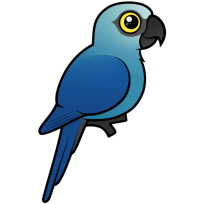
The Spix’s Macaw takes this trick to the extreme. A jay or a bunting mixes its structural blue with black, white, or brown, but a Spix’s Macaw is blue-gray from its head to the tip of its tail, with nothing else to hide behind. Scientists who studied its close cousin, the Scarlet Macaw, found a tangled 3D lattice of keratin rods inside its blue feathers, each rod only about 100 nanometers thick. That is roughly a thousand times thinner than a single human hair. It is the exact same trick as a Blue Jay’s feather, just built by a totally different kind of bird on the other side of the world.

Spix’s Macaws actually vanished from the wild completely around 2000, and the species was formally declared extinct in the wild in 2019. Then, starting in 2022, scientists began releasing macaws raised in captivity back into a forest in Brazil, and wild-hatched chicks have since taken flight there for the first time in decades. Every one of those famous blue feathers is running on the same tiny "nanotechnology" as a jay’s wing in a North American backyard.

What’s Your Favorite Structurally Blue Bird?

Ours might be the Indigo Bunting, a bird that spends half the year not even bothering to be blue. There's something almost funny about a color that only shows up when it's needed. What's yours?

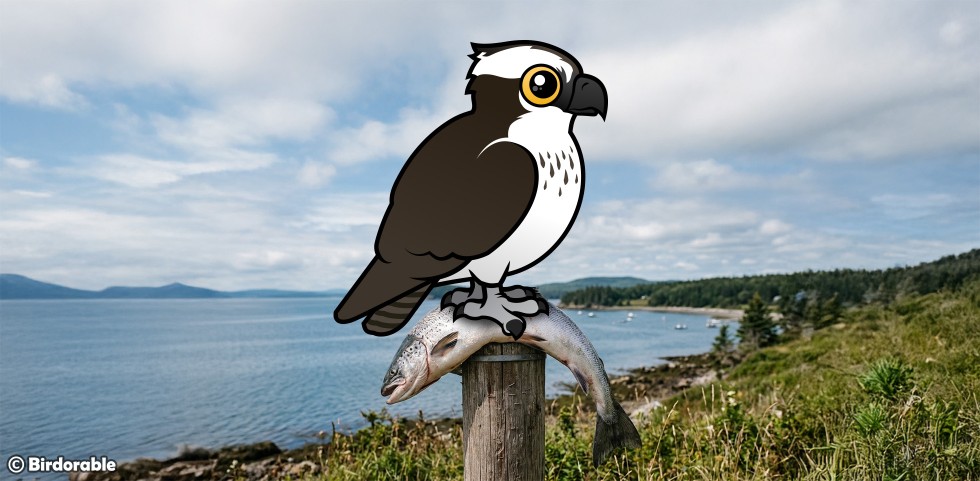
BIrdorable Osprey standing on a wooden post, gripping a large fish in its talons, with a calm coastal bay and distant hills in the background.

An Osprey folds its wings, drops feet-first into open water, and vanishes in a burst of spray. A second later it hauls itself back into the air, a fish gripped in its talons and turned to face forward, nose-first, like cargo lashed down for the flight home. It looks like something any hawk or eagle could do. It is not.

A Trick Almost No Other Raptor Has

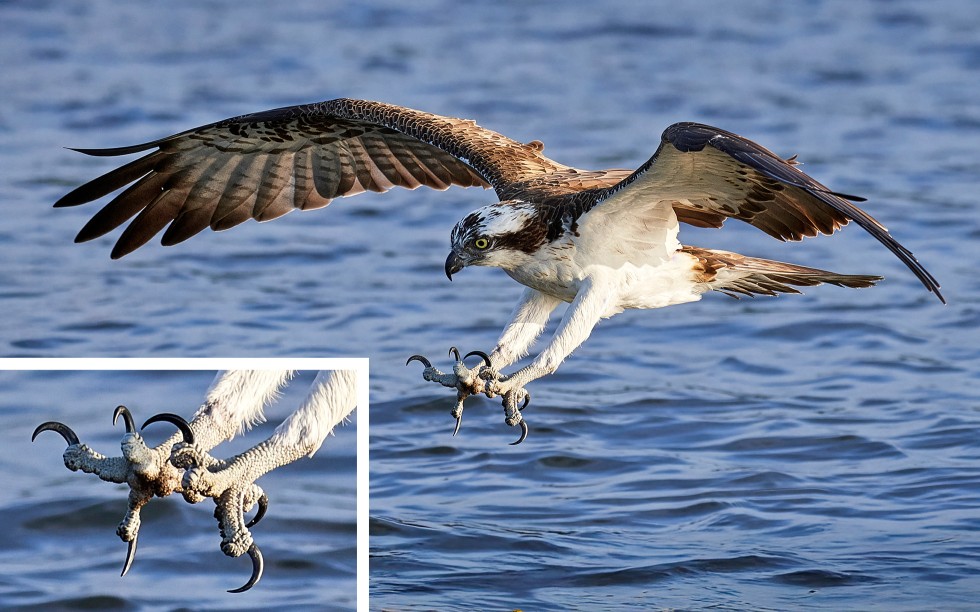
Most birds of prey grab with a fixed foot: three toes forward, one back, built for pinning a squirrel or a rabbit to the ground. The Osprey has something different. According to the Cornell Lab of Ornithology, ospreys are “unusual among hawks in possessing a reversible outer toe that allows them to grasp with two toes in front and two behind,” and the soles of their feet carry barbed pads that dig into wet, muscled fish the way a fixed grip never could.

The University of Michigan’s Animal Diversity Web lists the full kit: unusually long legs for a raptor, those barbed footpads (called spicules), long curved claws, and the reversible outer toe, backed up by dense oily plumage and nasal valves that seal shut so no water gets in during a dive. None of it is decorative. Every piece exists to solve one problem: holding onto a live fish that does not want to be held.

An Osprey in flight over water with wings swept back and talons extended forward, about to strike; inset close-up shows its feet and curved black talons.

An Osprey lines up for a strike, talons spread and ready.

Built Around One Job

That foot is why the Osprey can do something almost no other raptor manages. Cornell calls it the only raptor of North America that eats almost exclusively live fish, and the numbers back that up: more than 80 fish species make up 99 percent of its diet. It hunts by hovering over shallow water, then plunging feet-first, reaching no more than about three feet below the surface. It does not always succeed, catching a fish on anywhere from roughly 1 in 4 dives to as many as 7 in 10, depending on conditions, after an average hunt of around 12 minutes. It is a specialist in a family of generalists, and that specialization is unusual enough that the Osprey was given its own taxonomic family, Pandionidae, entirely separate from every hawk and eagle around it.

The Relative Who Never Bothered

The Bald Eagle fishes the same bodies of water as the Osprey, but it didn't evolve the same fish-catching traits.  No reversible toe, no spicules, just the standard-shaped raptor foot. So instead of building the gear, Bald Eagles frequently skip the work: they dive-bomb a fishing Osprey in midair and force it to drop its catch. According to the Adirondack Almanack, Benjamin Franklin watched this happen often enough that he wrote to his daughter in 1784 to complain about it: “He is a Bird of bad moral Character. He does not get his Living honestly. You may have seen him perched on some dead Tree near the River, where, too lazy to fish for himself, he watches the Labour of the Fishing Hawk (Osprey); and when that diligent Bird has at length taken a Fish, and is bearing it to his Nest for the Support of his Mate and young Ones, the Bald Eagle pursues him and takes it from him.” Franklin cited exactly this behavior as a reason he did not want the Bald Eagle representing the country.

Put the two birds side by side and the reputations flip. The eagle gets the seal, the currency, and the national holiday. The Osprey gets a toe that rotates and a patch of built-in sandpaper on its feet, and that is the actual reason one of them can fish and the other one, often enough, just waits for someone else to.

Team Osprey or Team Eagle?

Now that you know what is actually happening in that grip, does it change which bird you would put on the Great Seal of the United States?

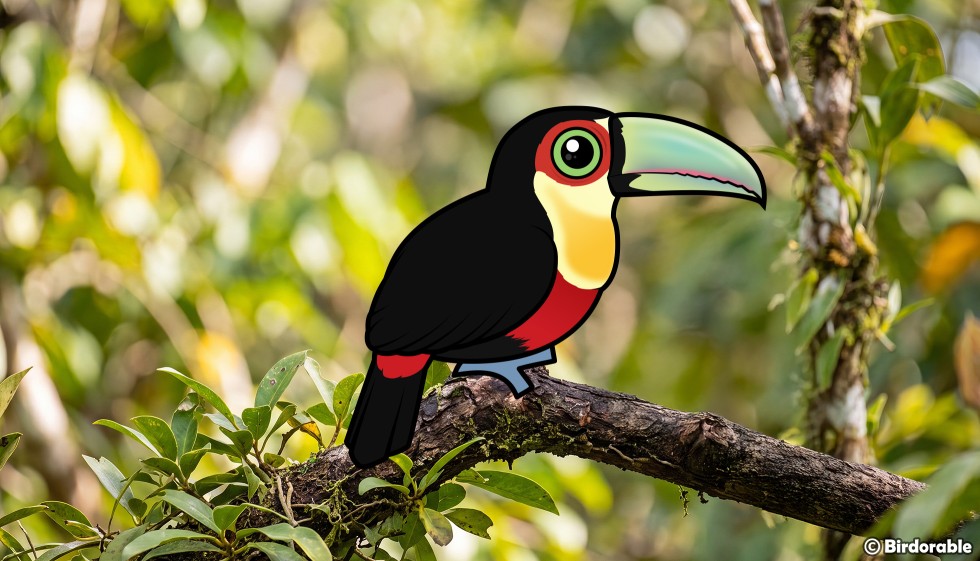
Birdorable Red-breasted Toucan

Listen closely on a morning hike through the mist-shrouded mountain forests of southern Brazil, and you might hear what sounds like a tiny croaking frog high up in the trees. Look closer through your binoculars, and you won't find an amphibian, you'll spot a flash of scarlet and gold tumbling through the fruit trees.

Meet the Red-breasted Toucan (Ramphastos dicolorus), also known as the Green-billed Toucan, one of the Atlantic Forest's most energetic acrobats. It ranges through southern and southeastern Brazil into eastern Paraguay, Bolivia, and the far northeast of Argentina, and it's the smallest member of the toucan genus Ramphastos.

That croak, by the way, is a family trait. Ornithologists split the big Ramphastos toucans into two camps by voice: the "yelpers" and the "croakers." Our little friend is firmly a croaker.

The Rainforest’s Ultimate Fruit Handler

While many tropical birds spend their days hunting insects on tree trunks or sweeping over rivers, this toucan has one primary mission: finding ripe fruit.

Because they live high in the canopy, reaching food can be tricky. A heavy branch might hold a bird's weight, but the juiciest figs and palm fruits usually hang at the very tips of flimsy, fragile twigs.

That's where the beak comes in handy. It's actually on the short side by toucan standards, only about 4 inches long, but it works like a lightweight pair of long-handled kitchen tongs, letting the bird snatch fruit off delicate branches without ever leaving the safety of a sturdy perch. Once they grab a piece of fruit, they toss their head back with a quick flick, letting gravity slide the treat straight down their throat.

Not Just Fruit: A Sneaky Rainforest Hunter!

Fruit might make up the bulk of their daily menu, but Red-breasted Toucans are far from strict vegetarians! They are clever omnivores and opportunistic hunters that won't pass up a high-protein snack.

When they aren't foraging for berries, they use their keen eyesight and long beaks to:

  • Hunt insects: Snatch up large beetles, caterpillars, and cicadas from the foliage.
  • Grab other creepy-crawlies: Spiders and other arthropods are fair game too.
  • Catch small prey: Small tree frogs and lizards moving through the leaves.
  • Raid nests: During the breeding season, toucans have a bit of a sneaky reputation: they will raid other birds' nests for eggs and nestlings to feed their own growing chicks!

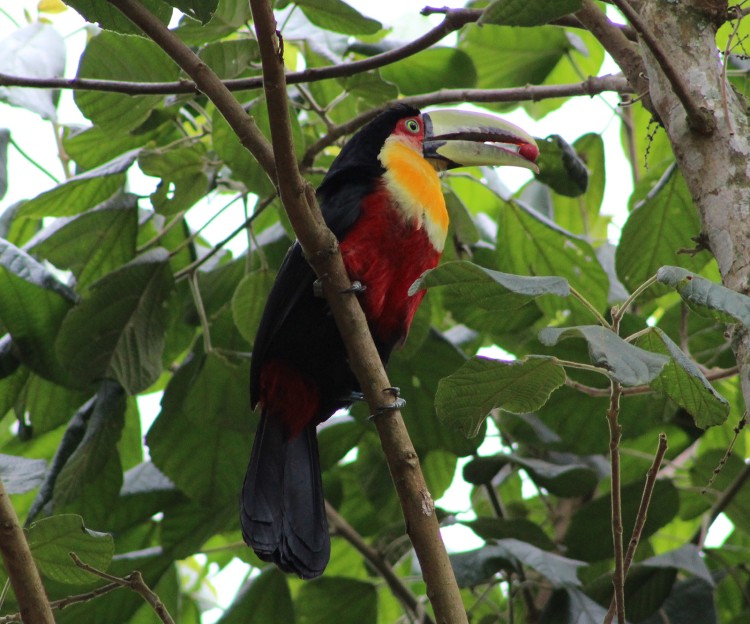
Red-breasted Toucan

A Bill That Doubles as a Radiator

At first glance, a bird with a big pale-green bill, a golden throat and chest, and a blaze of red across its lower belly seems like it would stand out like a neon sign. And honestly? It does.

But the bill is doing something far stranger than looking pretty. In 2009, researchers pointed thermal cameras at toucans and discovered that the bill is a living radiator. It's packed with blood vessels, and the bird can dial blood flow to it up or down to dump body heat or hold it in. Relative to body size, it turns out to be one of the largest "thermal windows" in the entire animal kingdom, right up there with an elephant's ears. On a hot afternoon a toucan's bill glows on infrared; as the bird settles down to sleep, it shuts the flow off and tucks the bill under its wing to stay warm.

Look closely at that bill and there's more going on than plain green, too: a black stripe rings the base, the base and tip are washed with red, and the cutting edges are lined with pale, tooth-like serrations for gripping slippery fruit.

As for the rest of the outfit, the toucan's back, crown, and tail are glossy black, so a hawk passing overhead mostly sees a dark shape against dark leaves. The scarlet and gold are saved for the front, where the birds that matter most can see them: other toucans.

Over to You!

If you were a rainforest bird, would you want a big, giant beak like a toucan, or super fast wings like a hummingbird?

Birdorable Brolga

If you ever find yourself looking out across the vast, sun-drenched wetlands of northern or eastern Australia, you might witness one of the most mesmerizing spectacles in the natural world: a pair of tall, silver-gray birds stepping gracefully in sync, tossing their heads, leaping into the air, and spreading their broad wings in a synchronized dance.

Meet the Brolga, Australia's famous native crane!

The Famous Dancers of the Outback

For thousands of years, Aboriginal peoples across Australia have celebrated the Brolga's dancing. The bird appears in stories of the Dreaming belonging to many different nations, and its courtship and social dances inspired ceremonial and traditional dance movements that are still performed today.

Unlike many birds that only dance to attract a mate, Brolgas dance all year round, and at almost any age!

How to Dance Like a Brolga:

  • The Bow: Stand tall, then lower your head and bow deeply to your partner.
  • The Leap: Spring about 3 feet (1 meter) straight into the air with wide, outstretched wings!
  • The Prance: Walk in light, graceful circles while shaking your feathers.
  • The Toss: Pick up a stick, grass clump, or small twig with your beak and toss it high into the air, catching it on the way down!

In the video below, a Brolga shows off some of these moves:

How to Identify a Brolga

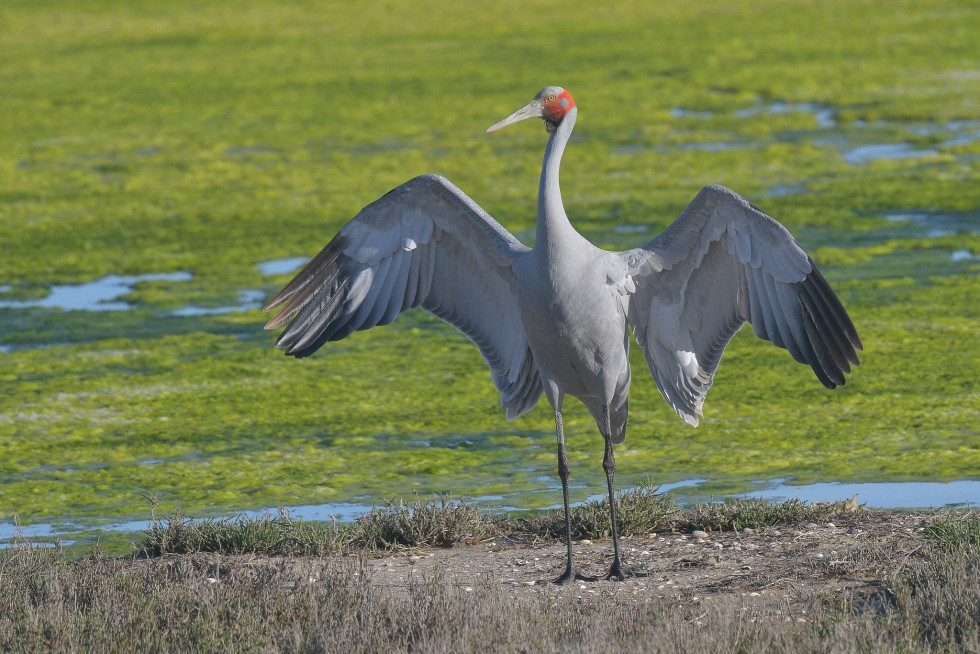
Standing up to about 4.5 feet (1.4 meters) tall, and with a wingspan stretching nearly 8 feet (2.4 meters) across, the Brolga (Antigone rubicunda) is one of Australia's largest flying birds. You'll find them across northern and eastern Australia, from Queensland down to Victoria, and in southern New Guinea too.

Here are its standout features:

  • Plumage: A sleek, silver-gray body with black flight feathers at the wingtips.
  • Red Head, Grey Cap: Bare, fiery red-orange skin covers the face, cheeks, and back of the head. The crown on top stays a neat grey-green, like a little cap.
  • The Dewlap: A dark pouch of skin hanging under the chin. It's biggest and floppiest on adult males.
  • Legs & Eyes: Long, blackish-grey legs made for wading through shallow water, and bold yellow-orange eyes.
Photo of a Brolga

Photo by Dorothy Jenkins (CC BY-SA 2.0)

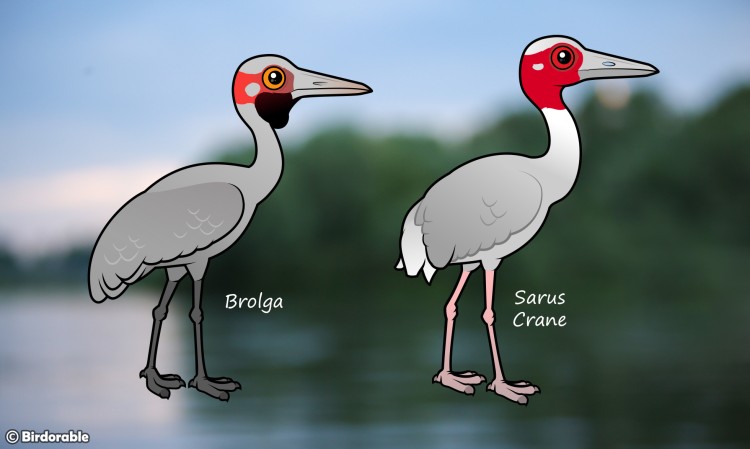
Brolga vs. Sarus Crane: A Case of Double Identity

Birdwatchers visiting Australia often run into a tricky identification challenge! Australia is home to another tall crane: the Sarus Crane. The two species even live side by side in northern Queensland.

While they look almost identical at first glance, three features will sort them out:

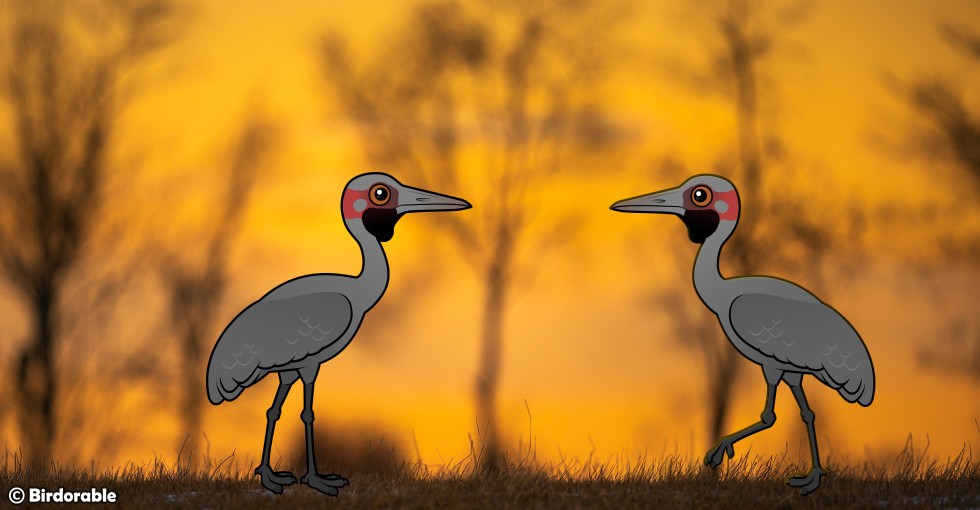
Feature Brolga Sarus Crane
Legs Blackish-grey Pink
Red skin Stops at head Runs partway down the neck
Chin Dark dangling dewlap No dewlap


The legs are the giveaway. You can pick them out from far across a paddock, long before you could ever make out a dewlap!

Compare Birdorable Brolga and Sarus Crane

Champion Diggers: What Do They Eat?

Brolgas are omnivores equipped with long, heavy bills built for digging. They spend their days wading through shallow swamps, floodplains, and agricultural fields.

Up in the tropical north, their favorite meal is bulkuru sedge tubers, sweet, nutrient-rich roots that grow in the mud underwater. Brolgas use their powerful beaks like mini shovels, digging deep holes to reach them, and these tubers keep the northern birds going right through the dry season. Bulkuru doesn't grow in the south, so Brolgas down that way eat more grain and other tubers instead.

Wherever they live, they'll also snack on:

  • Insects (especially grasshoppers and beetles)
  • Small frogs, lizards, and fish
  • Mollusks and crustaceans
  • Grains and seeds

Life in the Wetlands

Brolgas form strong, lifelong pairs. During the wet season, parents work together to build a nest, a giant mound of grass, reeds, and other plants piled up on a small island or right in the middle of shallow water to keep predators away.

Both the mother and father take turns sitting on their two speckled eggs for about a month. Once the chicks hatch, they can walk and follow their parents within just a few hours!

There are still plenty of Brolgas across northern Australia, but the smaller population down south in Victoria and New South Wales has been shrinking as wetlands are drained, so those southern dancers need their wetlands protected.

Over to You!

If you could learn a dance inspired by any animal in the wild, which animal's moves would you want to try? Let us know in the comments below!

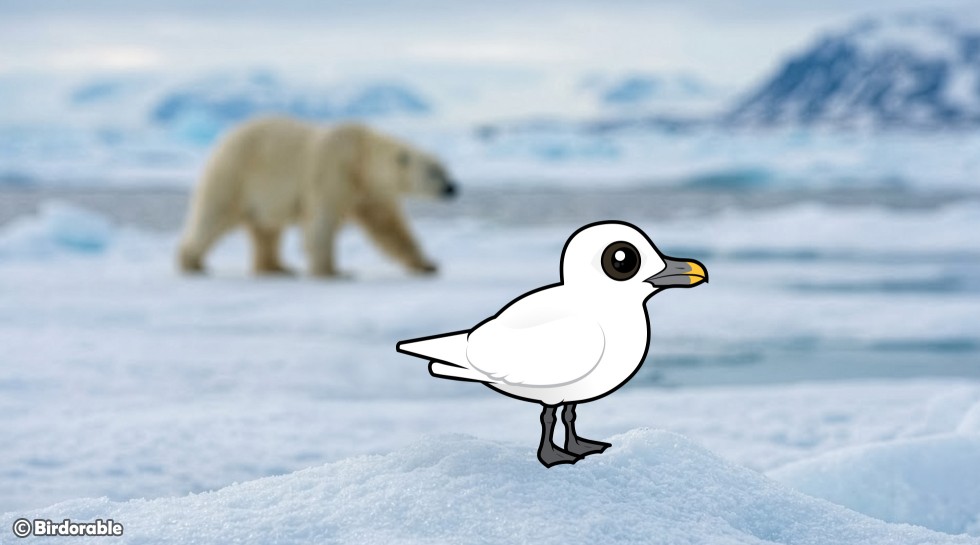
Illustration of a Birdorable Ivory Gull — pure white with black legs and a grey bill tipped with yellow — standing on Arctic pack ice, with a polar bear walking across the ice behind it.

Ivory Gulls shadow polar bears across the pack ice, waiting for what's left of the kill.

Here’s a secret that will make you sound like an expert next time you’re at the beach: there is no such bird as a “seagull.”

Not one. Open any bird guide in the world and you won’t find the word. There are Herring Gulls and Ivory Gulls and Laughing Gulls, dozens of species in all, but not a single one of them is called a seagull.

Now, this is the point where a certain kind of birdwatcher gets smug about it, but that’s not what we’re here for. “Seagull” is a perfectly good everyday word, and nobody needs to be corrected while they’re eating an ice cream. But it is a word that hides something, and what it hides is genuinely interesting. Packed into those two little syllables are two mistakes, and the bird underneath is far more surprising than the word lets on.

Mistake One: Most of Them Aren’t Sea Birds

Let's start with “sea,” because that’s the half that goes wrong first.

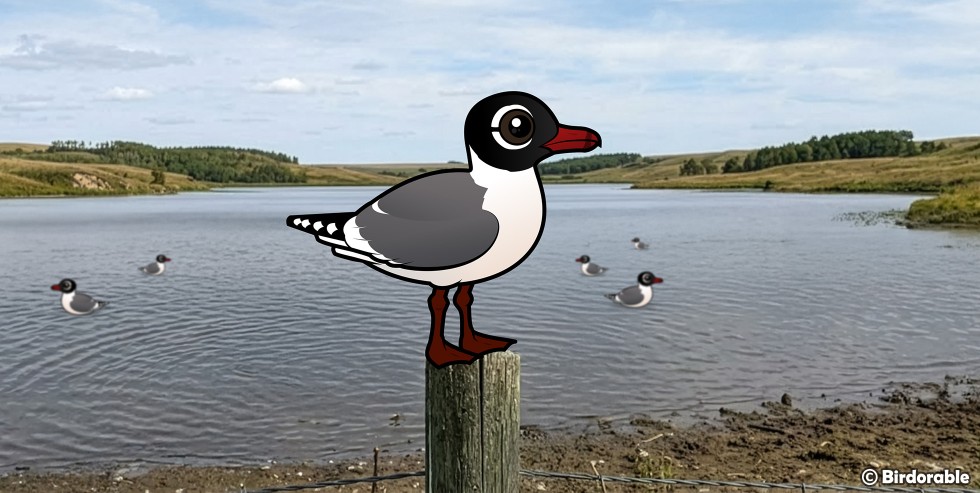
Plenty of gulls hardly bother with the ocean at all. Franklin’s Gull nests in colonies on prairie lakes in the middle of Canada and the northern United States, building nests on the ground or floating them on the water. In spring, flocks feed on newly hatched insects over inland water bodies and across wet pastureland. Come autumn they leave the continent entirely for Argentina, Chile and Peru. It's only in the off-season that you'll find them on ocean coastlines.

And the gulls you do see at the seaside are often somewhere else the rest of the week. Black-headed Gulls spend much of the year hunting invertebrates in plowed fields. Gulls follow tractors, patrol reservoirs, roost on playing fields, and work landfills and supermarket parking lots a hundred miles from salt water.

If we’d named them for where most of them actually spend their time, we’d be calling them fieldgulls, parking-lotgulls, or landfillgulls.

Mistake Two: They’re Not All the Same Bird

The second mistake is sneakier. “Seagull” suggests a single generic bird: white, gray, noisy, and after your lunch. One word, one bird.

Let's consider a few of them side by side.

The Ivory Gull lives on the pack ice of the high Arctic and is pure white all over, with no gray back at all, a blue bill with a yellow tip, and black legs. It makes its living in a way no seaside scavenger would recognize: it follows polar bears across the ice and feeds on what is left of their kills. (It also eats polar bear droppings and seal placentas, which is the sort of fact that either delights you or does not.)

The Glaucous Gull is the second-largest gull on Earth, big enough to rival a Great Black-backed Gull, and it’s a serious Arctic predator that takes eggs, chicks and other birds. Nearly every gull has black wingtips; this one has no black anywhere at all, on wing or tail. It is a pale ghost of a bird.

The Slender-billed Gull of the Mediterranean has a long neck and a long tapering face, dark red bill and legs, and in the breeding season a soft pink blush across its white breast.

The Silver Gull is the bright-red-billed Australian that will absolutely steal your chips.

And the Black-headed Gull? Its head isn’t black. It’s chocolate-brown; it only looks black from a distance. The hood isn’t there most of the year either, appearing around March and fading by July. The rest of the time the bird has a white head with two dark smudges, one above and one behind the eye.

A polar-bear scavenger, an Arctic predator, a pink Mediterranean beauty, an Australian food thief, and a bird whose name is wrong twice over. That’s not one bird, a "seagull". That’s not even close.

Illustration of a Birdorable Franklin's Gull with a black hood and red bill perched on a wooden fence post beside a prairie lake, with several real Franklin's Gulls swimming on the water behind it.

Not a beach in sight. A Franklin's Gull surveys its prairie lake, about as far from the sea as a "seagull" can get.

So Why Do Gulls Seem So Alike?

Partly because in most places the ones we see really are alike, and partly because lots of gulls are genuinely difficult to identify.

We tend to meet the same few species. The gulls that do well around people are a handful of big, adaptable ones. You could spend years visiting seaside towns in Britain or North America and mostly cross paths with only three or four species, all of them white and gray and much the same shape.

And gulls change their looks as they grow up. This is the part that catches nearly everyone out. Small gulls take about two years to grow into adult plumage, and the big ones like Glaucous, Caspian and Herring can take four. A young gull may be a mottled brown bird that looks nothing like its parents. So one flock might hold a single species wearing four different plumages, alongside several other species that closely resemble each other.

Experienced birdwatchers find this hard too. The Caspian Gull was taxonomically treated as a subspecies of the Herring Gull until relatively recently, and separating the two is one of birdwatching’s classic puzzles (in fact, the entire Herring Gull complex is somewhat fraught and complicated). The clues are all in the shape: a long slender bill, a sloping forehead, a small dark eye, long pale legs. Individuals may be carefully studied and still be noted by the birder as "probably.”

What the Word Costs

Here’s why it’s worth a bit of care.

The Herring Gull is the archetypal “seagull”: the big pink-legged one from the seaside, the one making lighthearted newspaper headlines about stolen food. It is also Red-listed in the UK, the highest level of conservation concern, after long-term declines estimated at around 60%. Britain and Ireland hold a substantial share of the entire world population.

Meanwhile, the Ivory Gull is classed as Near Threatened and falling, and the main reason is the loss of the sea ice its whole life is built around. The Canadian population dropped by roughly 80% between the 1980s and the early 2000s.

And the Silver Gull? Booming. It has adapted so well to towns and beaches that its numbers have risen wherever people gather.

Three birds. One collapsing, one in serious long-term trouble, one thriving. And one word, “seagull,” that flattens all three into the same slightly annoying bird at the beachside snack bar. When every gull is the same bird, a species quietly disappearing looks exactly like a species doing fine.

You Only Have to Learn One

You don’t need to identify every gull in the flock. Honestly, nobody does. But learning to name one can change how the rest look.

Start with what’s easy to see:

  • Legs. Pink, yellow, red, or black? Often the fastest clue there is.
  • Bill. A red spot, a black ring, a plain yellow bill, or bright red all over?
  • Wingtips. How much black, or is there any at all?
  • Size. Compare it to the gulls standing next to it, not to a bird in a book.

Pick the most distinctive bird in the flock and work out what it is. Next time, you’ll more easily spot it, and everything around it will suddenly look different by comparison.

That’s the whole trick. Not knowing every gull, just knowing that there’s something there to know.

What’s Your Favorite Gull?

Ours might be the Ivory Gull, following polar bears across the sea ice at the top of the world. Or the beautifully plumaged Heermann's Gull, with its subtle gray gradients. Which one would you pick? Tell us in the comments below!

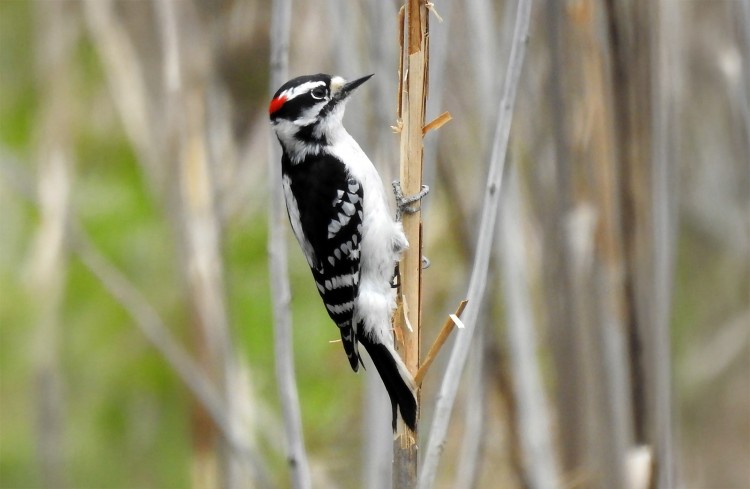
Birdorable Downy Woodpecker

With hundreds of woodpecker species drumming on tree trunks across the globe, today we're featuring a bird that holds a special title: the Downy Woodpecker is North America's smallest woodpecker!

No bigger than a house sparrow, and a good bit lighter than one at that, these energetic little birds pack a huge personality into a tiny, feather-packed package.

Where Do They Live?

The Downy Woodpecker (Dryobates pubescens) is native to North America. Its range spans most of the continent north of Mexico, from the dense forests of Alaska and Canada all the way down to Florida and California. There are just two big gaps on the map: the parched deserts of the Southwest, and the treeless tundra of the far north,  both tough places for a bird that makes its entire living on wood!

Across their range, they are resident birds, meaning they don't migrate long distances for the winter. Once a Downy Woodpecker finds a forest, park, or suburban neighborhood with plenty of trees, it stays put year-round!

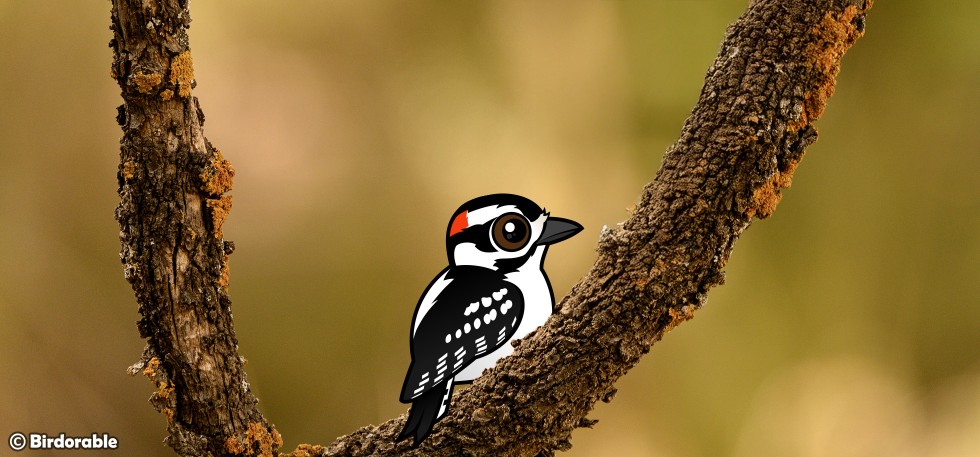
Male Downy Woodpecker

How to Spot One

At just 5.5 to 6.7 inches (14 to 17 cm) long and weighing less than an ounce (under 30 grams), the Downy Woodpecker is built for quick movements and nimble climbing. Key field marks include:

  • Bold Pattern: A bright white belly, dark black wings speckled with crisp white spots, and a thick white stripe running down the middle of its back.
  • Head Markings: Distinct black and white facial stripes.
  • Male vs. Female: Males sport a small, fiery red patch on the back of their head (the nape), while females have only black and white feathers on their head.
  • Tiny Bill: A short, delicate bill that is shorter than the total length of its head.

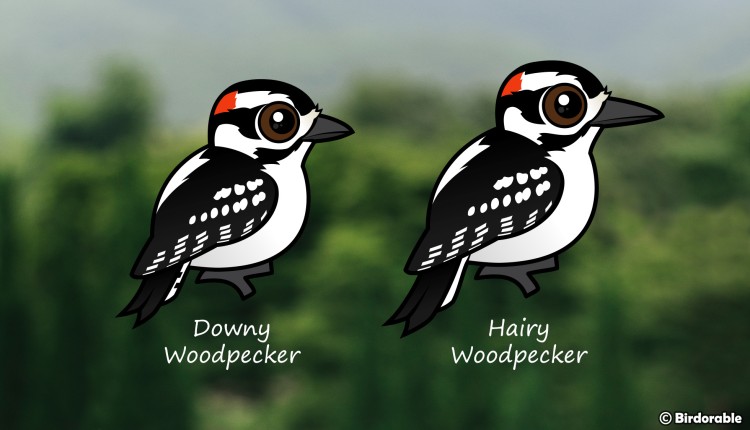
Downy vs. Hairy: The Classic ID Challenge

Birdwatchers across North America frequently ask: Is that a Downy or a Hairy Woodpecker?

Both species share much of the same habitat and look nearly identical in color and pattern, but they are easy to tell apart once you know what to look for!

Feature Downy Woodpecker Hairy Woodpecker
Size Small (~6 inches / 15 cm, sparrow-sized) Medium (~9 inches / 23 cm, robin-sized)
Bill Length Short (less than half the head length) Long & sturdy (as long as its head)
Outer Tail Feathers White with tiny black spots/bars Pure, plain white
Feeding Style Nimble; feeds on thin twigs & weed stalks Prefers large tree trunks & major limbs
Compare Birdorable Downy Woodpecker vs Hairy Woodpecker

Amazing Adaptations: Built for Drilling

How can a bird spend all day hammering its head against solid wood without getting a headache? Woodpeckers everywhere share incredible physical adaptations:

  • A Skull Built for Hammering: For decades, it was assumed that woodpecker skulls worked as shock absorbers. The idea even inspired helmet designs. Then in 2022, researchers filmed woodpeckers pecking in ultra-slow motion and discovered the beak and the brain decelerate in perfect lockstep. There's no cushioning at all! The head works as a stiff hammer, which is exactly what makes it such an effective drill, since any give would waste the energy of the blow. So why isn't the bird knocked silly? Because its brain is tiny, and small masses can shrug off impacts that would concuss a much bigger one.
  • Zygodactyl Feet: Unlike songbirds with three toes facing forward and one back, woodpeckers have two toes pointing forward and two pointing backward, giving them an exceptionally strong grip on vertical bark.
  • Built-in Kickstand: Stiff, reinforced tail feathers act as a third point of support against tree trunks while climbing and hammering.
  • Super Long Tongue: A barbed, sticky tongue that can extend far past the beak to extract insects from tiny crevices. It's so long that when it retracts, it has to curl up and over the outside of the skull, tucked away beneath the skin and anchored right up in the bird's upper bill.

Feeding Habits

In North American yards, Downy Woodpeckers are enthusiastic visitors to birdfeeders, especially those offering suet, peanuts, or black oil sunflower seeds. Out in nature, they use their tiny beaks to pick beetle larvae, ants, and spiders out of bark crevices and galls.

What About You?

Have you ever spotted a Downy Woodpecker in the wild, or do you have a favorite local woodpecker species where you live? Tell us in the comments below!