


Stuck on Land: The Truth About Loon Takeoffs
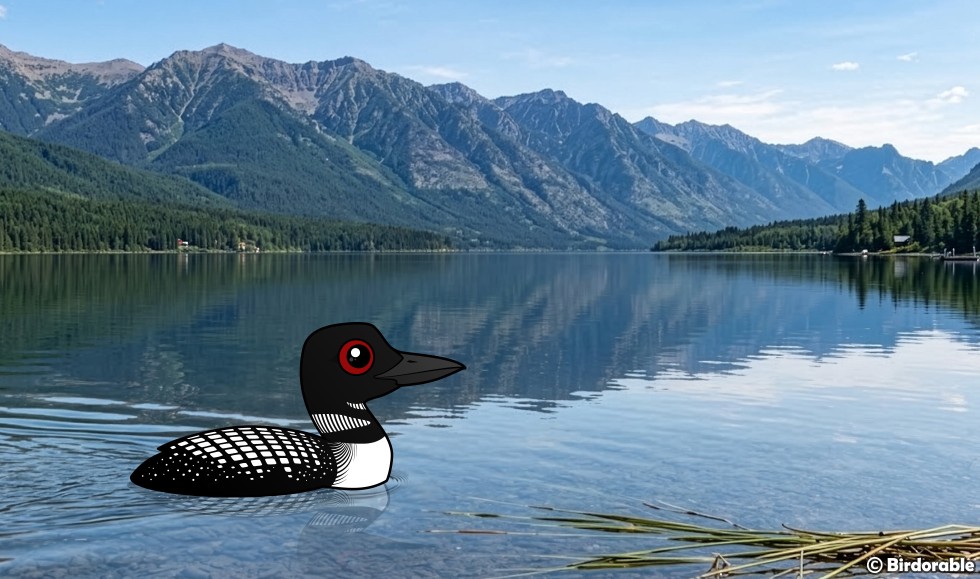
A Common Loon at home on open water.
A Common Loon floating on a quiet lake looks like it should be able to do whatever any other water bird does: paddle around, dive for fish, and lift off again whenever it feels like it. Most people, if they thought about it at all, would assume that a bird that can land somewhere can also leave the same way. For loons, that assumption is wrong.
A Body Built for Diving, Not Walking
Everything about a loon's body is built around one job: staying underwater long enough to catch fish. Its legs sit far back on its body, near the tail, which gives it powerful, efficient propulsion for swimming and diving, but almost no ability to balance upright on land. Most birds have hollow, lightweight bones built for flight; loons carry unusually solid, dense bones instead, which cuts their buoyancy and helps them slip beneath the surface. On land, the same design that makes a loon a superb diver leaves it able to do little more than shuffle a short distance on its belly and breast.
There are five species of loon, and all share the same body type, with the legs protruding far back on the body, and the solid bones. Besides the familiar Common Loon with its widespread range across North America, the other loon species are the Red-throated Loon, the Pacific Loon, the Arctic Loon, and the Yellow-billed Loon.
Takeoff Needs a Runway Made of Water
Ducks and geese can burst almost straight up off a pond in a couple of wingbeats. A loon cannot. Because of that dense, heavy body, a loon has to paddle and flap across the surface of the water for a long stretch before it builds enough speed to lift off, the same way a seaplane needs a running start rather than a vertical takeoff. Cornell's Lab of Ornithology and the Loon Preservation Committee both put the outer end of that runway at up to a quarter mile, though the minimum distance cited varies by source, from roughly a hundred feet on a calm day to a hundred yards or more depending on wind. A loon cannot take off from dry land at all, no matter how much room it has. It needs open water, and a lot of it.
When the Runway Isn't There
That requirement becomes a real problem during migration, when loons fly at night or through fog and rain and have to pick a landing spot from the air. Sometimes wet pavement catches light the same way open water does, so a road, a parking lot, or even a rain-soaked field can look from above exactly like the lake a tired loon is searching for. Once it lands and realizes its mistake, it is stuck. It cannot walk to safety and cannot run far enough to take off again.
This is not a rare fluke. Rescue groups across the loon's range handle these calls every migration season. In one recent case, a loon grounded itself in a gravel parking lot where National Grid stores construction equipment near Boonville, New York, apparently mistaking the dry lot for a lake. A retired forest ranger with decades of loon-handling experience caught it, and it was released unharmed onto a real lake nearby, but plenty of grounded loons are not found in time. Overheating is often the bigger danger than the landing itself, since a loon's body, so well suited to cold water, has no good way to cool down on hot, dry pavement.
What to Do If You Find One
Wildlife groups are consistent on this: a grounded loon needs a trained rescuer, not a well-meaning bystander. A loon's sharp, dagger-like bill is built for spearing fish, and a startled bird will use it on a person trying to grab it. If you find a loon anywhere away from water, the guidance from loon conservation groups is to keep people and pets back, keep the bird shaded if possible, and call a local wildlife rehabilitator or loon rescue organization right away rather than attempting to move it yourself.
Who to call depends on where you are. The National Loon Center Foundation keeps a running, region-by-region list of contacts for exactly this:
- Maine, Massachusetts, New Hampshire, New York, and Vermont: Northeast contacts
- Michigan, North Dakota, and Wisconsin: Midwest contacts
- Alaska, Idaho, Montana, Washington, and Wyoming: West and Northwest contacts
- Anywhere else, including Minnesota: the National Loon Center's own page, or Animal Help Now to find a wildlife rehabilitator nearby.
Even the Bird's Name May Trace Back to This
Here is a detail that even etymologists cannot fully settle: one long-standing theory traces the word “loon” back to an Old Norse term that may have meant something like “lame,” a possible nod to the bird's awkwardness on land. A competing theory ties the name instead to the sound of its calls rather than its walk. To make things messier, the unrelated English word “loon,” meaning a foolish or crazy person, appears to come from an entirely different root, and the two words seem to have merged in popular use mainly because of the bird's wild, unsettling call rather than its clumsy gait. Nobody has fully solved it, which feels fitting for a bird whose biggest weakness is so easy to see and so hard to plan around.
Have You Ever Watched a Loon Take Off?
Our favorite loon moment is the takeoff itself: a long, thundering run across still water at dawn, wings pounding and feet slapping the surface, right up until the bird finally clears the lake. It is a strange thing to watch once you know how much the bird actually needs that runway to survive. Have you ever seen one make that run?


Comments
Be the first to comment
Thank you!