The Azure-winged Magpie: A Tale of Two Continents
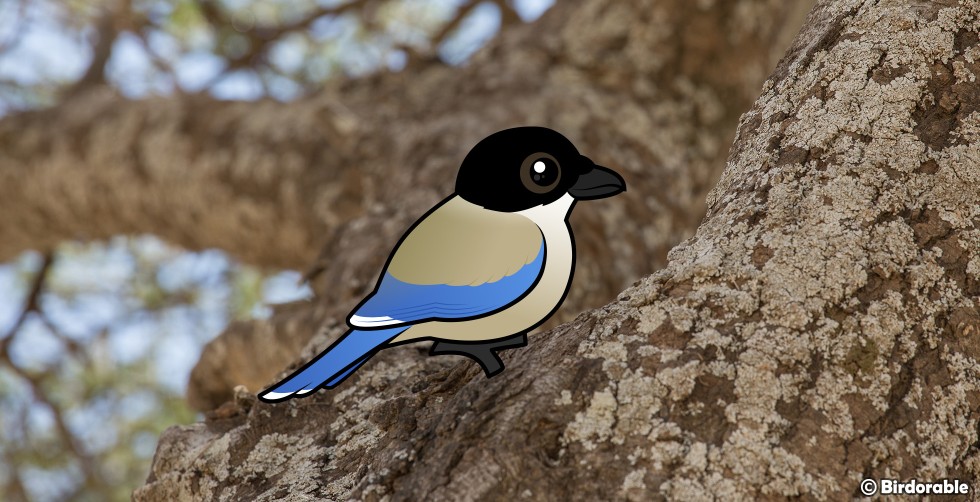
Birdorable Azure-winged Magpie

The Azure-winged Magpie, a member of the crow family, is an enchanting bird that captures the imagination with its striking coloration and intriguing geographical distribution. With the classic shape reminiscent of a European Magpie but displaying a more slender profile, these birds boast a blend of elegance and mystery that is hard to overlook. The black caps sitting atop their heads contrast beautifully with the vivid azure blue of their feathers, creating a visual spectacle that is both striking and serene.

One of the most fascinating aspects of the Azure-winged Magpie is its highly unusual distribution. In Europe, this bird finds its home exclusively in the southwestern part of the Iberian Peninsula, a notably small area when considering the bird's overall global presence. However, what truly piques curiosity is the existence of another population of Azure-winged Magpies living more than 5,000 miles away in eastern Asia, spanning across China, Korea, Japan, and Mongolia. The vast distance separating these two populations presents a biological and historical puzzle that has intrigued scientists and bird enthusiasts alike.

The mystery of their separated populations has sparked various theories over the years. One possibility is that their range was once continuous, stretching from Europe to Asia, but was fragmented, perhaps by climatic changes such as an Ice Age. Another theory suggests human intervention, proposing that early explorers might have transported the birds from the Far East to Spain and Portugal. However, recent genetic analyses have provided fascinating insights, indicating that both populations indeed share a common ancient ancestor but were separated well before the age of European exploration in the Far East. This revelation adds a layer of deep historical mystery to the narrative of these birds, suggesting a separation that occurred thousands of years ago, for reasons still not entirely understood.

Photo of Azure-winged Magpie in Portugal

Azure-winged Magpie in Setúbal, Portugal by Luiz Lapa (CC BY 2.0 DEED)

Cute Azure-winged Magpie Gifts

Comments

Tough Titmouse on May 24, 2012 at 5:42 PM wrote:
Wow, I didn't know.... Ad, well WOW! ;D
Tough Titmouse on May 24, 2012 at 5:42 PM wrote:
I meant "and, well, WOW!"
Harpy Eagle on July 4, 2017 at 10:17 PM wrote:
We see lots of Azure- winged magpies here in Beijing, they're really pretty.

Leave a comment

Comments with links or HTML will be deleted. Your comment will be published pending approval.
Your email address will not be published
You can unsubscribe from these communications at any time. For more information on how to unsubscribe, our privacy practices, and how we are committed to protecting and respecting your privacy, please review our Privacy Policy. By clicking submit below, you consent to allow Birdorable to store and process the personal information submitted above to provide you the content requested.

Tiny and Colorful: The White-browed Tit-Warbler

Today's new bird is a colorful little songbird native to parts of Asia: it's our Birdorable White-browed Tit-Warbler! The White-browed Tit-Warbler is one of nature's tiny, colorful wonders. Native to the high-altitude regions of Central Asia, including the Himalayas, this little bird is a favorite among birdwatchers...

Keeping Cool: How Birds Handle Hot Weather

When temperatures rise, birds have to work hard to keep cool. Unlike humans, birds don't sweat. So how do they survive the summer heat? Birds have evolved several clever ways to regulate their body temperature and stay safe when the sun is blazing. One of...

Swallow-tailed Kites and their Acrobatic Flying Skills

It is a sure sign of spring, here in Florida, when the iconic outline of Swallow-tailed Kites can be seen overhead once again. These graceful black-and-white birds, with their deeply forked tails, breed near the coast from Texas to...

Meet the European Crested Tit: A Distinctive and Charming Songbird

Today, as part of our Birdorable Bonanza 2013, we are excited to introduce a delightful small European species to our collection. Our third Bonanza bird, known for its distinctive appearance, is the Crested Tit. The Crested Tit, a member of the tit...