A Closer Look at the Black Woodpecker: The Forest's Master Carpenter

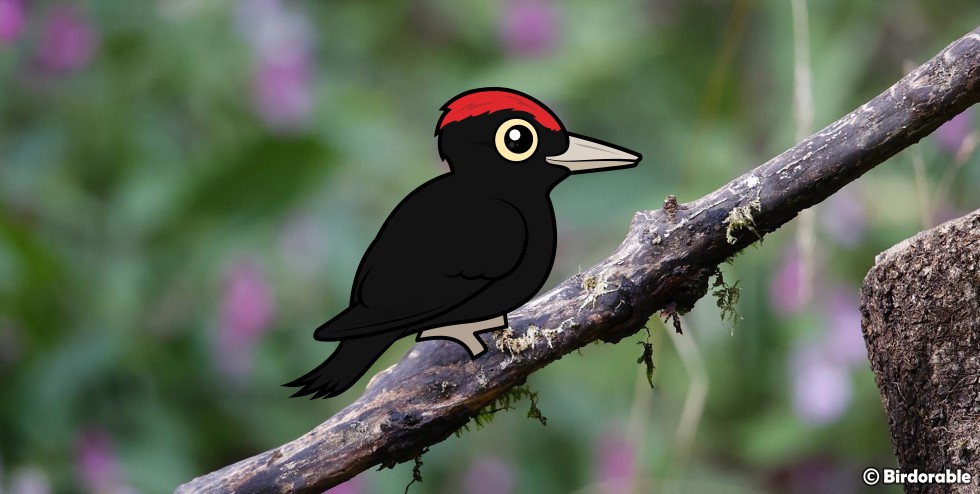
Birdorable Black Woodpecker

If you've ever wandered through the dense forests of Eurasia, you might have been lucky enough to hear the deep, resonant drumming of the Black Woodpecker. This striking bird, cloaked in jet-black feathers with a bold red crown, is a sight to behold. Standing as the largest of the Old World woodpeckers, the Dryocopus martius carves out a niche in both the literal and ecological sense, playing a vital role in its habitat.

The Black Woodpecker, with its glossy black plumage, is not just a feast for the eyes but also a marvel of bird engineering. Its beak, a natural chisel, is designed to bore into the hardest of woods, creating intricate nests and searching for its favorite meal: wood-boring insects. These birds are master carpenters of the avian world, and their ability to excavate large cavities in trees not only provides them with nesting sites but also benefits other species that use these spaces for their homes.

Living primarily in mature forests across Europe and Asia, these woodpeckers have adapted perfectly to life in the woods. Their preference for old-growth forests, with plenty of dead or decaying trees, showcases the importance of preserving natural woodlands. These habitats are crucial not only for the Black Woodpecker but also for maintaining biodiversity and ecosystem health.

Despite their somewhat ominous appearance, Black Woodpeckers are shy and elusive. Spotting one requires patience and a bit of luck. Early morning is often the best time to catch a glimpse of these birds as they go about their daily routines of foraging and nest-building. Their distinctive call, a loud and clear "klee-yee," can echo through the forest, serving as a beacon for birdwatchers.
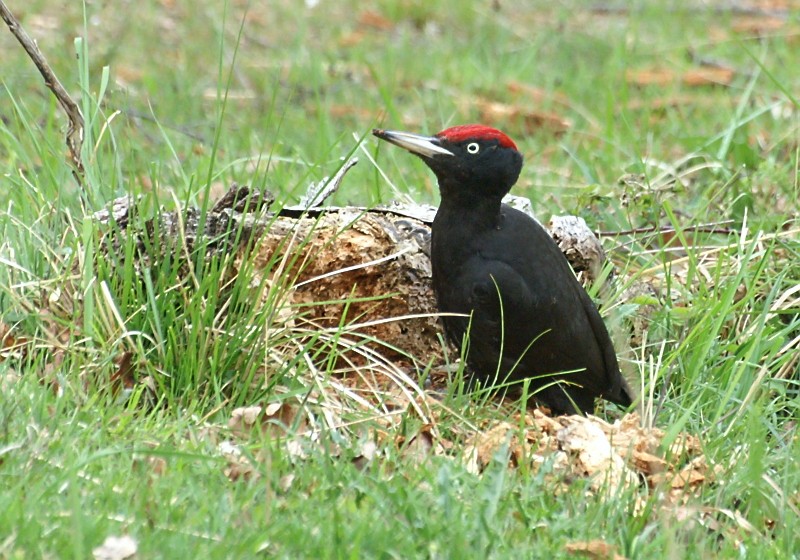
Black Woodpecker by Stefan Berndtsson (CC BY 2.0 DEED)

The breeding season brings out another interesting aspect of Black Woodpecker behavior. They are monogamous birds that put a lot of effort into their nesting sites, which they return to year after year, continuously improving and expanding them. The male takes the lead in nest excavation, which can take up to two weeks—a testament to their dedication and work ethic.

Conservation efforts for the Black Woodpecker have been relatively successful, with the species maintaining a stable population in most of its range. However, they are not without threats; habitat loss due to deforestation and the removal of dead trees, which are often seen as unsightly or dangerous, can have detrimental effects on their population. Thus, conservationists emphasize the importance of preserving old-growth forests and standing deadwood, vital components of the Black Woodpecker's habitat.

The Black Woodpecker's role in the ecosystem extends beyond just being a magnificent bird to observe. By creating nesting cavities, they provide habitats for a variety of other species, including bats, owls, and other small mammals and birds that cannot excavate their own nesting sites. This makes them a keystone species, underlining the interconnectedness of forest ecosystems and the importance of each species within it.

For those passionate about birds, the Black Woodpecker represents the mystery and allure of the forest. Its presence is a reminder of the wild, untamed beauty of nature and the need to protect and preserve our natural habitats. Whether you're a birdwatcher, a conservationist, or simply someone who appreciates the wonder of nature, the Black Woodpecker is a bird that captivates the imagination and inspires a deeper appreciation for the natural world.

Cute Black Woodpecker Gifts

2010 Bonanza Bird #2

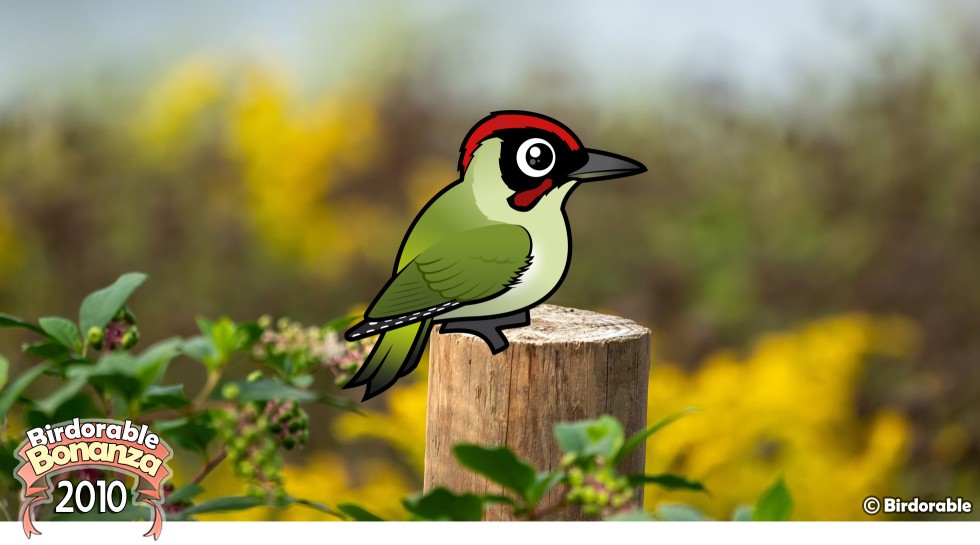
Meet the Avian Anteater: The Birdorable Green Woodpecker

Birdorable Eurasian Green Woodpecker

Meet the Green Woodpecker, the avian equivalent of an anteater, and the second star of our Birdorable Bonanza 2010. This vibrant bird, with its striking green plumage, offers a fascinating glimpse into the adaptability and ecological niche that birds can occupy.

Green Woodpeckers are a spectacle of nature, primarily found frolicking across the landscapes of Europe and parts of western Asia. Their presence is notably significant in countries like France, Spain, and Germany, where they contribute to over half of their global population. What sets these birds apart is not just their vivid coloration but their unusual feeding habits.

Unlike their wood-boring cousins, Green Woodpeckers have carved out a niche that involves foraging for their food on the ground. Their diet is remarkably specialized, focusing almost exclusively on ants. This peculiar choice of sustenance has earned them the nickname "avian anteaters." They use their long, sticky tongues to probe into ant colonies, extracting their prey with precision. This diet is not only a testament to their adaptability but also highlights the intricate relationships within ecosystems, where every species plays a role in maintaining the balance.

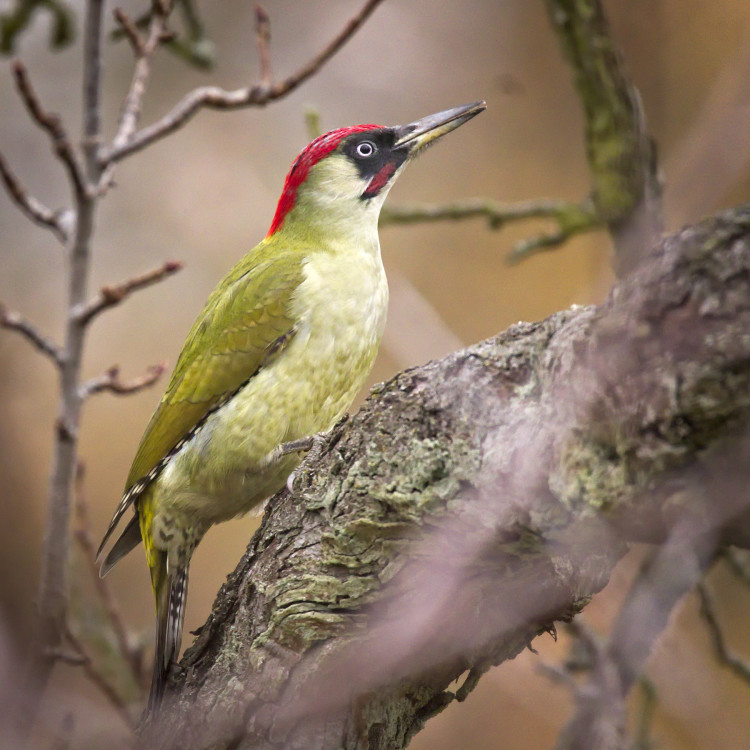
Male Green Woodpecker photo

Male Green Woodpecker by hedera.baltica (CC BY-SA 2.0 DEED)

The Green Woodpecker's approach to life is a departure from the typical woodpecker behavior. Most woodpeckers are known for their characteristic pecking on tree trunks, a behavior that serves multiple purposes, including foraging for insects, creating nesting sites, and communicating with other woodpeckers. However, the Green Woodpecker spends a significant amount of its time on the ground, its bright green plumage blending seamlessly with the grass, as it hunts for ants.

Observing a Green Woodpecker in its natural habitat is a treat for birdwatchers. Their vibrant plumage, combined with their distinctive laughing call, adds a layer of charm to the forests and woodlands they inhabit. The sight of a Green Woodpecker diligently foraging on the ground, undeterred by the presence of onlookers, is a reminder of the diversity and adaptability of bird life.

Tomorrow, we turn our attention to a beautiful little yellow bird that breeds in cavities in North America. Can you guess what it will be?

Cute Green Woodpecker Gifts

Geeking out with Penn Jillette

Today friend-of-Birdorable Sharon - Birdchick herself - posted a neat celebrity birding video on her blog. In the clip, she talks with Penn Jillette (of Penn and Teller) about the birds in his Las Vegas back yard, including a Black-chinned Hummingbird. It's a fun interview and includes some tips on using binoculars with glasses and on identifying your local Columbiformes. Sharon's wearing a Pecker Checker shirt from Birdorable in the interview, which means we join her in geeking out - Penn Jillette saw one of our shirts, OMG!

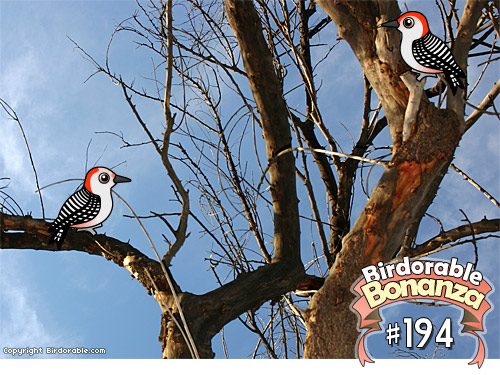
Birdorable 194: Red-bellied Woodpecker

Cute Birdorable Red-bellied Woodpecker

Just six more birds in the Birdorable Bonanza until we reach our 200th Birdorable. We hope you like all the new birds so far. Today's species is one of our favorite local birds, the Red-bellied Woodpecker. This cute woodpecker lives in the eastern part of North America. They are named for a reddish tint found on the lower belly.

Until the 31st of July we'll be adding a new bird every day as part of our Birdorable Bonanza until we reach the 200th at the end of this month. Here's a preview of tomorrow's bird:

Preview of Birdorable 195

Save the Red-cockaded Woodpecker

The Red-cockaded Woodpecker is a beautiful bird, with its black and white striped back, black cap and nape and large white cheek patches. Unfortunately, it is an endangered species and the 5,000 groups of RCWs still left, or 12,500 birds from Florida to Virginia and west to southeast Oklahoma and eastern Texas, represent only about 1% of the woodpecker's original population. Check out our new Save the Red-cockaded Woodpecker t-shirt design:

Save the Red-cockaded Woodpecker T-Shirts by Birdorable

Do you believe in the Birdorable Ivory-billed Woodpecker?

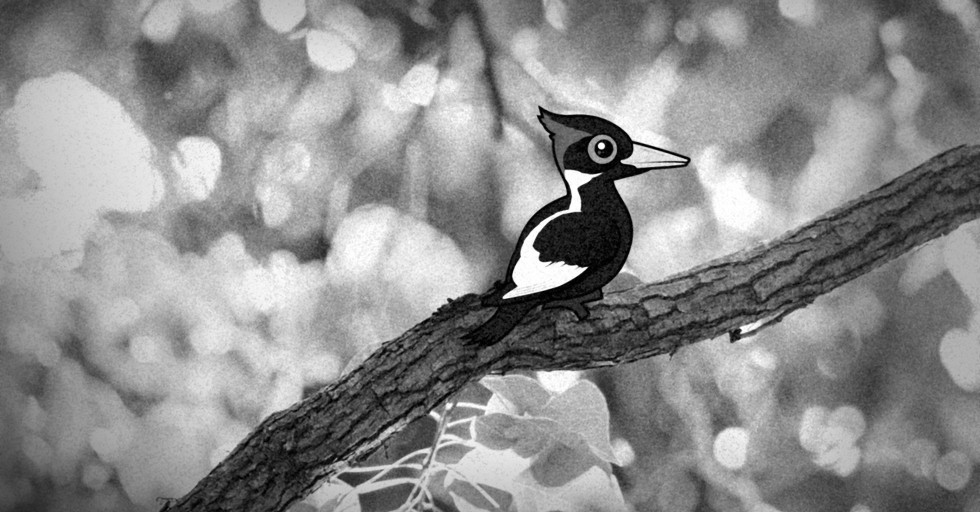
Old photo of Birdorable Ivory-billed Woodpecker

Rare photo of a Birdorable Ivory-billed Woodpecker

The Ivory-billed Woodpecker is one of the largest woodpecker species in the world. The bird is shiny blue-black with extensive white markings on its neck and on both the upper and lower trailing edges of its wings. It has a pure white bill and displays a prominent top crest, red in the male and black in the female.

That is what most people agree on, but what they don't agree on is if it's either extremely rare or extinct! There is no solid proof of recent sightings of the birds, but some people do claim they have seen it in the woods of the Southeastern United States.

Heavy logging activity and hunting by collectors decimated the population of Ivory-billed Woodpeckers in the late 1800s. It was generally considered extinct in the 1920s, when a pair turned up in Florida, only to be shot for specimens. By 1938, an estimated 20 individuals remained in the wild, some 6-8 of which were located in the old-growth forest called the Singer Tract in Louisiana.

By 1944 the last known Ivory-billed Woodpecker, a female, was gone from the cut-over tract. Reports of at least one male bird in Arkansas in 2004 and 2005 were reported in April 2005 by a team led by the Cornell Laboratory of Ornithology. But no real evidence exist of the sighting, making many believe that the bird is extinct. The Ivory-billed Woodpecker is the miracle bird of the century - or is it?

Cute Ivory-billed Woodpecker Gifts