Cute Big Cranky

Great Blue Heron

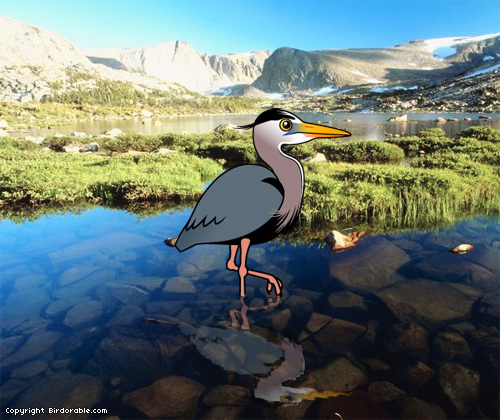
The Great Blue Heron is our 227th cute Birdorable and the answer to yesterday's Spot the Birdorable. If you live in North America you've probably seen these around near water as they are quite common. It has several nicknames, including Big Cranky, Blue Crane, Long John and Poor Joe. Did you know that all Herons have two or more patches of powder-down feathers on their breasts? The feathers break up into a fine power when crushed. The birds apply this powder to areas of blood, mud or slime to absorb the mess. Once it has clumped up they can just scrape it off with their feet. They also sprinkle the powder on fish that they just caught to more easily clean off the slime and oil before eating it.
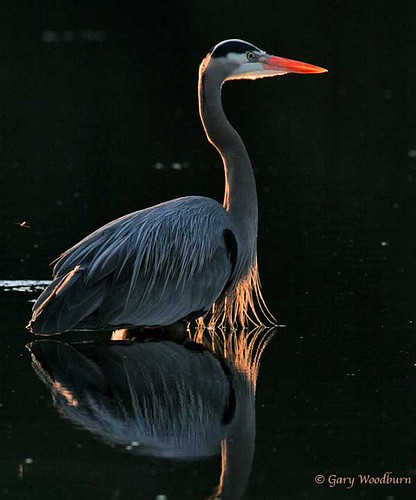
Twilight
Photo by Gary Woodburn (via Flickr)

If you like this bird see our other egrets and waders. We've also added the grey equivalent of this bird: the Grey Heron, which can be found across temperate Europe, Asia and parts of Africa.
Comments

Canaduck on January 29, 2010 at 9:37 PM wrote:
That is SO cute. I've never heard GBH's being called "Big Cranky" before, but the name fits, to be sure!
Kim B. on June 9, 2011 at 2:32 PM wrote:
I love GBH. Which reminds me that I need to go over the the heronry/rookery and check out the babies.
molly on October 1, 2011 at 1:49 AM wrote:
awwwwwwwww its soooo cute
Spurwing Plover on April 12, 2020 at 5:02 AM wrote:
I have seen Great Blue Herons my Grandma called them Icabods
Reed on May 14, 2020 at 1:10 PM wrote:
I see alot of GBHS at falls lake which is the lake near my house

Leave a comment

Comments with links or HTML will be deleted. Your comment will be published pending approval.
Your email address will not be published
You can unsubscribe from these communications at any time. For more information on how to unsubscribe, our privacy practices, and how we are committed to protecting and respecting your privacy, please review our Privacy Policy. By clicking submit below, you consent to allow Birdorable to store and process the personal information submitted above to provide you the content requested.

Bare-Faced Beauty: The Unique Appearance of Australian Brushturkeys

Happy Thanksgiving! Today's new species isn't related to today's most famous bird, but the name is similar -- welcome the Australian Brushturkey to Birdorable!Australian Brushturkeys are large, darkly plumaged birds with bare facial and neck skin. In males, the...

Meet the Magnificent Violet Sabrewing Hummingbird

Our Birdorable Hummingbird Week 2024 continues today with a new species added to our flock: it's the Violet Sabrewing! The Violet Sabrewing is one of the largest and most stunning hummingbirds in the Americas. This vibrant bird is a spectacle with its iridescent plumage and dynamic behavior. Found...

Winged Harbingers: The Annual Return of the Swallows to Capistrano

Every spring, a small but mighty signal marks the transition from winter to spring in San Juan Capistrano, California. We're not looking for a blooming flower, or feeling for a warm breeze -- we're awaiting the celebrated return of the swallows to Mission San Juan Capistrano. This...

Crane Week Bird Term: Precocial

We're celebrating cranes on the Birdorable blog this week! Today we'd like to share a bird term that relates to cranes and other birds. Let's learn about what it means to be precocial! The term precocial comes from the Latin praecocia, which...