2013 Bonanza Bird #26: European Bee-eater

There are just a few more days to go in our Bonanza! On Wednesday we will reveal our 500th bird, but today we introduce #26 in the Bonanza and #495 overall - the European Bee-eater.
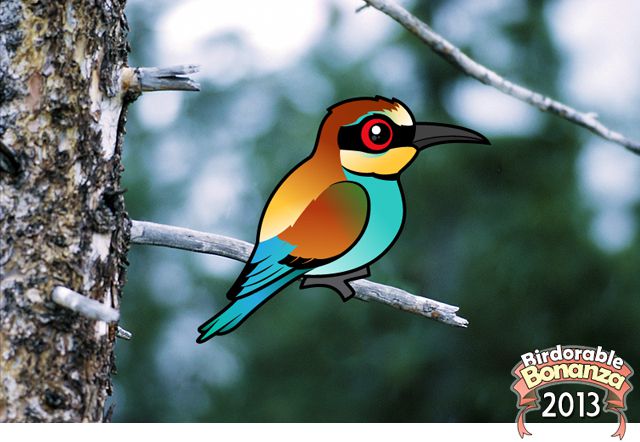
Birdorable European Bee-eater

The European Bee-eater is an extremely colorful species of bird that breeds across much of Europe. These striking feathered jewels are migratory and most spend the winter across the southern half of Africa. There are 26 species of bee-eater in the world. This family is appropriately named - they are known to eat a lot of bees!
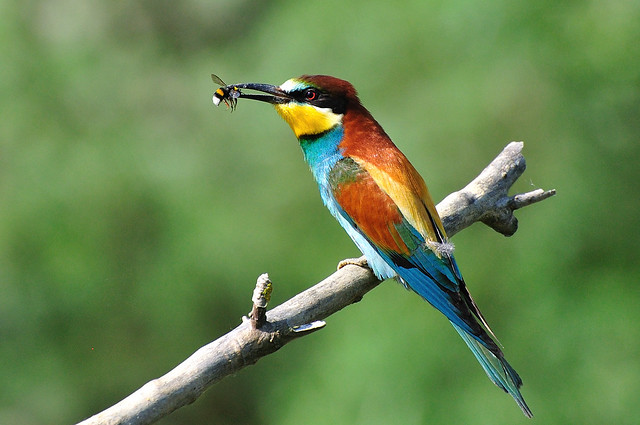
Guêpiers d'Europe
European Bee-eater by Sandra (CC BY 2.0)

Bees have stingers and venom, so how do bee-eaters safely consume them? After a bee (or wasp or other stinging insect) is captured, the bird beats the insect on a hard surface. This act both removes the stinger and extracts most of the venom. Once this is complete, the insect is consumed. European Bee-eaters eat other insect too, but only flying ones. Prey is always captured on the wing -- perched insects are simply ignored!

european bee eater

Tomorrow's new species is a bird of prey from Africa that, like today's bee-eater, is named in part for what it likes to eat.

bonanza-2013-preview-26

Comments

Gustavo Carvalho on July 26, 2013 at 9:40 PM wrote:
African Fish Eagle?
ILOVEBIRDS! on August 5, 2013 at 5:34 AM wrote:
So colorful :)
Jays and Kestrels on September 10, 2013 at 7:39 PM wrote:
yeah I wish i had them where i live XD
Louise Warner on February 7, 2017 at 4:06 PM wrote:
african fish eagle?becasuse of Its shape?the birds eat mainly fish but will also eat the occasional baby flamingo.thay are so powerful.with a wingspn of 8 feet.
Harpy Eagle on July 4, 2017 at 10:46 PM wrote:
Fish eagle or snail kite.
Spurwing Plover on April 21, 2020 at 5:07 AM wrote:
SQUAWK SQUAWK KRRAAAAWWWW SKTREEET SKREEEEE
Spurwing Plover on July 7, 2021 at 2:50 AM wrote:
Bee Eaters with rub the bee against a branch to get rid of the venom they play it smart they also smack the bee on a branch to stun it before they eat
Pesquet's Parrot is a Vampire on December 18, 2024 at 6:57 PM wrote:
What if the Bee-eater uses a tube to eat alot of bees? 🐝🐝🐝
Spurwing Plover on September 30, 2025 at 6:53 PM wrote:
European Bee Eaters only eat European Bees

Leave a comment

Comments with links or HTML will be deleted. Your comment will be published pending approval.
Your email address will not be published
You can unsubscribe from these communications at any time. For more information on how to unsubscribe, our privacy practices, and how we are committed to protecting and respecting your privacy, please review our Privacy Policy. By clicking submit below, you consent to allow Birdorable to store and process the personal information submitted above to provide you the content requested.

Birds' Use of Ants in Self-Care: A Fascinating Behavioral Adaptation

Anting 🐜 is a behavior exhibited by some birds in which they allow ants 🐜 to crawl on their feathers and skin, or they actively apply ants, other insects, or substances ants secrete, to their feathers. They do this as part of their preening, or self-care, routine. Anting is...

How Conservation Efforts Saved the Black-capped Vireo from Extinction

The Black-capped Vireo, a small, striking species of songbird that once teetered on the brink of extinction, serves as a symbol of hope in the world of conservation. Its road to recovery showcases the power of targeted conservation efforts. In learning about the Black-capped Vireo, we can...

Introduction to Vulture Week 2024

This coming Saturday, September 7th, marks International Vulture Awareness Day (IVAD). This commemorative day, always the first Saturday in September, has been celebrated since at least 2009. IVAD aims to highlight the importance of vultures and vulture conservation through education. We'd like to focus on vultures and condors...

The Blue-fronted Parrot: Nature's Skilled Mimic

When we think of parrots, one thing that often comes to mind is their incredible ability to mimic human speech. Among the avian masters of mimicry, the Blue-fronted Parrot, also known as the Blue-fronted Amazon, stands out with its vibrant personality, striking appearance, and, most notably, its remarkable vocal talents.