Birdorable Bonanza 2025 Bird #10

The Hadada Ibis: An Iconic Voice of Africa
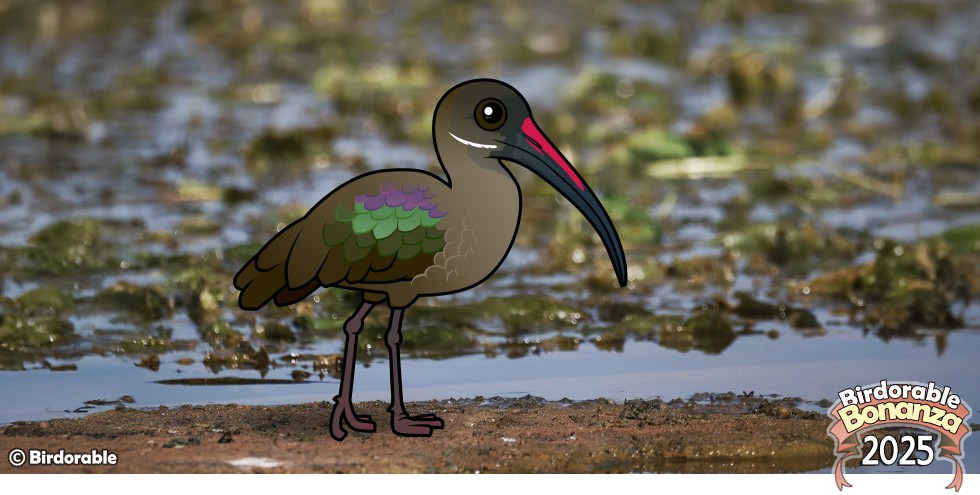
Birdorable Hadada Ibis

Today our 2025 Birdorable Bonanza comes to a close with the introduction of our 840th species: the Hadada Ibis!

The Hadada Ibis is a large, loud bird found across much of Sub-Saharan Africa. It’s instantly recognizable not only by its size, shape, and slightly curved bill, but also by its unmistakable call, for which it is named: a harsh "haa-haa-haa-de-dah" sound. These birds are often heard flying overhead or calling from rooftops, especially in the early morning or evening.

Hadada Ibises are primarily greyish-brown with an iridescent green or purple sheen on their wings that shines in the sunlight. They have long, sturdy legs and a heavy, curved bill adapted for probing the soil. They often forage in gardens, parks, wetlands, and even along roadsides. Their favorite foods include insects, earthworms, and other invertebrates, which they find by poking their bills into soft ground.

While their calls can be jarring, especially in suburban areas, Hadada Ibises are well-loved by many for their quirky personalities and adaptability. They've taken to urban environments easily, commonly seen in backyards and on golf courses where lawns make great foraging grounds. Their increasing presence in cities shows how well some wild birds can coexist with humans when given the chance.
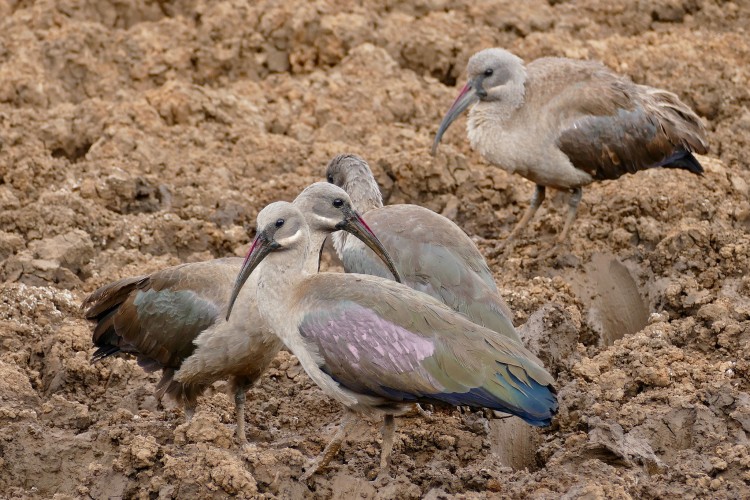
Hadada Ibises by Bernard DUPONT [CC BY-SA 2.0]

In flight, Hadada Ibises display slow, powerful wingbeats and fly with their necks outstretched. They often travel in pairs or small groups and are very vocal while flying. Their noisy habits may not be ideal for light sleepers, but their presence is a reminder of how wildlife can still thrive alongside human activity.

Breeding typically takes place during the rainy season. Hadada Ibises build large stick nests in trees, often close to water. Both parents share duties, including incubating the eggs and feeding the chicks. The young are fed through regurgitation and fledge after about six weeks.

Although not considered threatened, Hadada Ibises benefit from access to open spaces and healthy green areas. Their growing populations in urban areas have even made them unofficial ambassadors of biodiversity in some African cities. While they might be loud neighbors, they're also a fascinating and charismatic part of Africa’s birdlife.

Hadada Ibis Gifts

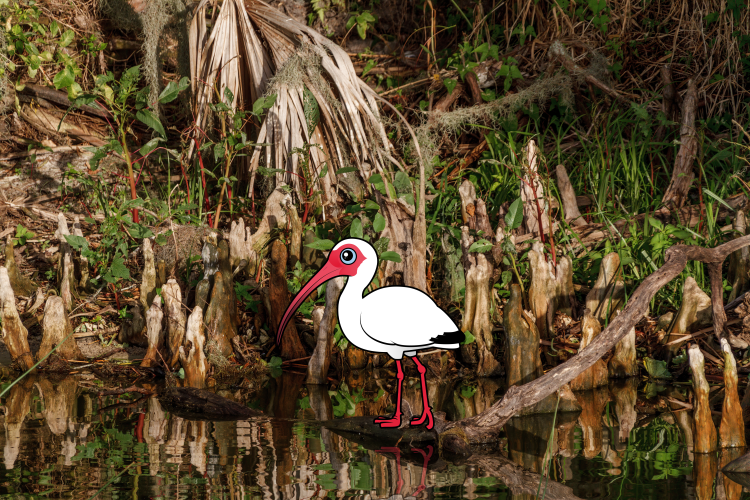
Did you know that the White Ibis is sometimes called the "hurricane bird"? This coastal wader, known for its bright white feathers, pinkish-red bill, and curved posture, has a reputation for behaving in ways that seem to predict the weather. The nickname comes from a mix of science and folklore, especially in hurricane-prone states like Birdorable's home here in Florida.

One of the main reasons White Ibises have earned this nickname is their tendency to change locations before a storm. Observers have long noted that large flocks will move inland from the coast before a hurricane or severe weather hits. It's as if they can sense the shift in atmospheric pressure or other environmental cues, prompting them to seek safer ground. This behavior isn’t just a fluke—many coastal birds have evolved to respond to changing conditions, but the White Ibis seems to do it in especially noticeable numbers.

In southern communities, this behavior has turned into local lore. People say that when they see White Ibises gathering in unusual numbers, flying away from the coast, or changing their feeding habits, it's time to keep an eye on the weather forecast. In this way, White Ibises have become an unofficial early-warning system. While not a replacement for meteorology, they add a natural signal that some folks still trust.

White Ibises in flight by Florida Fish and Wildlife [CC BY-ND 2.0]

Adding to their "storm bird" reputation is the fact that White Ibises are often among the first birds to return to coastal wetlands after a hurricane has passed. Their return can be seen as a small sign of recovery, a symbol of the ecosystem beginning to bounce back. Seeing them wade through flooded marshes or forage in newly settled areas can be a comforting sight to people living in storm-hit regions.

White Ibises are common in southeastern wetlands, often foraging in groups in shallow water. They use their long, curved bills to probe for insects, crustaceans, and small fish. They nest in colonies, often with other wading birds, and their social nature makes their movements more noticeable to birdwatchers and locals alike.

Hurricane season in the southeastern U.S. runs from June through November, so it's the perfect time to watch White Ibis behavior closely. Whether you're a birder keeping field notes or just someone who enjoys spotting birds in your neighborhood, the presence—or sudden absence—of these birds might hint at changes ahead.

At Birdorable, we love sharing fun facts like this with our readers and fans. Our Birdorable White Ibis might not predict a storm, but it's ready to brighten your day no matter the weather!

Birdorable White Ibis Gifts

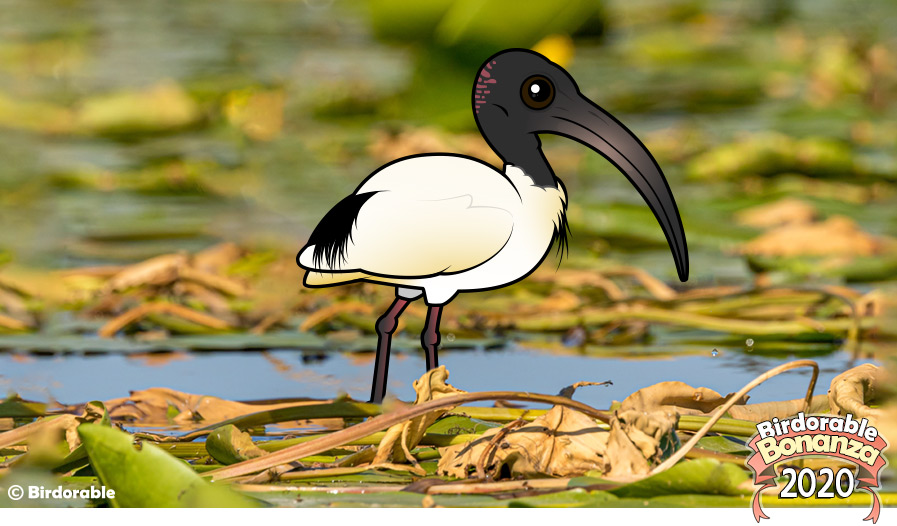
Birdorable Australian White Ibis

Today’s new bird is an Australian wading species, native to the island nation and now widespread across a variety of habitats. Our second bird in the 2020 Birdorable Bonanza is the Australian Ibis!

This species is also known as the Australian White Ibis. Like other ibis species, this bird has a long, down-curved bill. Its white plumage is highlighted by fluffy black feathers over the tail, which are actually secondary wing feathers.

Australian Ibis feed on aquatic prey, like frogs, fish, and mussels. They also eat worms and, having adapted to living in areas near human habitation, will also feed on carrion and even food scraps found in trash.

Australian White Ibis
Australian White Ibis by James Niland (CC BY 2.0)

Tomorrow we will reveal a new species of parrot found in high elevation scrubland in parts of South America, including around Lake Titicaca. Can you guess the bird?

Cute Australian Ibis Gifts

The fourth bird in our 2014 Bonanza is a North American wader with a curved bill.
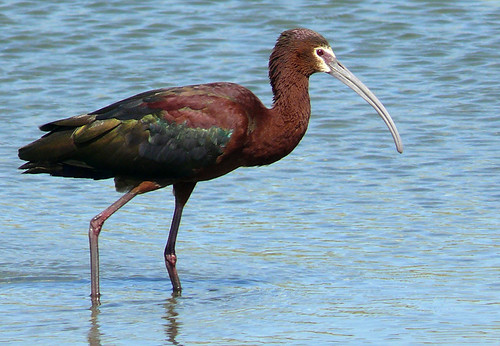
It's the White-faced Ibis!

PicWhiteFacedIbisBlog

The White-faced Ibis is one of three ibis species found regularly in the United States. The White Ibis and Glossy Ibis are both restricted in range to the east and southeast of the U.S., plus northern parts of South America. The White-faced Ibis ranges in the central and western parts of North and Central America, ranging all the way to the Pacific Coast. There is a separate resident population in southeastern South America as well.

White-Faced Ibis  -  Explore #136  5-06-09
White-Faced Ibis - Explore #136 5-06-09 by Linda Tanner (CC BY 2.0)

White-faced Ibises breed and feed around marshy habitats. They forage by probing their curved bills into soft marshy substrate. They eat invertebrates like insects, snails, and worms. White-faced Ibises will also take prey items like frogs, crayfish, and small fish. The White-faced Ibis joins Birdorable today, bringing our total number of bird species to 562. We now have 21 wading birds and a total of six ibises. If you love ibises as much as we do, be sure to check out our cute Birdorable ibis t-shirts & gifts!. Our Bonanza continues tomorrow with a small bird from Down Under named for its dark bib. Can you guess tomorrow's species?

Bonanza2014Preview5

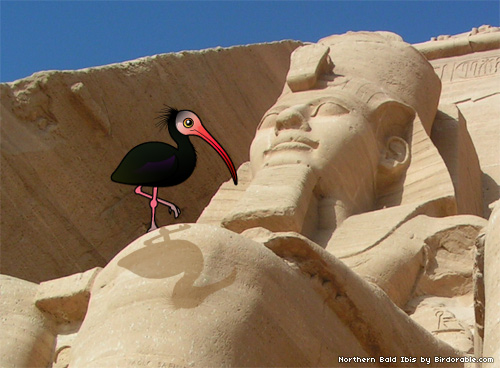
Northern Bald Ibis

Birdorable Northern Bald Ibis

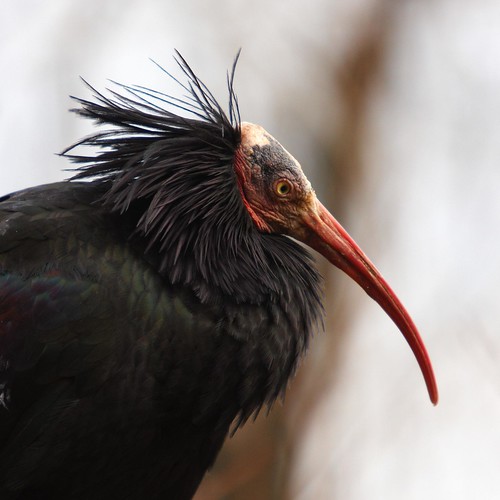
We recently added the Northern Bald Ibis to Birdorable. This bird is a non-wading species of Ibis with a feather-free head. Along with the Southern Bald Ibis, these birds prefer arid landscape over wetlands, and will breed on cliffs rather than in trees. These traits, along with their bald heads, separates these two species of ibis from all others. Unfortunately, the Northern Bald Ibis is a critically endangered species. Originally native to the Middle East, north Africa and south Europe, the species is no longer found in Europe and is declining in its remaining range. A group of 500 wild birds in Morocco make up the bulk of the population today. There are approximately 1100 Northern Bald Ibises living in captivity. The guidelines for conservation and reintroduction of the species were established at an International Advisory Group for Northern Bald Ibis (IAGNBI) conference in 2003. The release of captive birds into the wild has not been successful so far, but several different groups are hard at work on discovering a successful method of release to increase the wild population. Interestingly, the Northern Bald Ibis became one of the world's first protected species by decree of the Archbishop Leonhard of Salzburg in 1504. Despite this status the species still died out in Austria, along with the rest of Europe. And its struggles continue today. If you'd like to learn more about the Northern Bald Ibis and the work being done to save this critically endangered species, visit the IAGNBI website.

Northern Bald Ibis
Northern Bald Ibis by Luke Robinson, on Flickr
Birdorable Sacred Ibis

Today we've added the Sacred Ibis, a bird that lives in sub-Saharan Africa and parts of Europe, where it was introduced. The Sacred Ibis is famous for its role in ancient Egyptian mythology, where it was often mummified as a symbol of the god Thoth, God of wisdom. In art, Thoth was often depicted as a man with the head of an ibis or a baboon. Its name means "He who is like the ibis".

Thoth

The bird may have been sacred in Egypt, but in Europe it is having a negative impact. An increasing population of Sacred Ibises in France and southern Europe are devastating breeding colonies of terns and herons. They also compete successfully for nest sites with Cattle Egrets and Little Egrets. In the late 1970s, just twenty Sacred Ibis were originally imported from Kenya to the Branféré Zoological Gardens in southern Brittany, France. A breeding colony was established and spread to neighboring wetlands. A census in 2005 revealed circa 3,000 of the birds.

Sacred Ibises
SACRED IBIS
Photo by Ruslou (via Flickr)

If you like this bird please check out our other Birdorable ibises.

Birdorable 184: Scarlet Ibis

Cute Birdorable Scarlet Ibis

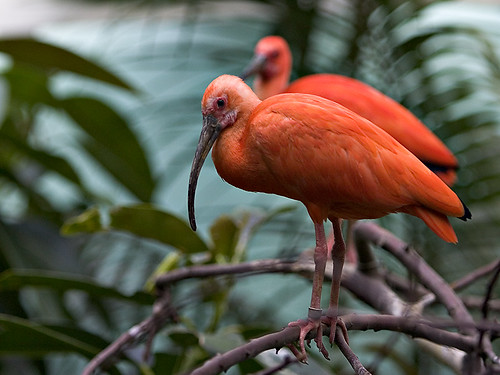
In the next 17 days we'll be introducing a new Birdorable bird every day as part of our Birdorable Bonanza. Today's addition is the Scarlet Ibis, a beautiful bird that lives in tropical South America. It is completely scarlet-colored, except for black wing-tips. It is very closely related to the American White Ibis and sometimes hybridizes with them, producing pink offspring. How cute is that? :)

Scarlet Ibis
Photo by bikeracer (Source: Flickr)

Here's a sneak peek at tomorrow's bird. Until July 31st we'll be adding a new Birdorable bird species every day until we reach the 200th Birdorable at the end of this month.

Preview of Birdorable 185