Red-tailed Hawk: New White House Groundskeeper?

Earlier this week, the White House reported the sighting of a new guest on their famous grounds -- a juvenile Red-tailed Hawk.

Red-tailed Hawks are abundant across the United States, and have adapted well to developed areas. Pale Male, New York City's famous hawk, is an example of the large raptor thriving in an urban environment (he and his mate have three young that are about to fledge from their famous nest).

The appearance of a predator on the White House grounds is a good sign for visiting birders, but not so good for any resident rodents living on the property. Red-tailed Hawks prey upon mice, rats, voles, rabbits, and other mammals, as well as other birds, reptiles, and amphibians. This raptor might just earn a spot as a groundskeeper 1600 Pennsylvania Avenue.

Fun Fact: Did you know that the Red-tailed Hawk makes a raspy call that is almost always used in popular media as the voice of our national bird, the Bald Eagle? How appropriate would it be to hear the majestic cry of the Red-tailed Hawk while visiting the White House?
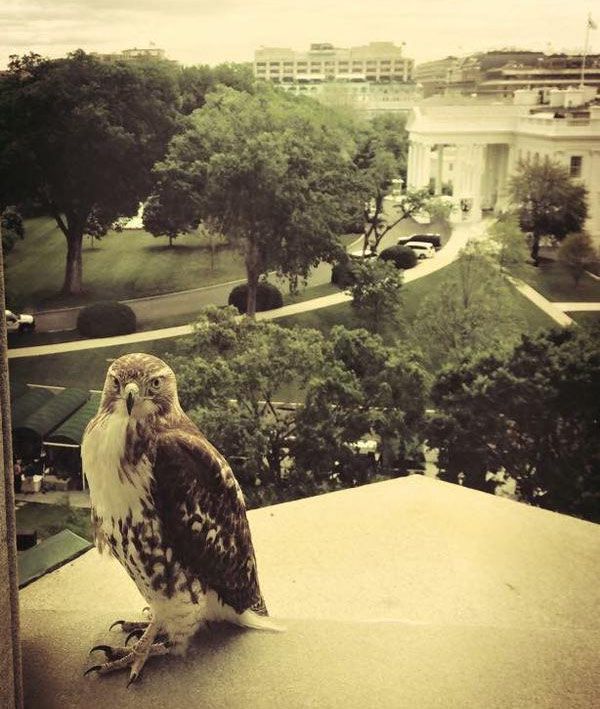

Photo by DJ Patil

Comments

Louise Warner on February 8, 2017 at 5:54 PM wrote:
i'v heard of him! it's a long stroy.
Spurwing Plover on January 26, 2022 at 8:18 AM wrote:
PALE MALE

Leave a comment

Comments with links or HTML will be deleted. Your comment will be published pending approval.
Your email address will not be published
You can unsubscribe from these communications at any time. For more information on how to unsubscribe, our privacy practices, and how we are committed to protecting and respecting your privacy, please review our Privacy Policy. By clicking submit below, you consent to allow Birdorable to store and process the personal information submitted above to provide you the content requested.

Meet the Birdorable Rufous Hornbill: A Philippine Treasure

Today’s new species is one of 10 hornbill species found in the Philippines. The Rufous Hornbill is a Philippine endemic found in forest habitat across 11 of the nations’ islands. It is also known as the Philippine Hornbill. There is little known to science...

Seasonal Ch-Ch-Changes: How Birds Prepare for Winter

As autumn deepens and the days grow shorter, birds undergo remarkable behavioral and physiological changes to prepare for the winter months ahead. From altering their eating habits to changing their sleep patterns, birds respond in a variety of ways to the decreasing daylight. Here’s a look at how...

Flamingo FAQs

We're celebrating flamingos this week! Let's learn about these pink beauties -- here are some frequently asked questions about flamingos. Why do flamingos stand on one leg? The true reason that flamingos often stand one leg has long been debated. One popular theory is that a bird can conserve body...

South Africa's National Bird: The Elegant and Endangered Blue Crane

The Blue Crane, with its enchanting grace and striking presence, holds the esteemed title of the national bird of South Africa. This elegant avian animal (Anthropoides paradiseus) is not just a symbol of the nation's fragile, rich biodiversity, but also an emblem deeply woven into the cultural...