The Burrowing Owl is the second owl that we've added to Birdorable this week. These little cuties are about the size of an American Robin. They like to hang out underground in burrows that were dug out by small mammals like prairie dogs and ground squirrels. Burrowing Owls appear to be diurnal as you can often see them foraging during the day, but they actually hunt all day and night long, although they tend to avoid the mid-day heat. In the United States Burrowing Owls are distributed from the Mississippi west to the Pacific and you can also find them in Florida and the Carribean Islands. They live in dry open areas with low vegetation.


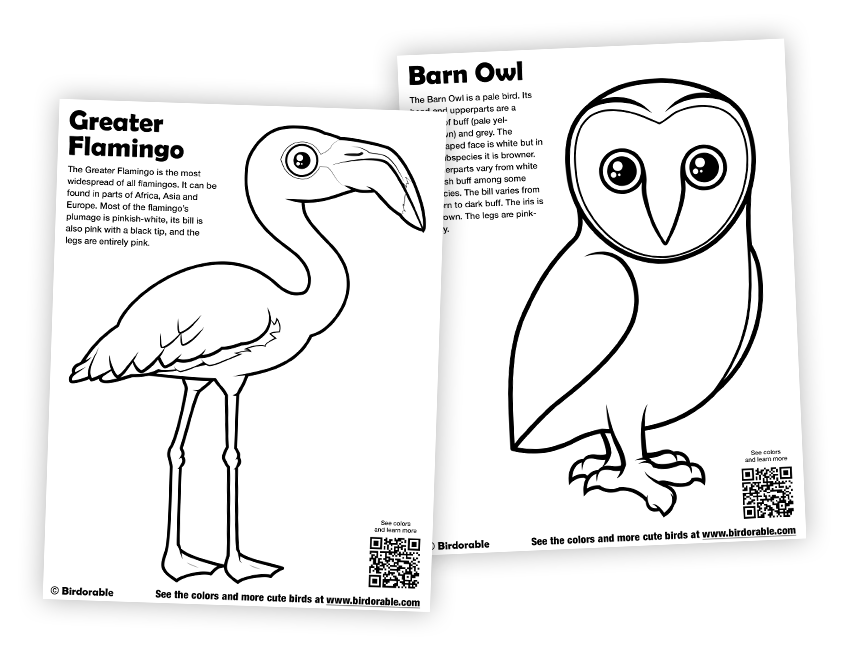
Source: WikipediaThe Barn Owl is one of the most widely distributed birds in the world. You can find it on all continents; almost anywhere except for polar and desert regions. There are about 46 different subspecies of Barn Owl in the world. The North American one is the largest, weighing more than twice as much as the smallest race from the Galapagos Islands. Barn Owls are experts in hunting for small ground mammels, like mice, rats and gophers. And they need to catch a lot of foot! Barn Owls are able to consume twice as much food as other owls in comparison to their weight. A young Barn Owl can eat 25.000 mice a year!


The Barn Owl is our 174th Birdorable bird and the answer to our last Spot the Birdorable. If you like our Birdorable Barn Owl you may also like our other birds of prey.
We've added 7 new organic t-shirts to our Birdorable store today. They are made of 100% organic cotton and they are super comfortable. Organic cotton is cotton grown without the use of chemicals or pesticides, which leads to less environmental damage and health risks. Our Birdorable organic t-shirts are the perfect gear for every birder or bird lover.

One of the latest additions to Birdorable is the Yellow-headed Blackbird. This striking 8.5-inch blackbird is unmistakable with its yellow head and breast. You can find it across North America and especially in freshwater cattail marshes west of the Great Lakes. Each spring, enormous flocks of yellowheads migrate from Mexico and the southern United States northward to their nesting territories in western North America. You'll often see them hanging out with Red-winged Blackbirds, but the yellowheads are larger and dominant over the redwings. Here's a nice picture of both species flocking together:

The Yellow-headed Blackbird is a handsome bird, but it isn't afraid of getting its beautiful plumage dirty. Check out these pictures by Rick Wright in Arizona of yellowheads hanging out with cows in the mud.


This is our cute Birdorable version of the Yellow-headed Blackbird. For more than 170 other Birdorable birds see the Meet the Birds page.

The Common Kingfisher has been crowned Germany's Bird of the Year 2009 by NABU, the German BirdLife organization. NABU has been nominating the 'Bird of the Year' since 1971 to focus people's attention to a particular species and its habitat. The first bird was the Peregrine Falcon, which, thanks to several conservation projects, is no longer on the list of threatened birds in Germany. The Common Kingfisher itself isn't endangered in Germany — there are between 5,600 and 8,000 breeding pairs in Germany — but conservationists are hoping the added attention may results in increased protection for its dwindling habitat, which is rivers. Kingfishers need clear water and natural river banks to nest.


The Blue-footed Booby is a beautiful bird that lives off the western coast of Central and South America. Half of all breeding pairs can be found on the Galápagos Islands, which is one of those places that I would love to visit once in my life. A true birder's paradise! Isn't this an astonishing pair of blue feet?
Blue-footed Boobies are marine birds that only come to land to breed. The name 'booby' comes from the Spanish word bobo, which means stupid fellow. Hey, that's not very nice! They were given this name for the clumsy way they walk around on land. But when they are on land they sure love to dance and show off their blue feet! Check out this great video from National Geographic:
If you like our Birdorable Blue-footed Booby then don't forget to check out our products here. We've also added another Booby this week, the Peruvian Booby.

This is our Birdorable version of the Green-winged Macaw, a large macaw (it is 3 feet / 90 cm in length) that is widespread in forests of Northern South America. Unfortunately, in recent years, there has been a marked decline in its numbers due to habitat loss and illegal capture.

It has an extremely powerful beak which can generate a pressure of 200 psi, enough to snap a broomstick in half. This strong beak is designed to crush or open even the hardest nuts and seeds. It can break these Brazil Nuts with ease:

Our cute Macaw is available on t-shirts and other gifts. If you like this bird don't forget to check out our 45 other parrots and parakeets.
We recently moved into a new home in a village north of Chicago (before this we lived in the Netherlands). One of the first things we did after moving in was set up some bird feeders in our backyard. The area we live in is quite urban and in the first two weeks we didn't see many birds at all, except for some crows and starlings flying by. That changed a week ago when a beautiful male Northern Cardinal was hanging out in the trees behind our fence. He was looking at the feeders, but they were actually not suitable (too small) for a cardinal. We had bought some bigger feeders a couple of days earlier but the ground was too hard to put them in. Shortly after that I saw some Dark-eyed Juncos (slate-colored) flying around, but again they weren't landing on the feeders. Then a little bit later we suddenly saw an American Goldfinch chowing down on seeds. Yah, that was our very first backyard bird here in our new home. :)

In the past week a lot of juncos have been coming and going. They are so cute, hopping around the ground looking for seeds. Unlike many other birds, the juncos prefer to eat on the ground. They don't care about all the fancy feeder equipment we bought and prefer to hop around below them. At the beginning they were very hesitant to go anywhere near our feeders and a few always kept watch from the trees as one was eating, but now the juncos are getting more comfortable and they are staying around for a while.

Today we had a new visitor to our yard, a Black-capped Chickadee. Two, actually! I know it's no big deal to get these juncos, goldfinches and chickadees in your backyard, but we're quite excited to finally have some after not seeing any for a couple of weeks. We're hoping that these guys will tell all their friends and we'll soon have lots of birds at our feeders. Which birds do you get in your backyard?