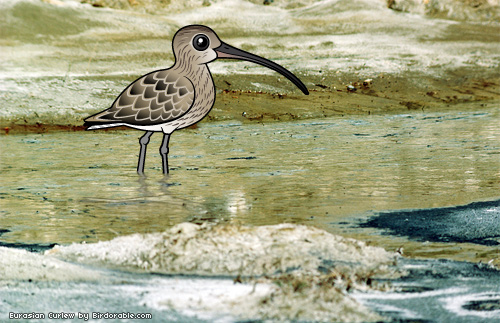
10 Facts about the Eurasian Curlew

Birdorable Eurasian Curlew

Here are ten facts about the Eurasian Curlew:

  • The Eurasian Curlew is the largest wading bird found in Europe;
  • In Scotland it is known as the "Whaup";
  • The birds can be found from central and southern Europe and Asia to parts of Africa;
  • Curlews are migratory, but are present all year in the milder climate of the British Isles and the adjacent European coasts;
  • Within its range the Curlew is most similar to the Whimbrel, but the latter is smaller and has a shorter bill that is less smoothly curved;
  • They eat mostly worms, crabs and invertebrates, which they find by touch using their long curved bill to probe soft mud;
  • Its name is derived from its 'curloo-oo' call;
  • The female is larger and has a longer bill than the male, but the different is not always distinct;
  • A group of curlews is called a "curfew", "salon", or "skein" of curlews;
  • The species is threatened due to loss and fragmentation of moorland and grassland habitats.

The Eurasian Curlew is the 360th bird species on Birdorable. Check out our Curlew t-shirts and gifts and other Birdorable Plovers & Shorebirds.

Birdorable Eurasian Curlew sample products

Comments

Emma on April 29, 2019 at 3:03 AM wrote:
I think that The Curlew is an awesome animal and I am so sad and angry that they are endangered!!! #somad
Emma on April 29, 2019 at 3:05 AM wrote:
Where do they live?
Hollie on November 2, 2020 at 11:48 AM wrote:
Curlews look so cool!!!!
Hayley on November 2, 2020 at 11:50 AM wrote:
Are they herbivores or omnivores?
Layla on November 2, 2020 at 11:56 AM wrote:
Hi
nigga on November 10, 2020 at 3:58 PM wrote:
nibb
Spurwing Plover on December 10, 2021 at 11:55 PM wrote:
And they can migrate and cover a long area from their Nesting Grounds to their Wintering Grounds
Spurwing Plover on June 17, 2022 at 7:32 AM wrote:
Eskimo Curlew
Spurwing Plover on June 4, 2025 at 5:35 PM wrote:
Some man walked 53 Miles across England in their own Curlew Outfit

Leave a comment

Comments with links or HTML will be deleted. Your comment will be published pending approval.
Your email address will not be published
You can unsubscribe from these communications at any time. For more information on how to unsubscribe, our privacy practices, and how we are committed to protecting and respecting your privacy, please review our Privacy Policy. By clicking submit below, you consent to allow Birdorable to store and process the personal information submitted above to provide you the content requested.

Bird Term: Sexual Dimorphism

Sexual dimorphism refers to observable differences between males and females of the same species. In basic terms, it means that a male of a species is easily distinguished from a female. In birds this usually means differences in size or in...

Red-billed Streamertail: Jamaica’s Dazzling Doctor Bird

For this Hummingbird Week, we're introducing a fabulous new species of hummingbird to the Birdorable family: the Red-billed Streamertail! The Red-billed Streamertail is one of the most dazzling and delightful birds you can find in Jamaica. This bird is not only a sight to behold but also holds...

Birdorable Adelaide’s Warbler Joins the Flock for Puerto Rico Week

We’re excited to introduce a brand-new Birdorable for Puerto Rico Week—meet the Birdorable Adelaide’s Warbler! This small, bright yellow warbler is one of Puerto Rico’s 18 endemic bird species, meaning it’s found only on the island. With its soft gray back, white eye-ring, and...

Swallow Family Glossary: Terms to Help Understanding Swallows

As our week-long celebration of Swallows continues here on the Birdorable blog, we're sharing a glossary of terms related to the family Hirundinidae. Understanding these related terms will help with your understanding of the unique birds in this fascinating cosmopolitan family of insect-feeding birds.