2015 Bonanza Bird #19: Helmeted Curassow

Our Birdorable Bonanza: 2015 Advent Edition rolls on today with an unusual species of grouse from South America: the Helmeted Curassow!
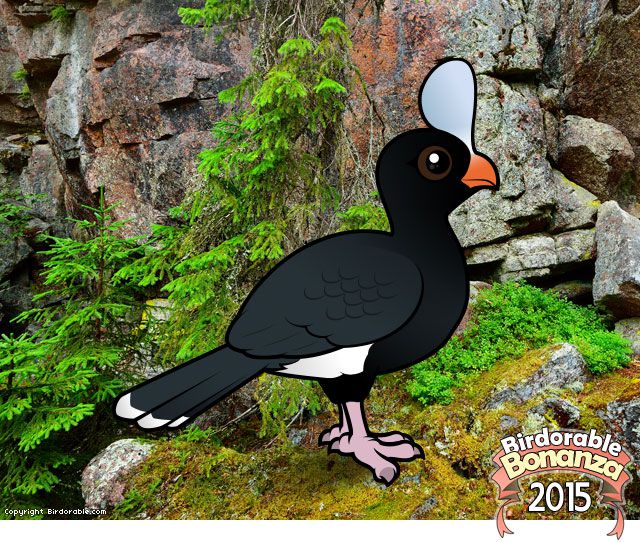
Birdorable Helmeted Curassow

Helmeted Curassows are large grouse found in the Venezuelan and Colombian Andes Mountains. They can be found in subtropical cloud forest habitat. Their diet primarily consists of seeds and fruits. They will also feed insects and small animals.

The Helmeted Curassow is recognized by the large blue-grey casque, or "helmet", on its forehead. This unsual feature gives the species its name. Both males and females have the casque and look alike. A rare color morph can be found in some females where the plumage is rufous with barring.

Helmeted Curassows are considered to be Endangered by the IUCN. Their current range is heavily segmented along the eastern Andes mountains in Venezuela and Colombia and the species faces major threats from habitat loss and hunting.

Northern Helmeted Curassow
Photo by Jason Wesley Upton (CC BY-ND 2.0)
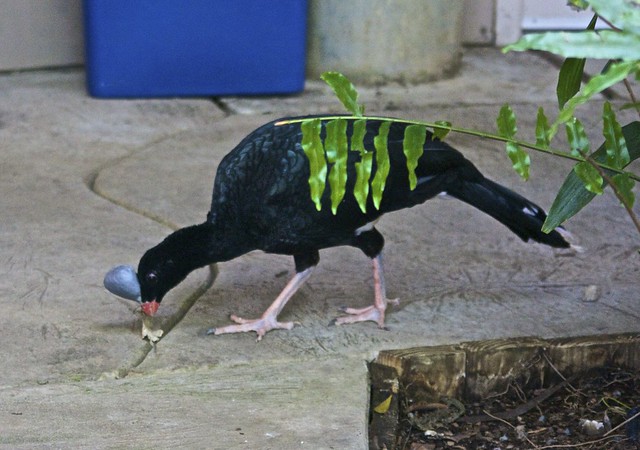
Helmeted Curassow
Helmeted Curassow by Jean (CC BY 2.0)

The Helmeted Curassow joins Birdorable today as our 635th cute cartoon bird. Be sure to check out our selection of apparel and gifts featuring our Birdorable Helmeted Curassow.

Tomorrow our Bonanza will reveal a spotted species of sparrow. Can you guess tomorrow's species?

Comments

???c????? ????? (White-throated Sparrow) on December 19, 2015 at 8:03 PM wrote:
Nice... Maybe a... Harris' Sparrow?
???c????? ????? (White-throated Sparrow) on December 20, 2015 at 9:49 AM wrote:
Oh wait... Nvm. The bird of the day (Eastern Towhee) made me think it's gonna be Spotted Towhee... I remember suggesting that bird...
Birdorable (Arthur) on December 20, 2015 at 11:10 AM wrote:
Very good @Ζ²ΟƒΖ–cαяσηα ...you're right once again: http://www.birdorable.com/blog/2015-bonanza-bird-20-spotted-towhee/
Heather Richards on October 7, 2016 at 8:34 PM wrote:
Nice wig!
yotaDcool on October 28, 2016 at 9:47 AM wrote:
its from INDONESIA
Heather Richards on May 5, 2018 at 9:54 PM wrote:
Its blue β€œhelmet” looks like a cool hairdo πŸ’β€β™€οΈπŸ˜Ž
Spurwing Plover on May 26, 2022 at 7:18 AM wrote:
Not afraid of coming out in the open

Leave a comment

Comments with links or HTML will be deleted. Your comment will be published pending approval.
Your email address will not be published
You can unsubscribe from these communications at any time. For more information on how to unsubscribe, our privacy practices, and how we are committed to protecting and respecting your privacy, please review our Privacy Policy. By clicking submit below, you consent to allow Birdorable to store and process the personal information submitted above to provide you the content requested.

Bird Terms: Wattles, Dewlaps, and Snoods, Oh My!

Some birds have fleshy growths hanging or protruding from the head or the neck. When these are a normal part of their anatomy, they are called caruncles. Caruncles are often made of bare skin, though some may have a sparse covering...

Share the Love: Celebrate Valentine's Day with Birdorable Shareable Graphics

This Valentine's Day, Birdorable is here to help you tell that special someone just how much they mean to you with our collection of bird-themed Valentine's graphics. Perfect for sharing on Facebook, Twitter, Instagram, and other platforms, these charming e-cards are sure to delight bird watchers and bird...

Fun Facts About Migratory Birds for World Migratory Bird Day

World Migratory Bird Day is a global celebration of one of the most incredible natural phenomena: bird migration. Each year bird migration is celebrated in the spring and fall. This fall, World Migratory Bird Day is today, October 12, 2024. This is a great opportunity to learn...

Wilson's Phalarope: From North American Breeder to South American Winterer

Today Birdorable welcomes another bird named after the ornithologist Alexander Wilson to Birdorable, following Wilson's Warbler and Wilson's Plover. Today Wilson's Phalarope joins our flock!Wilson's Phalaropes are the largest of all three of the world's phalarope species (the...