


Birdorable Bonanza 2026 Bird #9
The Violet-backed Starling Shines Like an Amethyst
Birdorable is turning 20! To celebrate, we’re introducing a brand-new bird every day for 20 days. Welcome to day nine of the 2026 Birdorable Bonanza.

High in an African tree, a small bird catches the morning sun, and its back flashes a deep, glowing violet. Nearby, a bird with a brown, streaky back looks like it belongs to a different species altogether. But the two are a pair. Meet the Violet-backed Starling, a bird in which the male and female look completely different.
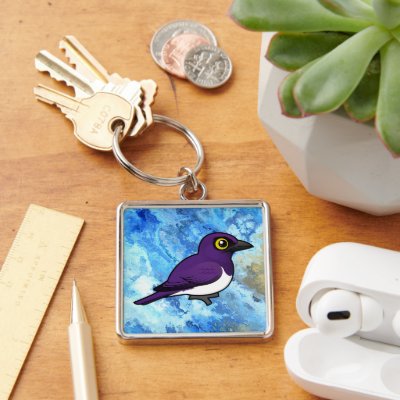
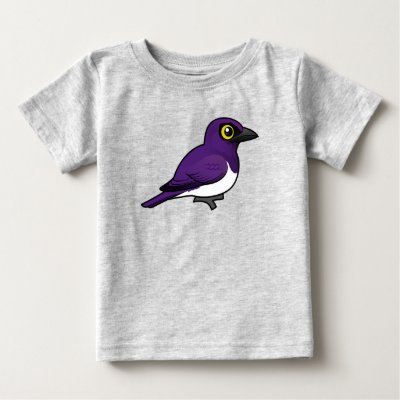
The male has an iridescent violet head and back and pure white underparts. The female looks like a thrush, with a boldly streaked brown back and heavily streaked white underparts. Both have yellow eyes. At about 7 inches long, this is a small starling. The male’s glossy coat has earned the bird two other names: the Amethyst Starling and the Plum-colored Starling.
The Violet That Isn’t Paint
Most colors in nature come from pigments, but this violet works more like a soap bubble. Scientists who looked inside the male’s feathers found tiny rods packed together in neat rows, and each rod has a hollow core filled with air. Together, the rods act like a crystal that bends and reflects light, and the exact spacing decides which color you see. That is why the color seems to shimmer and change as the bird moves. The same hollow-rod trick helps make the glossy feathers of the Wild Turkey, and researchers found that hollow rods let birds make a wider range of colors than solid ones can.
Life in the Treetops
Violet-backed Starlings live in open woodlands, forest edges and clearings across most of Africa south of the Sahara, and also in parts of the Arabian Peninsula. They rarely come down to the ground. They spend their days in the treetops eating fruit, seeds and insects, and sometimes they snatch insects out of the air, a bit like a flycatcher.

Violet-backed Starling by Michael Gwyther-Jones (CC BY 2.0)
Violet-backed Starlings nest in a hole or crevice in a tree. They line the nest with green leaves and animal dung. The female lays two to four pale blue eggs and keeps them warm for 12 to 14 days. The male helps feed the chicks until they leave the nest, after about three weeks. The species is common across a huge range, and it is listed as Least Concern, which means its population is not considered at risk right now.
Coming Up Tomorrow
Tomorrow we’re heading to a bird of prey that likes wide-open fields. It is small, with a pale gray back, a white belly and a black patch on each shoulder. It hunts by hovering in one spot in the air, just like a kestrel, while it watches the ground for a meal. When there are lots of rodents around, it can even raise more than one family in a single year, which is unusual for a bird of prey. Can you guess who it is? Come back tomorrow for bird number ten in the Birdorable Bonanza!

Cute Violet-backed Starling Gifts





Comments
Leave a comment
Thank you!