


Birdorable Bonanza 2026 Bird #2
Why Do Tapirs Love Black Caracaras?
Birdorable is turning 20! To celebrate, we’re introducing a brand-new bird every day for 20 days. Welcome to day two of the 2026 Birdorable Bonanza.
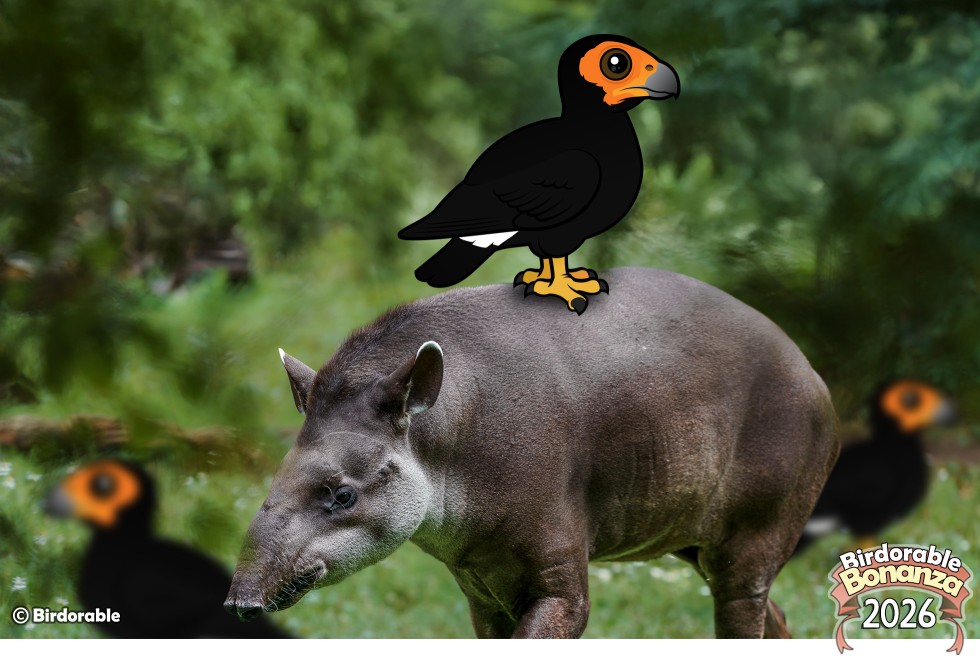
Deep in the Amazon rainforest, a tapir stands beside a small stream. Around it, a group of shiny black birds is busily picking at its skin. The tapir doesn’t mind one bit. Those birds are Black Caracaras, and they are helping the tapir.
The Black Caracara is a bird of prey in the falcon family, but it doesn’t act much like a speedy falcon. It is glossy black all over except for a bright white band at the base of its tail, and its bare face and feet are yellow to orange-red. It’s about 16 to 18 inches long, with wings that stretch around 3 feet from tip to tip, but it weighs less than a pound. Instead of soaring high like a hawk, it usually flaps its way along, and it’s often seen in pairs or small family groups of 3 to 5 birds.
A Bird That Cleans Tapirs
Tapirs are big, piglike animals with short, bendy snouts, and in the rainforest they pick up a lot of ticks. Black Caracaras love to eat those ticks. In 1993, a scientist working in the Amazon watched a group of eight Black Caracaras gathered right next to a large male tapir. Several of them were busy plucking ticks off its body, while ten or more other caracaras perched nearby, apparently waiting for their turn. When the caracaras feed in this way, the tapir gets rid of parasitic pests, and the birds get an easy meal. When both animals help each other like this, it is a type of symbiosis known as mutualism. Black Caracaras have also been seen picking ticks off deer and capybaras.
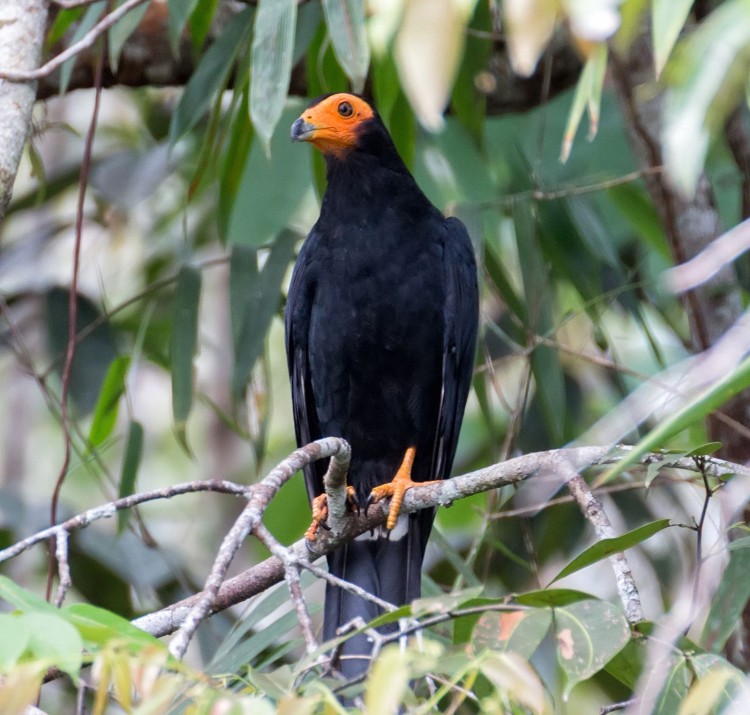
Black Caracara in by Misiek Mintus (CC BY-SA 2.0)
Ticks are just one thing on the caracara's varied menu. Black Caracaras will eat almost anything, from beetle grubs, ants, frogs, lizards and fish to fruit and palm nuts. They even search for food in places that have just burned. These birds are quite vocal, too. They build small stick nests high in big trees, in palms or in clumps of bromeliads, but scientists still have a lot to learn about how they raise their chicks. Black Caracaras live in the lowlands of the Amazon and northern South America, usually along rivers. They are listed as a species of Least Concern, which means the population is not considered at risk right now.
Coming Up Tomorrow
Tomorrow we’re heading to the forests of southern and Southeast Asia, from the foothills of the Himalayas all the way to Vietnam. Our next bird is dressed in black and bright yellow, and it wears a sunny crest that it raises when it gets excited or alarmed. It’s also the biggest member of its whole family, a family that includes the chickadees you might see at a backyard feeder. Can you guess who it is? Come back tomorrow for bird number three in this year's Birdorable Bonanza!



Comments
Leave a comment
Thank you!