


Birdorable Bonanza 2026 Bird #7
Blackcocks, Greyhens and a Dance at Dawn
Birdorable is turning 20! To celebrate, we’re introducing a brand-new bird every day for 20 days. Welcome to day seven of the 2026 Birdorable Bonanza.

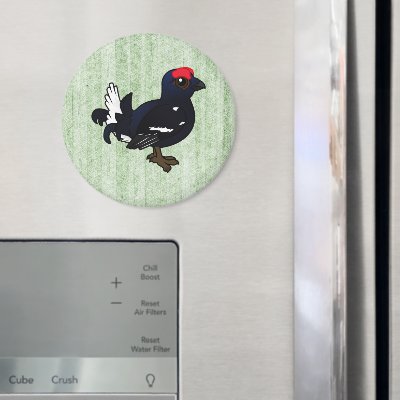
It’s a cold spring morning, and the sun is just coming up over a misty clearing. Out in the open, a group of glossy black birds are puffing up their necks, fanning their tails and making a long, bubbling coo. These are male Black Grouse, and they are putting on a show. A male Black Grouse is black with a deep blue shine on his neck and back, and he has a bright red patch of bare skin above each eye. His most amazing feature is his tail. Its outer feathers curl out to the sides, like the frame of an old-fashioned harp, called a lyre.
Australia’s Superb Lyrebird has a showy tail that reminds people of a lyre too, but the two birds aren’t closely related. When the Black Grouse raises his tail to show off, a fluffy burst of white feathers pops up underneath. In flight, he also shows a white stripe along each wing. Males are about 2 feet long. Females are smaller and grayish brown, with soft patterns that help them hide. People have been calling the males “blackcocks” and the females “greyhens” since at least the 1600s.
Dancing at Dawn
Every spring, male Black Grouse gather at the same open spots to display. This kind of gathering place is called a lek. The males strut, fan their tails and bubble away at dawn, competing to catch the eye of the females who come to watch. In western Europe a lek usually has fewer than 40 birds, but in Russia leks of 150 are not unusual, and some have had as many as 200!
Once a female has picked a mate, she takes care of nesting and raising her chicks on her own. She scrapes a shallow dip in the ground, often at the base of a tree between its roots, and lays about 6 to 11 pale eggs speckled with brown. After 23-28 days, the precocial chicks hatch, and they are ready to leave the nest and follow their mother right away. At first the chicks eat tiny bugs and other small creatures, then more and more plants as they grow. By the time they are two weeks old, they can already make short flights.


Black Grouse live across a huge stretch of Europe and Asia, from Britain all the way to Siberia, Mongolia and China. They like the edges where forests meet open land, such as heaths, moors, grasslands and pastures. In spring and summer they eat berries, shoots and stems of low shrubs like bilberries and cranberries. In winter they gather in big flocks in the forest and feed on the buds, leaves and needles of trees. Around the world there are an estimated 15 to 40 million Black Grouse, so they are listed as a species of Least Concern. In some places, though, they are in trouble. In western Europe their numbers have dropped, and in the United Kingdom they are on the Red List because of habitat loss and overgrazing.
Coming Up Tomorrow
Tomorrow we’re heading to the forests of the Philippines to meet a shy dove that spends nearly all of its time on the ground. It has a bright red patch in the middle of its white chest that looks like a wound, and one of its old Spanish names means “stabbed pigeon.” Don’t worry, though, because the bird is perfectly fine. Can you guess who it is? Come back tomorrow for bird number eight in the Birdorable Bonanza!






Comments
Leave a comment
Thank you!