A Fragrance of Murres

Birdorable Common Guillemot

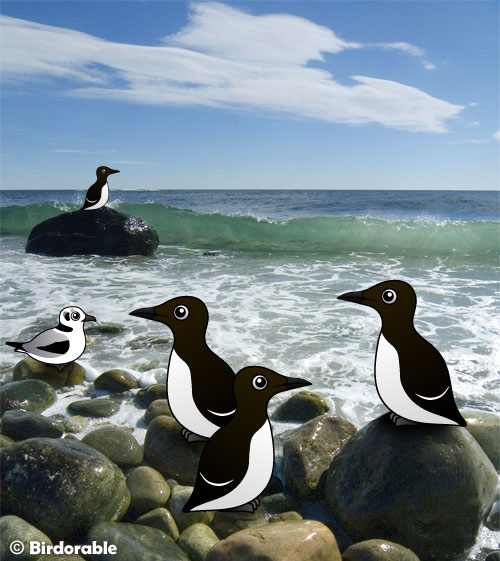
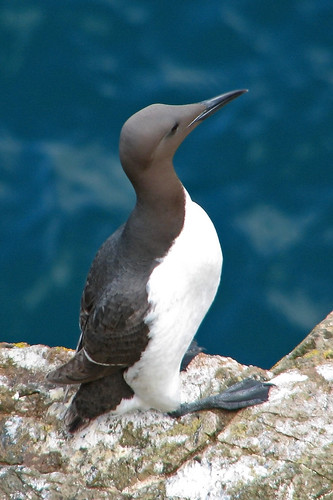
We've added another cutie to Birdorable, the Common Murre, also known as the Common Guillemot. These sea birds can be found in low-Arctic waters in the North Atlantic and North Pacific oceans, all over the northern hemisphere. They spend most of their lives out at sea and only come to land to breed on rocky cliffs or islands, where they get together in huge groups, which are called a 'bazaar', or a 'fragrance' of murres. Check out this incredible photo of thousands of murres at Point Reyes National Seashore, approximately 30 miles north of San Francisco.
Guillemot 1
Common Guillemot

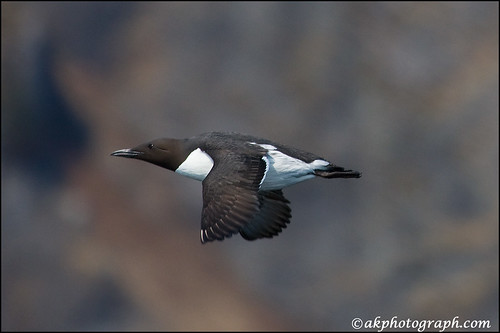
From their nest site they fly as far as 125 miles to look for food for their chicks. They are excellent divers. Using their wings for propulsion they can dive as deep as 600 feet to forage for food. Check out this neat video of Guillemots diving underwater at Farne Islands, off the coast of Northumberland in England.


Video of diving guillemots at the Farne Islands

The Birdorable Murre is available on t-shirts and other apparel in two different designs:

Comments

aga on January 13, 2009 at 11:45 AM wrote:
cool so sweet ;)
Ashira on January 13, 2009 at 6:41 PM wrote:
They are so, so cute! : D Nice pictures - I didn't know they could fly that well.
animtreebird on January 16, 2009 at 1:59 AM wrote:
Very beautiful bird. Nice photo. :)))
Reed on May 14, 2020 at 5:54 PM wrote:
What about that gull in the background?
Spurwing Plover on January 24, 2022 at 6:45 AM wrote:
They Fly They Swim They Walk

Leave a comment

Comments with links or HTML will be deleted. Your comment will be published pending approval.
Your email address will not be published
You can unsubscribe from these communications at any time. For more information on how to unsubscribe, our privacy practices, and how we are committed to protecting and respecting your privacy, please review our Privacy Policy. By clicking submit below, you consent to allow Birdorable to store and process the personal information submitted above to provide you the content requested.

Flamingo FAQs

We're celebrating flamingos this week! Let's learn about these pink beauties -- here are some frequently asked questions about flamingos. Why do flamingos stand on one leg? The true reason that flamingos often stand one leg has long been debated. One popular theory is that a bird can conserve body...

Baby Birdorable: Barn Swallow

If you think our Birdorable birds are cute as adults, what about when they are babies? Below are some baby photos (shared via Flickr Creative Commons) of the Barn Swallow. Barn Swallows build a nest of mud, often on a man-made structure. Both the male and female...

Birdorable Featured in Chickadee Research Presentation

Birdorable loves birds, and we love when others share their passion for birds, too! Last year, we were interested to hear from Megan LaRocque, a Master of Science student at the University of Alberta in Canada. Megan reached out to us with a special request—she wanted to...

Sympatry in Nature: When Species Share the Same Space

Today we'd like to discuss a term that describes two related species or populations that exist in the same area: sympatry. Sympatry can refer to almost any kind of species or populations, but for this discussion we will focus on examples that include birds. Species that are sympatric live...