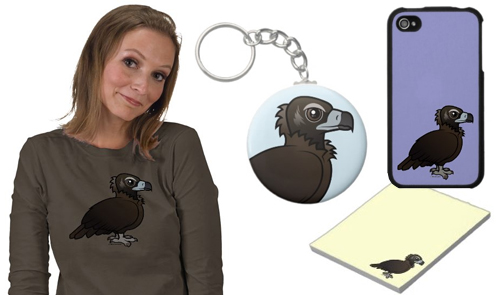
We at Birdorable are proud to have provided use of our cute Andean Cock-of-the-rock image to The Field Museum's 24th rapid inventory team that traveled to the Kampankis mountains of Peru this summer. A few months ago, we were kindly contacted by one of the conservation biologists working on the survey. We were asked if our Andean Cock-of-the-rock could be used for the team's t-shirt, and we were happy to comply! The survey was done in northern Peru, in an area where Andean Cocks-of-the-rock are abundant. Below is a photo of some of the team members when they recently arrived in Tarapoto after the survey. If you look closely, you'll find at least five Birdorables in the photo!

These surveys are huge team efforts and entail adventure and discovery. For example, the above photograph was taken during an earthquake after a multi-day weather delay. If you'd like to learn more about the high adventure and about the fascinating work done during the rapid survey of the Kampankis mountains, check out the rapid inventories of remote regions blog.

Get ready to dress up your pumpkins this Halloween with some cute Birdorable birds! Below you can download four different cute bird pumpkin carving patterns of varying skill levels as free downloads. Two of our patterns are simple bird cut-outs, and two are inverted designs where the area around the bird must be carved away. Just click on a pattern thumbnail to download the PDF and get carving!

Birdorable Bird Pumpkin Patterns

  • Our first free pumpkin carving pattern is a cut-out Birdorable chickadee. Chickadees love Halloween, you know! After all, they are always singing, "Trick or treat-treat-treat-treat," aren't they?!
  • Next, our free spoonbill pumpkin pattern is another cut-out, though a bit more involved. You know, I bet that spoon-shaped bill would be very handy at cleaning out pumpkin guts this time of year!
  • Our cute owl pumpkin cut-away pattern has the owl looking out from inside the pumpkin, how adorable! Owls own the night - even on Halloween - and this little cutie is no exception.
  • Finally, we have our cute Birdorable Tufted Titmouse pumpkin pattern. This is another cute-away job, and requires a steady hand to leave enough pumpkin to keep the bird afloat. Be careful carving that wing, too!

Have you used any of our free printable downloads at home, in your classroom, or at an event? We’d love to hear about it! Send us photos of the pages in action, or the final result – we may showcase them on our blog!

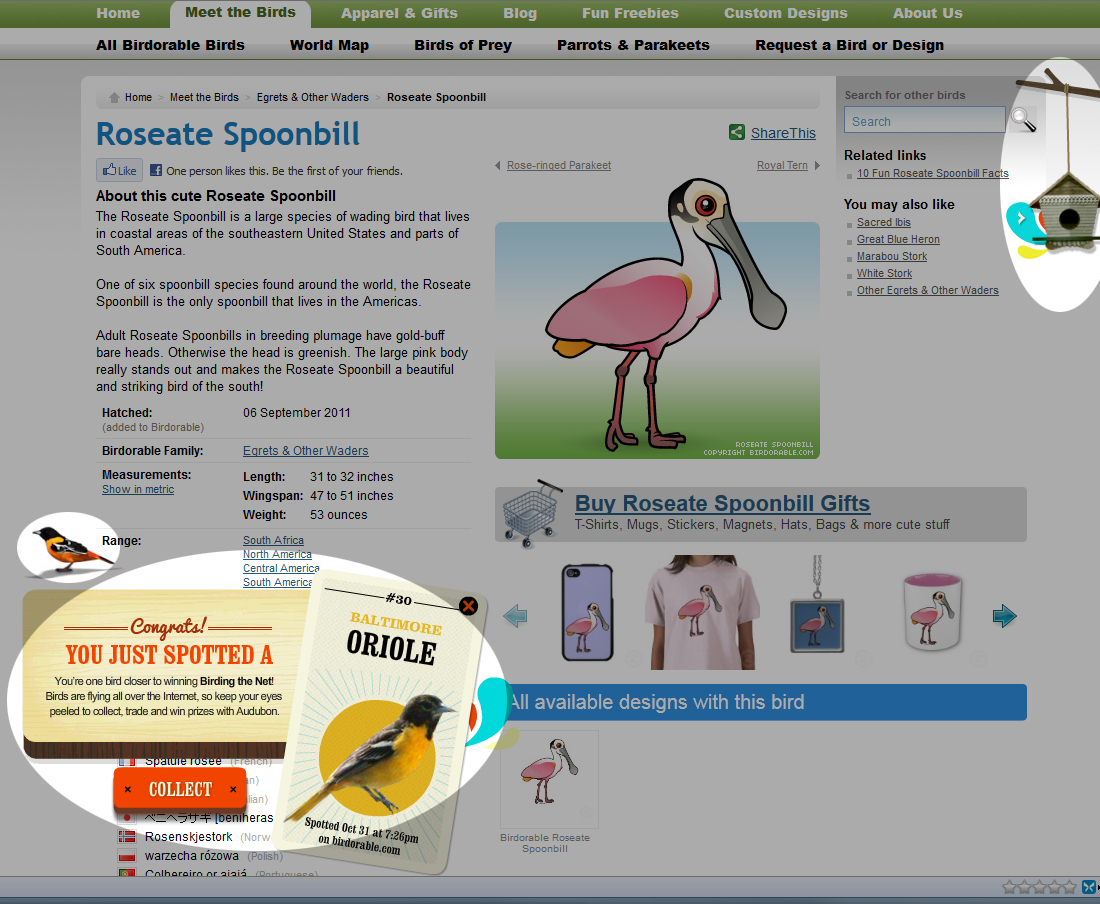
Discover 10 Fascinating Facts About the Birdorable Roseate Spoonbill

Birdorable Roseate Spoonbills

The Roseate Spoonbill is one of the newest birds to join the Birdorable family. Here are some fun facts about this unique species.

  1. Did you know the term for a group of spoonbills is called a bowl? Imagine spotting a bowl of Roseate Spoonbills in the wild – what a breathtaking view that would be!

  2. The stunning pink hue of the Roseate Spoonbills isn't just for show. It comes from their diet, which mainly consists of crustaceans that have been dining on algae. This diet directly influences their vivid coloring.

  3. In areas like Florida, it's common for people to mix up Roseate Spoonbills with flamingos, given their similar pink shades. Despite this, they are very different species with their own unique characteristics.

  4. Among the six species of spoonbills that roam our planet, the Roseate Spoonbill is the only one boasting pink feathers, setting it apart from its relatives.

  5. The Roseate Spoonbill also has the distinction of being the sole spoonbill species found throughout the Americas. This fact makes it a special sight for birdwatchers in the region.

  6. A fascinating aspect of Roseate Spoonbill biology is that chicks are born with straight beaks. As they grow, the beaks gradually morph into the distinctive spoon shape, a key adaptation for their feeding habits.

  7. Speaking of feeding, Roseate Spoonbills have a unique method of eating. They sweep their spoon-shaped bills through water to catch prey like fish or insects, closing their bills quickly when they touch something edible.

  8. The resilience of the Roseate Spoonbill is remarkable. The oldest known individual in the wild was found in the Florida Keys in 2006. The bird had been banded in 1990, and was an amazing 16 years old. This was quite the jump from the previously recorded lifespan of seven years for the species.

  9. Social butterflies, or rather, social birds of the wetlands, Roseate Spoonbills enjoy the company of their kind. They feed, nest, and fly together, forming a tight-knit community with other wading birds.

  10. And, don't forget, the Roseate Spoonbill made its Birdorable debut on September 6th, 2011. Be sure to check out our array of Roseate Spoonbill t-shirts and gifts, a must-have for enthusiasts of this splendid species.

Photo of a Roseate Spoonbill

Cute Spoonbill Gifts

International Vulture Awareness Day (IVAD) may be tomorrow, but we here at Birdorable love vultures all year, and we can't wait to introduce our newest Birdorable bird: the Lammergeier, or Bearded Vulture.

Birdorable Lammergeier

Lammergeiers like to eat dead things (just like people, if you think about it!), but they are a bit picky when it comes to their favorite treat: bone marrow! While they can easily swallow some bones, very large bones require a bit more work. Lammergeiers are so smart, they have a great trick to get at the bone marrow inside the bones of very large carcasses: they drop them on rocks! The bird will hold the bone and fly up high above a rocky area. At just the right moment, it will drop the bone so that it is broken or shattered by the rocks below. The Lammergeier then proceeds to chow down on the bone fragments along with the nutritious marrow inside. To help you celebrate IVAD, please have a look at our free fun vulture downloads, including an all-new Lammergeier coloring page. And check out our cute Lammergeier gifts.

The Crested Auklet's Fresh Citrus Scent

Crested Auklets are small seabirds that live in the Bering Sea. They are in the same family as other cute birds like Atlantic Puffins, Razorbills, and the extinct Great Auk. During the breeding season, which begins in mid-May, Crested Auklets of both sexes are in their beautiful and striking breeding plumage. This includes an unusual crest of bristles at the forehead, white eyeline contrasting with black body plumage, and a bright orange bill. Perhaps the most unusual component of the Crested Auklet's finery includes a strong but not-unpleasant odor, which is said to smell like tangerines, or another citrus-like odor. The function of this odor is not known to science, but it may have something to do with attracting a mate. While we don't currently offer scratch-and-sniff gifts, our selection of Crested Auklet apparel and novelties are great for anyone who loves these unusual, striking and fresh-scented birds!

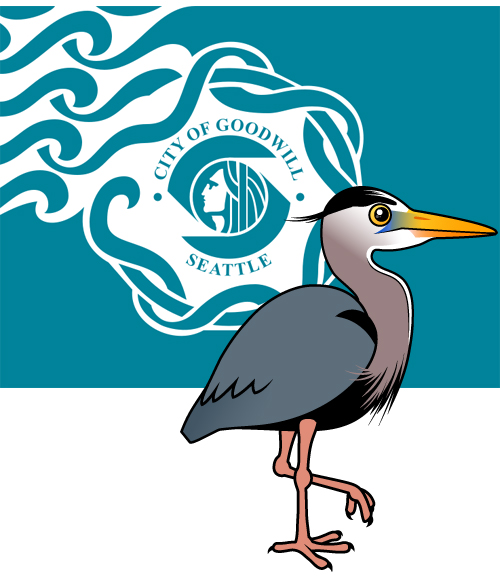
You are probably well-aware that many countries have an official national bird. For example, the national bird of the United States is the Bald Eagle, and the national bird of Bolivia is the Andean Condor. Several U.S. states also have official birds. But did you know that there are even some cities that have their own official bird? The official city bird of Abiko, Japan, is the Eurasian Coot. We used to see these little water birds all the time while we lived in the Netherlands, but in fact their range is across much of Eurasia - all the way to Japan! Besides being one of just a few global cities to have an official bird, Abiko goes a step further with their love of avian friends. It is home to the Abiko City Museum of Birds!


Birdorable Eurasian Coot with the flag of Abiko

Here is a new Birdorable coloring page for some cute coloring fun: the Northern Fulmar. Go to Coloring Pages to download the new free PDF. You can visit the Birdorable Northern Fulmar page to check the colors. This page is like getting three in one - the Northern Fulmar has three distinct color morphs!

Birdorable Northern Fulmar Coloring Page

This download will be available until 15 September 2011. Check here for more coloring pages. Subscribe to the Birdorable Blog by RSS feed or by email to get notified when new downloads like this are added. Have you used our coloring pages at home, in your classroom, or at an event? We’d love to hear about it! Send us photos of the pages in action, or the final result – we may showcase them on our blog!

Birdorable Brown Kiwis with egg

The Brown Kiwi is one of five species of kiwi. All kiwis, native to the islands of New Zealand, are flightless. The national symbol of New Zealand holds at least two avian records. First, these grown-dwelling birds have the largest egg in relation to their body size. The kiwi is about the size of a domestic chicken, while the egg is about the size of an emu's egg! The egg may be up to 1/5 of the body weight of the mother bird. Kiwis are also unusual in that after the egg is laid, the male takes care of incubation and nest maintenance. The other record held by the kiwi relates to unusual anatomy: it is the only bird with nostrils at the end of the bill. Unlike most other bird species, the kiwi has a good sense of smell. It uses scent to find prey. If you can't get enough of this extreme avian species, be sure to check out Birdorable's collection of cute Brown Kiwi t-shirts & gifts.

Here is a new Birdorable coloring page for some cute coloring fun: the Palm Cockatoo. Go to Coloring Pages to download the new free PDF. You can visit the Birdorable Palm Cockatoo page to check the colors.

Birdorable Palm Cockatoo Coloring Page

This download will be available until 1 August 2011. Check here for more coloring pages. Subscribe to the Birdorable Blog by RSS feed or by email to get notified when new downloads like this are added. Have you used our coloring pages at home, in your classroom, or at an event? We’d love to hear about it! Send us photos of the pages in action, or the final result – we may showcase them on our blog!

Birdorable Emperor Penguin with chick

Did you know that all penguins practice fasting during the year? Prior to fasting, penguins build up a thick fat layer which will provide energy during the fast period. Penguins fast for two reasons. First, some species don't leave their nesting grounds during the entire courtship, breeding and incubation period. Their food is found in the water so they are unable to feed if they don't leave the nesting grounds. Penguins also fast during seasonal molt.

When their new waterproof feathers are just growing in, they are unable to enter the water to feed. Different penguin species have different fast lengths. The male Emperor Penguin has the longest fasting period during breeding season. While preparing and caring for chicks, a male Emperor Penguin will fast for an incredible 90 to 120 days!

If you can't get enough of this extreme avian species, be sure to check out all of Birdorable's cute penguin t-shirts & gifts.

Cute Penguin Gifts