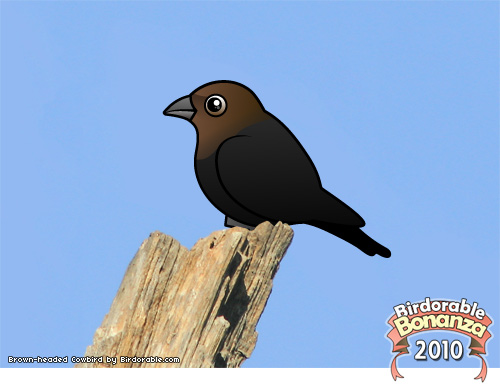
Birdorable Stamps

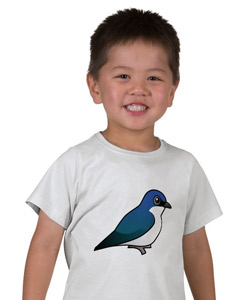
Have you already seen our Birdorable U.S. stamps? Make every letter a special delivery with cute stamps of your favorite bird. Until tomorrow night, July 14th 2010 at 11:59pm PT, sheets of Birdorable $0.44 stamps are on sale. Enter code JULYPOSTDEAL at checkout to receive a $8.80 discount for each sheet of twenty stamps. View all stamps here.

Birdorable Stamps

Offer is valid through July 14, 2010 at 11:59pm PT. This promotional offer may not combine with any other Zazzle promotional or volume discount offers. If a volume discount applies to your order, you will receive either the discount set forth in this offer or the standard volume discount, whichever is greater. Offer valid on Zazzle.com only.

ALERT: The Western Scrub-Jay was split into the California Scrub-Jay and Woodhouse's Scrub-Jay.
Birdorable Western Scrub-Jay

For 18 days we're adding a new Birdorable bird every day as part of our Birdorable Bonanza 2010. Today's bird is the Western Scrub-Jay! Western Scrub-Jays are members of the corvid family, along with crows and other jays. You can find these blue beauties in western North America, ranging from southern Washington to central Texas and central Mexico. They prefer low scrub and oak woods. These extremely clever birds store surplus food for future use. They are also known to steal food from other birds. They will even take measures to protect their own food stores from other thieving birds! You could say they have some food issues. ;)

Western Scrub-jay (Aphelocoma californica)
Western Scrub-jay (Aphelocoma californica) by Lorcan Keating

Tomorrow's bird is an Australian finch with rainbow colors. Can you guess what it is?

Birdorable Laughing Kookaburra

For 18 days we're adding a new Birdorable bird every day as part of our Birdorable Bonanza 2010. Today's bird is the Laughing Kookaburra! The Laughing Kookaburra is the largest species of the kingfisher family. These brown and white birds are named for their unusual call, which sounds like they are laughing: "koo-koo-koo-ka-ka-ka!" Although the species is native to eastern Australia, the unique call of the Laughing Kookaburra is often used by Hollywood as a sound effect in jungle scenes - no matter which continent. Have a listen to the call and see if you recognize it!

Laughing Kookaburras are fairly common within their range, often found in suburban or urban settings. They will even become habituated to humans. Last month one Laughing Kookaburra got into trouble after eating too many handout sausages. The bird became so overweight that it was unable to fly! Fortunately the bird was rescued and brought in to "bootcamp where it was expected to recover after being put on a diet and exercise plan.

A Wild and Free Laughing Kookaburra
A Wild and Free Laughing Kookaburra by ianmichaelthomas

Tomorrow's bird is a blue bird that lives in western parts of the United States. Can you guess what it is?

Birdorable Andean Condor

For 18 days we're adding a new Birdorable bird every day as part of our Birdorable Bonanza 2010. Today's bird is the endangered Andean Condor! Andean Condors are large birds that live in western parts of South America. They are among the largest flying birds, with a massive wingspan which may exceed ten feet! Andean Condors have relatively featherless heads, like other birds in the condor and vulture families. Males sport fleshy combs on the top of their heads and a wattle of skin on the neck. Both sexes sport a white fluffy neck "cowl."

January 10, 2010
Andean Condor by Fabio Mandrioli

Tomorrow's bird is a funny bird from Australia. Can you guess what it is?
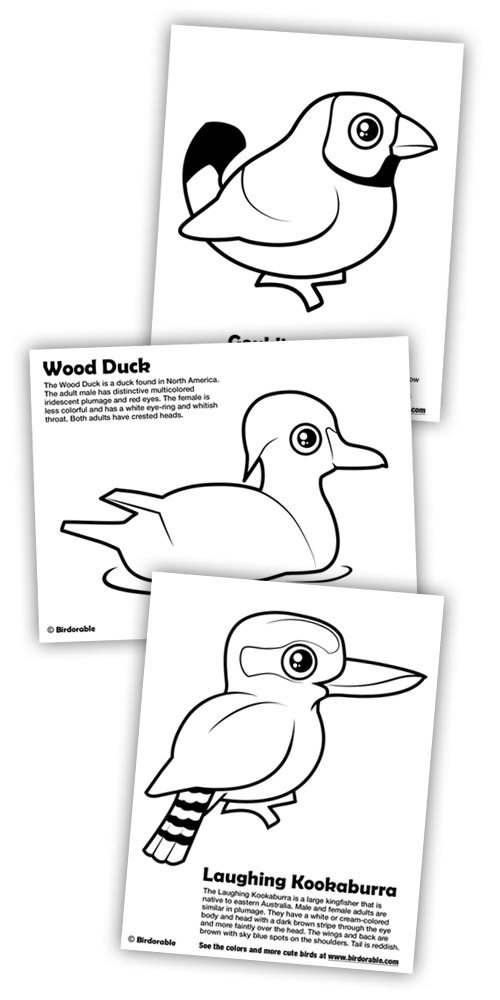
Here are two new Birdorable coloring pages for some cute coloring fun! They are the Andean Condor and Sandhill Crane, two new birds from our Birdorable Bonanza. Go to Coloring Pages to download these two new PDFs and check the Meet the Birds page to check the colors.

Birdorable Coloring Pages: Andean Condor and Sandhill Crane

These downloads will be available until 31 August 2010. Check here for more coloring pages. Subscribe to the Birdorable Blog by RSS feed or by email to get notified when new downloads like this are added.

Bonanza Bird #3: The Prothonotary Warbler

Birdorable Prothonotary Warbler

For 18 days we're adding a new Birdorable bird every day as part of our Birdorable Bonanza 2010. Our third bird is the Prothonotary Warbler, a brilliant yellow in the forest. Prothonotary Warblers are among the most brightly-colored warblers. Males are brilliant yellow overall with blue-grey wings. Females are similar, but duller; both sexes have black beaks and bright black eyes. Prothonotary Warblers are named for their yellow coloring. Prothonotaries were clerks in the Roman Catholic Church who traditionally wore robes of deep, bright yellow.

prothonotary warbler
prothonotary warbler by bmajoros

Tomorrow's bird is a large endangered bird that lives in South America. Can you guess what it is?

2010 Bonanza Bird #2

Meet the Avian Anteater: The Birdorable Green Woodpecker

Birdorable Eurasian Green Woodpecker

Meet the Green Woodpecker, the avian equivalent of an anteater, and the second star of our Birdorable Bonanza 2010. This vibrant bird, with its striking green plumage, offers a fascinating glimpse into the adaptability and ecological niche that birds can occupy.

Green Woodpeckers are a spectacle of nature, primarily found frolicking across the landscapes of Europe and parts of western Asia. Their presence is notably significant in countries like France, Spain, and Germany, where they contribute to over half of their global population. What sets these birds apart is not just their vivid coloration but their unusual feeding habits.

Unlike their wood-boring cousins, Green Woodpeckers have carved out a niche that involves foraging for their food on the ground. Their diet is remarkably specialized, focusing almost exclusively on ants. This peculiar choice of sustenance has earned them the nickname "avian anteaters." They use their long, sticky tongues to probe into ant colonies, extracting their prey with precision. This diet is not only a testament to their adaptability but also highlights the intricate relationships within ecosystems, where every species plays a role in maintaining the balance.

Male Green Woodpecker photo

Male Green Woodpecker by hedera.baltica (CC BY-SA 2.0 DEED)

The Green Woodpecker's approach to life is a departure from the typical woodpecker behavior. Most woodpeckers are known for their characteristic pecking on tree trunks, a behavior that serves multiple purposes, including foraging for insects, creating nesting sites, and communicating with other woodpeckers. However, the Green Woodpecker spends a significant amount of its time on the ground, its bright green plumage blending seamlessly with the grass, as it hunts for ants.

Observing a Green Woodpecker in its natural habitat is a treat for birdwatchers. Their vibrant plumage, combined with their distinctive laughing call, adds a layer of charm to the forests and woodlands they inhabit. The sight of a Green Woodpecker diligently foraging on the ground, undeterred by the presence of onlookers, is a reminder of the diversity and adaptability of bird life.

Tomorrow, we turn our attention to a beautiful little yellow bird that breeds in cavities in North America. Can you guess what it will be?
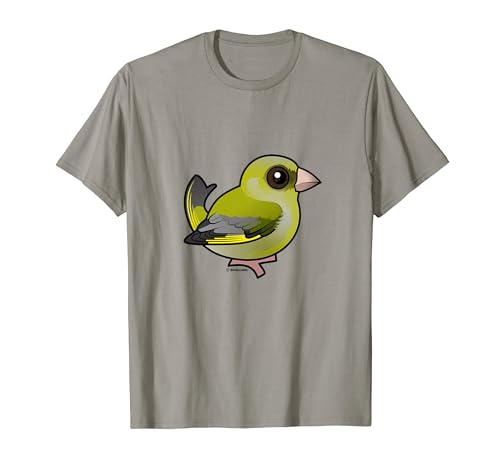
Cute Green Woodpecker Gifts

Birdorable Sandhill Crane

In the next 18 days we’ll be introducing a new Birdorable bird every day as part of our Birdorable Bonanza 2010. The first bird is this Sandhill Crane. Sandhill Cranes are large birds found in grassland and marshes throughout North America. Nesting usually occurs close to water. Their preferred feeding grounds are fields or shallow water; they are omnivorous and find food by foraging, probing into the soft soil with their beaks or hunting small prey.

Baker County Tourism – basecampbaker.com 16871
Sandhill Cranes along the Elkhorn Scenic Byway by Baker County Tourism (CC BY-ND 2.0)

Until July 24th we'll be adding a new Birdorable bird species every day. Here’s a sneak peek at tomorrow’s bird, a green anteater that lives in Europe and western Asia.

This week's featured t-shirt design is our renewed Birdorable Ruby-throated Hummingbird. Males have a bright, glossy red throat patch while females are duller but just as cute. Hummingbirds feed from flowers by hovering mid-air and sipping nectar out using their long narrow beaks and tongues. This is our cute Birdorable version of the Ruby-throated Hummingbird, shown here on a ladies casual scoop shirt and men's basic t-shirt.

Birdorable Ruby-throated Hummingbird T-shirts

Sample apparel with our cute Ruby-throated Hummingbird

Coming Soon: Birdorable Bonanza 2010

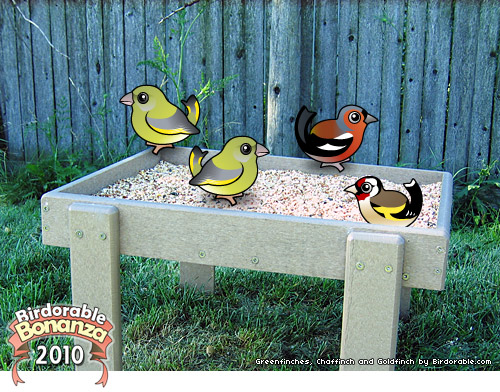
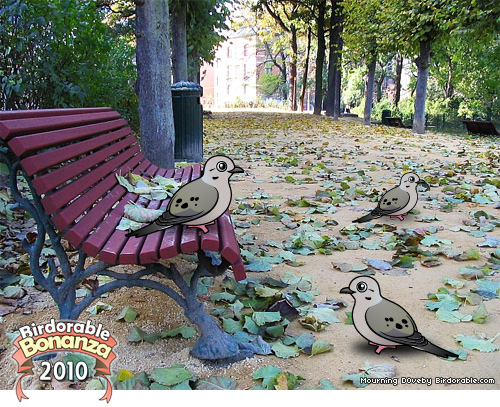
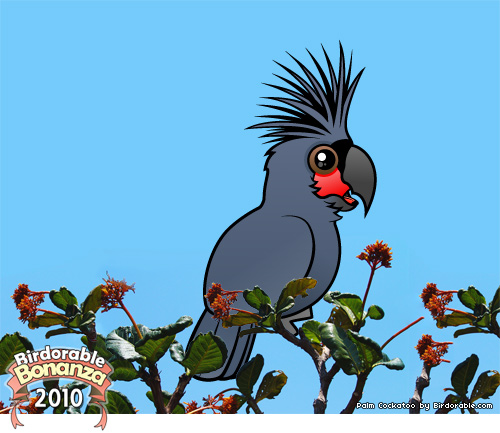
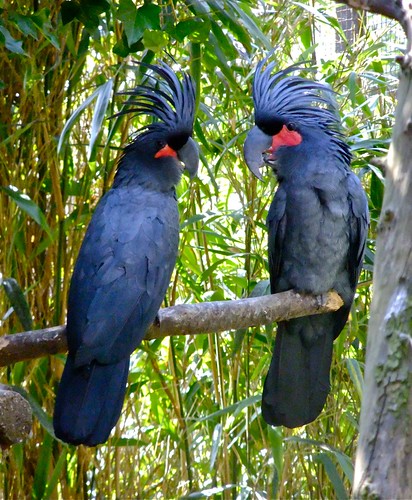
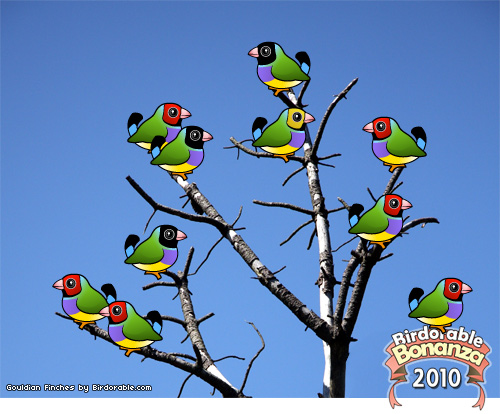
We're excited to announce that we'll be having another Birdorable Bonanza this summer! We had a bonanza last year, where we added a new bird every day for 17 days in a row (see Birdorable Bonanza 2009). It was so much fun we decided to do it again this year! Starting on July 7th, we'll be adding 18 new birds to Birdorable in our second annual Bonanza! Keep an eye on the blog or follow us on Twitter or Facebook to see all the new birds as they're added to the site each day. Here is a teaser. Can you guess what they'll be?

Birdorable Bonanza 2010 Preview