Vulture Week 2026
The Bird That Found the Gas Leaks: How We Learned Vultures Can Smell
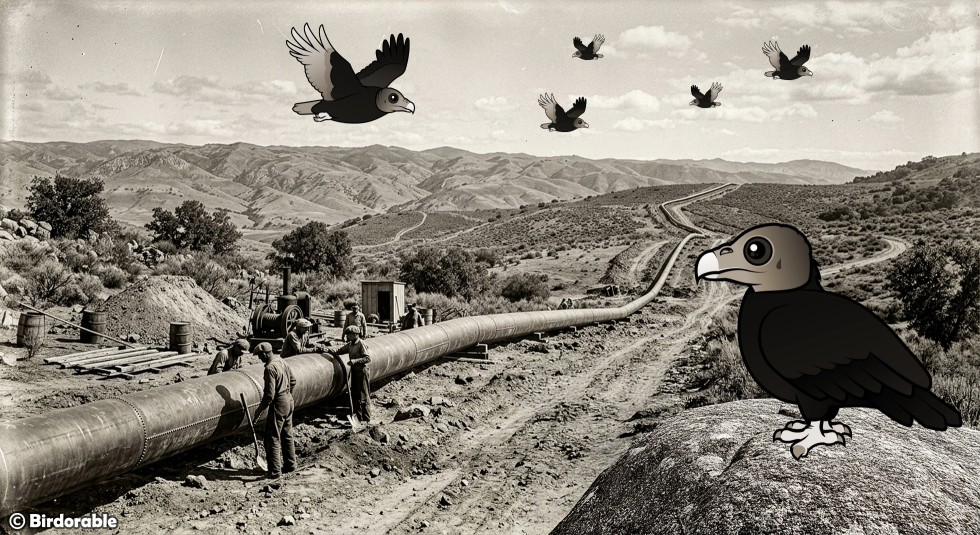
Somewhere along 42 miles of pipe, gas was escaping, and the birds knew exactly where.
In 1938, the Union Oil Company of California had a problem it could not solve. A 42-mile natural gas line had sprung a leak, and finding the breach by walking the line across rough terrain would be difficult, if not nearly impossible.
Then an engineer in Texas came up with a plan that involved no equipment at all, only birds.
The Idea
The idea was simple: pump a heavy dose of a strong-smelling chemical called ethyl mercaptan into the pipeline, then drive along the route and watch the sky. Wherever the gas was escaping, Turkey Vultures would gather overhead.
And that is exactly what happened. As Union Oil's engineers later described it, Turkey Vultures were seen circling above the pipeline or sitting on the ground at several points along the line. The smell of mercaptan was strong at each of those spots, and every one of them turned out to be a real leak.
The company kept using the method for years afterward. As one of their field engineers later recalled, they had stumbled onto the fact that Turkey Vultures have a remarkably well-developed sense of smell.
Why It Worked
Natural gas has no smell of its own. Gas companies add a warning odor so that leaks can be noticed, and one of the compounds commonly used for that job is ethyl mercaptan.
Ethyl mercaptan also happens to be one of the gases given off by flesh in the earliest stages of decay.
So to a Turkey Vulture, a leaking gas pipeline does not smell like an industrial accident. It smells like dinner, in this case it was spread out across 42 miles of hilly California countryside.
Meanwhile, Scientists Were Still Debating It
Here is the interesting part: while an oil company was quietly using vultures as leak detectors, scientists were still debating whether birds could smell at all, a question that had been open for over a century.
The argument began with a famous shot across the bow. In 1826, John James Audubon published a paper in the Edinburgh New Philosophical Journal with a title that left no doubt about his intentions: "Account of the habits of the turkey buzzard, particularly with the view of exploding the opinion generally entertained of its extraordinary power of smelling."
Audubon meant to demolish the idea, and for a long time he was widely believed. The naturalist Charles Waterton fought back in print through the 1830s with a series of rebuttals, one of them aimed squarely at Audubon's paper, and John Bachman published a defense of Audubon in response. The dispute rolled on without resolution, and a long succession of loosely controlled field tests followed over the next hundred years without settling anything definitvely.
The Conversation That Solved It
In the late 1950s, an ornithologist at the Los Angeles County Museum named Kenneth Stager was talking with field engineers at Union Oil when a retired engineer named Ralph Openshaw told him the story of the pipeline.
Stager realized he was being handed the answer to a question ornithologists had been arguing over for more than a century, so he set out to test it properly.
The Experiments
Stager's problem was that it was known vultures have superb eyesight, so any test where the bird could see the food would prove nothing, so everything he built was designed to remove sight from the equation.
First he built a machine that could produce a smell with nothing to see. A four-bladed, 20-inch exhaust fan mounted in a wooden housing pushed the odor of fresh and decomposing animal tissue out onto known air currents, with nothing visible at the site, and vultures responded to the scent alone.
Next he hid food in boxes instead. Perforated cardboard cartons were loaded with decomposing fish, abalone, ground squirrels, kangaroo rats, a domestic cat, and snakes, then concealed at test sites, and the vultures found every one of them. In one case a bird came down a canyon on a downwind course, landed, and stood motionless facing upwind toward a bait chamber hidden 75 yards away in a dense grove of pepper trees.
Finally he ran the experiment that settled the matter. Stager set out a mounted, taxidermied yearling mule deer as a purely visual decoy, and no vultures came. He then replaced the mount with a fresh deer carcass of identical size and appearance, and the vultures responded quickly, although they still did not gather to feed until they had picked up the smell.
The deer was the same shape, the same size, and in the same place as the mount before it. The only difference was odor, and odor turned out to be the thing that mattered most.
The Experiment on Old World Vultures
The most interesting part of Stager's work may be the test he ran on the other side of the world, where the study on Old World vultures produced very different results.
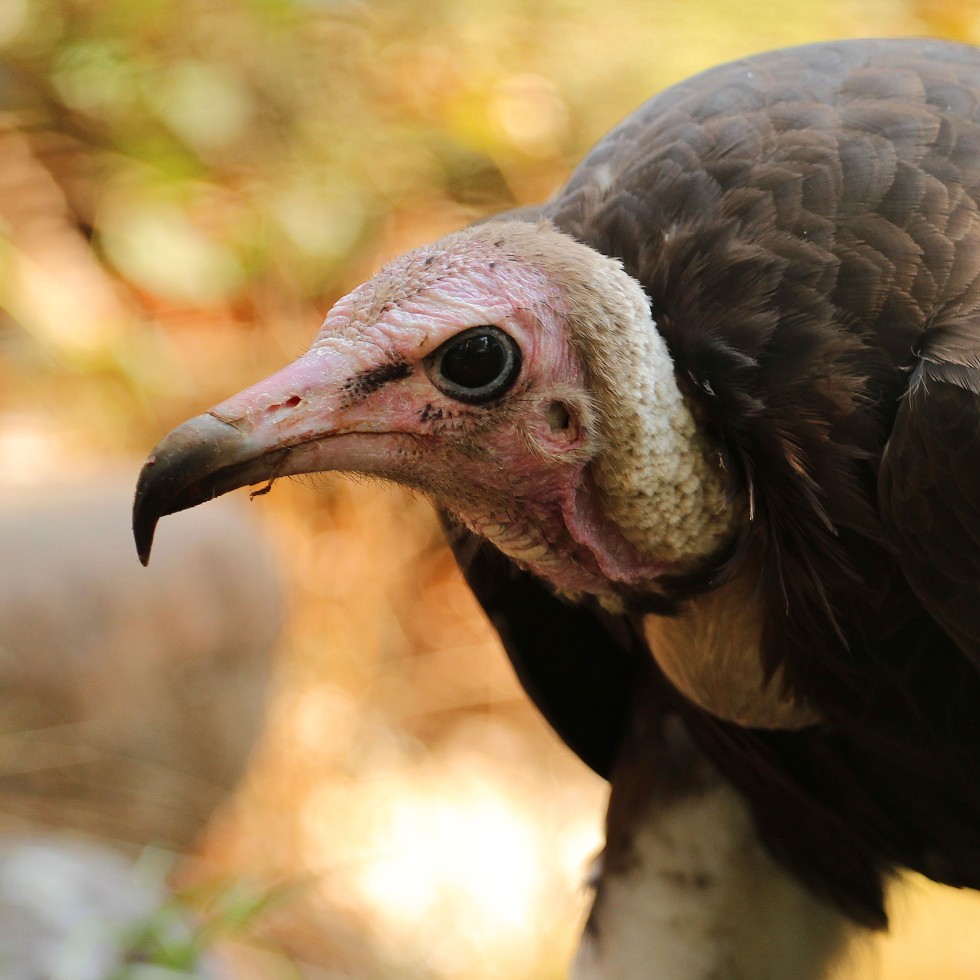
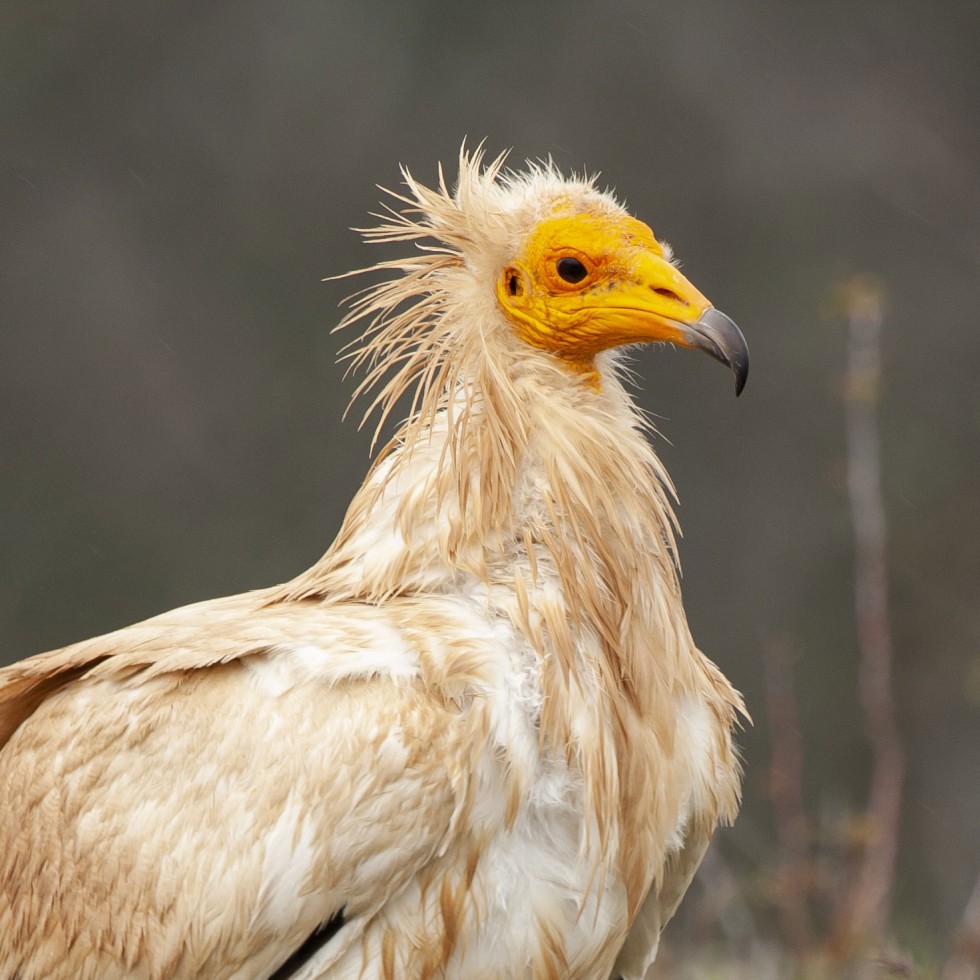
In early 1959, on a museum expedition to the Balaghat Forest District of Madhya Pradesh in central India, Stager found himself camped among roughly 150 Old World vultures, drawn in by the skinning of large mammal specimens. Most were White-rumped Vultures, with a scattering of Egyptian Vultures and Red-headed Vultures.
He asked the skinners to set aside more than 200 pounds of muscle from a tiger specimen, then waited until ten o'clock at night, so that no vulture could possibly have watched him do it. He and two assistants carried the meat onto a raised platform in an open, dry paddy field and buried it under a ten-inch layer of thatching straw, and each night afterward he checked that the straw had not shifted enough to expose anything.
The bait rotted, and the smell, Stager wrote, became overpowering, noticeable at a considerable distance even to the relatively weak nose of a human being.
For eleven days the vultures swarmed the camp and the surrounding fields, and not one of the three species gave the slightest sign of noticing a quarter of a ton of tiger meat sitting in the open a short walk away.
On the night before the twelfth day, Stager pulled the thatch off, and the next morning a Red-headed Vulture spotted it at once, dropped onto the platform, and started eating.
Old World vultures find their food by sight, and they are superb at it. Uncovered, the meat was spotted within hours, but smell simply does not come into play for these birds.
It Was Not the Flies, Either
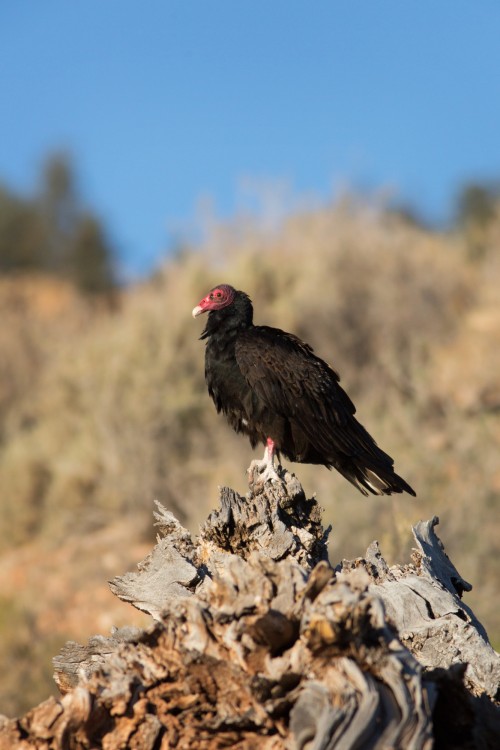
There was a rival theory worth ruling out first. Some researchers had proposed that Turkey Vultures do not smell carrion at all, and instead spot the clouds of flies that gather above it.
The India experiment ruled that out too. The hidden bait was, in Stager's words, black with flies and other carrion insects, and the vultures still could not find it. If insects were the visual signal, those birds had it right in front of them for eleven days and never responded to it.
Conservation note: Around 95 percent of the vultures Stager was watching were White-rumped Vultures, then so abundant in India that they filled the great Sal trees around him day and night. Within a few decades the species had lost more than 99 percent of its population to a veterinary drug given to cattle. The flock that failed his experiment would be almost impossible to gather today.
Inside the Skull
Stager then studied vulture anatomy. Working from casts of the inside of vulture skulls, he compared the olfactory bulb, the part of the brain that processes smell, across species. The bulbs were relatively large in the New World vultures; the groups of Old World vultures had smaller bulbs.
Modern methods of study have since taken this theory further. A 2017 study measured vulture brains directly and found that a Turkey Vulture's olfactory bulbs are four times larger than a Black Vulture's, with twice as many of the output cells that carry smell signals onward, even though the Turkey Vulture's brain is about 20 percent smaller overall. These two birds share the same sky over much of the Americas, yet one of them is wired for a sense that the other barely has.
1938-1964
Stager published his study on June 30, 1964, in Contributions in Science, the journal of the Los Angeles County Museum. Sixty-three pages of experiments, results, and retesting finally closed an argument that had been running since 1826.
Union Oil's engineers had already found the answer back in 1938. They knew they were right, and they used that knowledge for years to keep a pipeline safe, even though it did not become part of ornithological knowledge for another couple of decades.
As for why New World vultures have such a strong sense of smell while their Old World cousins do not, that is a much older story. The vultures of the Americas and the vultures of Europe, Africa, and Asia are not actually close relatives at all. They arrived at the same way of life separately, and only in the Americas did any of them evolve a nose for the work, through a process called convergent evolution, which is a story for another day.
Now You Know What to Look For
The next time you see a Turkey Vulture flying low and unhurried over a field, rather than circling high on the warm air, there is a good chance it is working a scent, doing exactly what those engineers drove 42 miles of pipeline to watch for. Tell us where you have spotted one in the comments below!
International Vulture Awareness Day
International Vulture Awareness Day takes place on the first Saturday of September each year. In 2026, we'll be celebrating this special day on September 5th.