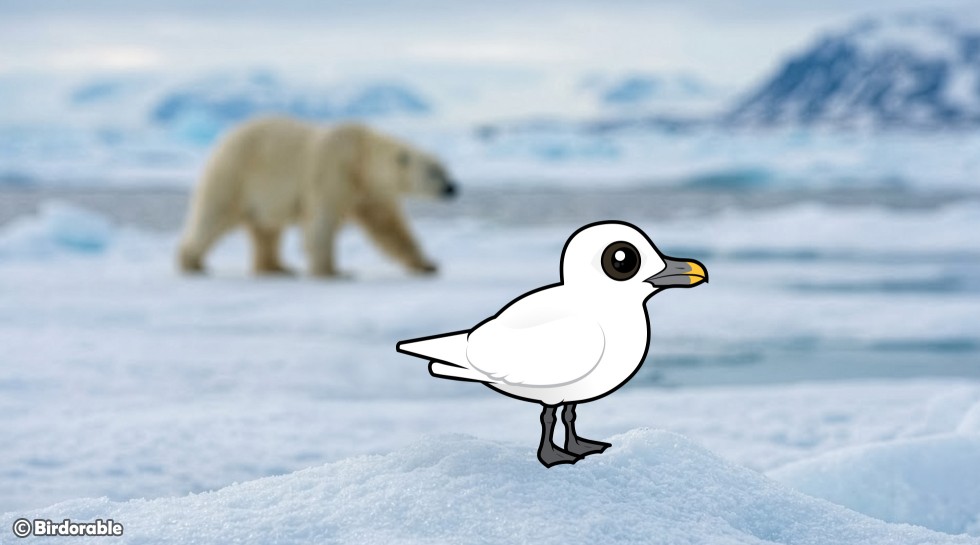
Illustration of a Birdorable Ivory Gull — pure white with black legs and a grey bill tipped with yellow — standing on Arctic pack ice, with a polar bear walking across the ice behind it.

Ivory Gulls shadow polar bears across the pack ice, waiting for what's left of the kill.

Here’s a secret that will make you sound like an expert next time you’re at the beach: there is no such bird as a “seagull.”

Not one. Open any bird guide in the world and you won’t find the word. There are Herring Gulls and Ivory Gulls and Laughing Gulls, dozens of species in all, but not a single one of them is called a seagull.

Now, this is the point where a certain kind of birdwatcher gets smug about it, but that’s not what we’re here for. “Seagull” is a perfectly good everyday word, and nobody needs to be corrected while they’re eating an ice cream. But it is a word that hides something, and what it hides is genuinely interesting. Packed into those two little syllables are two mistakes, and the bird underneath is far more surprising than the word lets on.

Mistake One: Most of Them Aren’t Sea Birds

Let's start with “sea,” because that’s the half that goes wrong first.

Plenty of gulls hardly bother with the ocean at all. Franklin’s Gull nests in colonies on prairie lakes in the middle of Canada and the northern United States, building nests on the ground or floating them on the water. In spring, flocks feed on newly hatched insects over inland water bodies and across wet pastureland. Come autumn they leave the continent entirely for Argentina, Chile and Peru. It's only in the off-season that you'll find them on ocean coastlines.

And the gulls you do see at the seaside are often somewhere else the rest of the week. Black-headed Gulls spend much of the year hunting invertebrates in plowed fields. Gulls follow tractors, patrol reservoirs, roost on playing fields, and work landfills and supermarket parking lots a hundred miles from salt water.

If we’d named them for where most of them actually spend their time, we’d be calling them fieldgulls, parking-lotgulls, or landfillgulls.

Mistake Two: They’re Not All the Same Bird

The second mistake is sneakier. “Seagull” suggests a single generic bird: white, gray, noisy, and after your lunch. One word, one bird.

Let's consider a few of them side by side.

The Ivory Gull lives on the pack ice of the high Arctic and is pure white all over, with no gray back at all, a blue bill with a yellow tip, and black legs. It makes its living in a way no seaside scavenger would recognize: it follows polar bears across the ice and feeds on what is left of their kills. (It also eats polar bear droppings and seal placentas, which is the sort of fact that either delights you or does not.)

The Glaucous Gull is the second-largest gull on Earth, big enough to rival a Great Black-backed Gull, and it’s a serious Arctic predator that takes eggs, chicks and other birds. Nearly every gull has black wingtips; this one has no black anywhere at all, on wing or tail. It is a pale ghost of a bird.

The Slender-billed Gull of the Mediterranean has a long neck and a long tapering face, dark red bill and legs, and in the breeding season a soft pink blush across its white breast.

The Silver Gull is the bright-red-billed Australian that will absolutely steal your chips.

And the Black-headed Gull? Its head isn’t black. It’s chocolate-brown; it only looks black from a distance. The hood isn’t there most of the year either, appearing around March and fading by July. The rest of the time the bird has a white head with two dark smudges, one above and one behind the eye.

A polar-bear scavenger, an Arctic predator, a pink Mediterranean beauty, an Australian food thief, and a bird whose name is wrong twice over. That’s not one bird, a "seagull". That’s not even close.
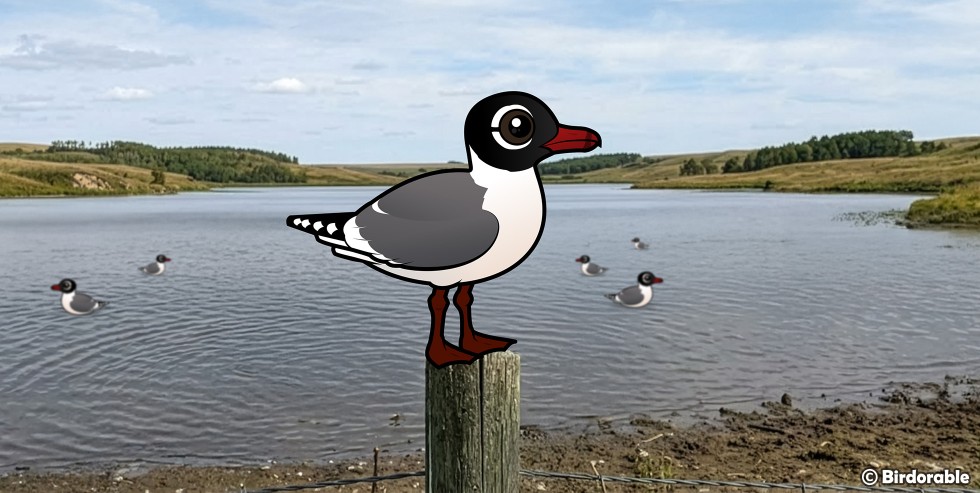
Illustration of a Birdorable Franklin's Gull with a black hood and red bill perched on a wooden fence post beside a prairie lake, with several real Franklin's Gulls swimming on the water behind it.

Not a beach in sight. A Franklin's Gull surveys its prairie lake, about as far from the sea as a "seagull" can get.

So Why Do Gulls Seem So Alike?

Partly because in most places the ones we see really are alike, and partly because lots of gulls are genuinely difficult to identify.

We tend to meet the same few species. The gulls that do well around people are a handful of big, adaptable ones. You could spend years visiting seaside towns in Britain or North America and mostly cross paths with only three or four species, all of them white and gray and much the same shape.

And gulls change their looks as they grow up. This is the part that catches nearly everyone out. Small gulls take about two years to grow into adult plumage, and the big ones like Glaucous, Caspian and Herring can take four. A young gull may be a mottled brown bird that looks nothing like its parents. So one flock might hold a single species wearing four different plumages, alongside several other species that closely resemble each other.

Experienced birdwatchers find this hard too. The Caspian Gull was taxonomically treated as a subspecies of the Herring Gull until relatively recently, and separating the two is one of birdwatching’s classic puzzles (in fact, the entire Herring Gull complex is somewhat fraught and complicated). The clues are all in the shape: a long slender bill, a sloping forehead, a small dark eye, long pale legs. Individuals may be carefully studied and still be noted by the birder as "probably.”

What the Word Costs

Here’s why it’s worth a bit of care.

The Herring Gull is the archetypal “seagull”: the big pink-legged one from the seaside, the one making lighthearted newspaper headlines about stolen food. It is also Red-listed in the UK, the highest level of conservation concern, after long-term declines estimated at around 60%. Britain and Ireland hold a substantial share of the entire world population.

Meanwhile, the Ivory Gull is classed as Near Threatened and falling, and the main reason is the loss of the sea ice its whole life is built around. The Canadian population dropped by roughly 80% between the 1980s and the early 2000s.

And the Silver Gull? Booming. It has adapted so well to towns and beaches that its numbers have risen wherever people gather.

Three birds. One collapsing, one in serious long-term trouble, one thriving. And one word, “seagull,” that flattens all three into the same slightly annoying bird at the beachside snack bar. When every gull is the same bird, a species quietly disappearing looks exactly like a species doing fine.

You Only Have to Learn One

You don’t need to identify every gull in the flock. Honestly, nobody does. But learning to name one can change how the rest look.

Start with what’s easy to see:

  • Legs. Pink, yellow, red, or black? Often the fastest clue there is.
  • Bill. A red spot, a black ring, a plain yellow bill, or bright red all over?
  • Wingtips. How much black, or is there any at all?
  • Size. Compare it to the gulls standing next to it, not to a bird in a book.

Pick the most distinctive bird in the flock and work out what it is. Next time, you’ll more easily spot it, and everything around it will suddenly look different by comparison.

That’s the whole trick. Not knowing every gull, just knowing that there’s something there to know.

What’s Your Favorite Gull?

Ours might be the Ivory Gull, following polar bears across the sea ice at the top of the world. Or the beautifully plumaged Heermann's Gull, with its subtle gray gradients. Which one would you pick? Tell us in the comments below!

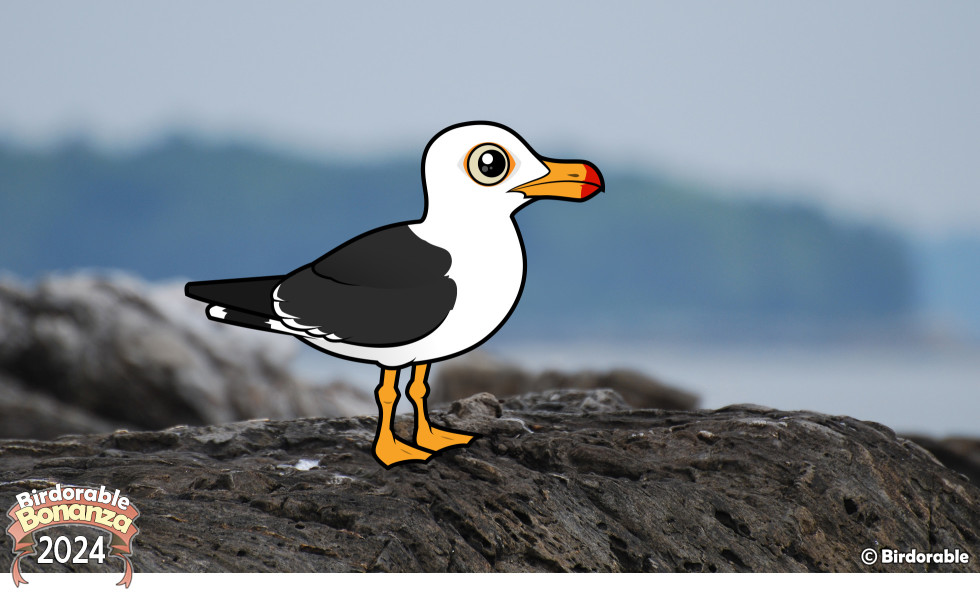
Birdorable Pacific Gull

Today's new species joins our family of Birdorable gulls! It's the hunky, chunky Pacific Gull!

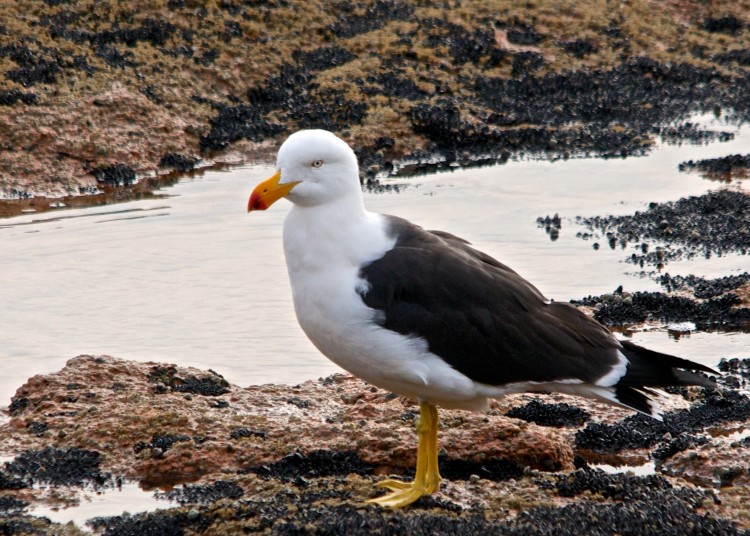
The Pacific Gull is a large and striking seabird native to the southern coasts of Australia. Known for its impressive size, bold markings, and strong, heavy beak, this gull is a charismatic species that commands attention wherever it goes.

Adult Pacific Gulls are easily recognizable by their black wings and back, contrasting sharply with their white head, neck, and belly. They also sport a bright yellow beak with a distinctive red tip, which is both eye-catching and perfectly adapted for breaking open tough prey like mollusks and crustaceans. Juvenile Pacific Gulls, in contrast, are mottled brown and gray, gradually transitioning to adult plumage over about four years.

This species inhabits coastal areas, including beaches, islands, rocky shorelines, and estuaries. They are rarely found far inland.

Unlike some gull species that form large colonies, Pacific Gulls are more solitary or seen in pairs. Their preference for quieter beaches and less urbanized areas distinguishes them from other more gregarious gulls.

Pacific Gull by Brian Ralphs [CC BY 2.0]

Pacific Gulls are opportunistic feeders with a varied diet. They forage for fish, squid, and other marine creatures but are also known to scavenge. Their powerful beaks enable them to crack open tough shells. They sometimes drop mollusks onto rocks to break them open, resulting in small piles of shells that may look like a strange natural formation but are just the leftovers from hungry gulls.

The breeding season for Pacific Gulls typically runs from late spring to early summer. They nest in isolated areas, often on remote islands or quiet stretches of coastline, where they can raise their young without disturbance. Their nests are shallow scrapes lined with vegetation, and females usually lay two to three eggs. Both parents share the responsibilities of incubation and feeding the chicks.

Although Pacific Gulls are not currently considered threatened, they face pressures from habitat destruction, pollution, and human disturbance, particularly in their breeding areas. Conservation efforts that protect coastal ecosystems are vital for the long-term survival of these impressive seabirds.

Whether soaring over the waves or patrolling the shoreline, the Pacific Gull is a symbol of Australia’s rugged coastal beauty. Its striking appearance and fascinating behaviors make it a favorite among bird enthusiasts.

Pacific Gull Gifts from Birdorable

Our 2024 Birdorable Bonanza continues tomorrow with another brand-new bird reveal! It's a sleek little songster with a bold black mask and bib, found in tropical savannas across much of South America. Can you guess what it is? Check out the silhouette and leave your guesses below! 🤔
We're celebrating gulls on the blog this week! Today we'd like to share a bird term that relates to some species of gulls. Let's find out about kleptoparasitism!

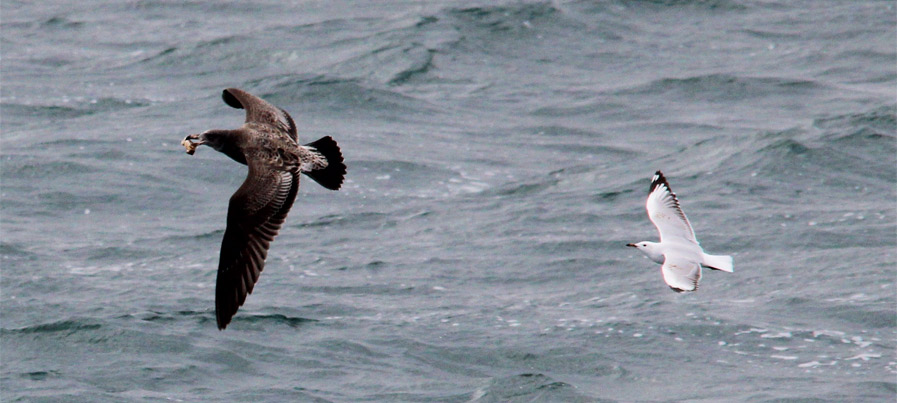
Seagull chasing juvenile pacific gull
Photo by Jade Craven (CC BY 2.0)

Kleptoparasitism is just what it sounds like - parasitism by theft (klepto-). It basically refers to one animal stealing food from another. Before we go on, it should be made clear that gulls are not the only species that engage in this behavior. They aren't even the only birds that do so.

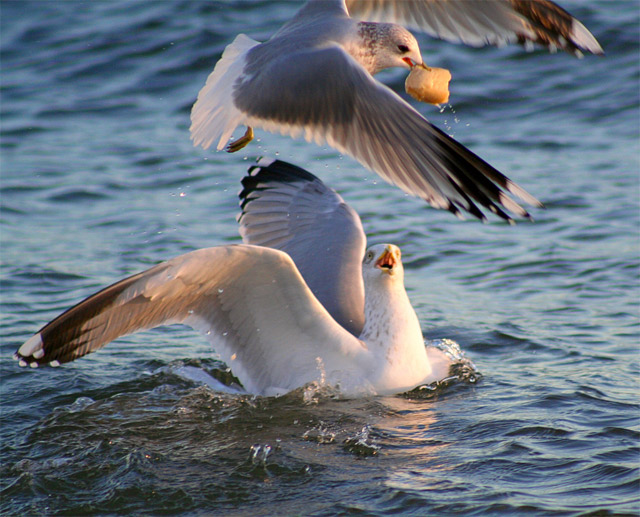
gulls stealing food
Photo by John Haslam (CC BY 2.0)

Why would one animal steal food from another? In some cases, the thief takes prey items that it would not be able to capture on its own. Sometimes the kleptoparasite steals food opportunistically, or to save the time and effort of obtaining prey. Kleptoparasitism can also refer to the theft of non-food items, like when Chinstrap Penguins steal nest material from other penguins to use in their own nest.

Birds in the seabird family Skua are known for their kleptoparasitic behavior. Some species of skua obtain a significant percentage of their food using this method, stealing prey caught by other seabirds.

Frigatebirds are known for this behavior as well, giving them the appropriate nickname "pirate of the sea".

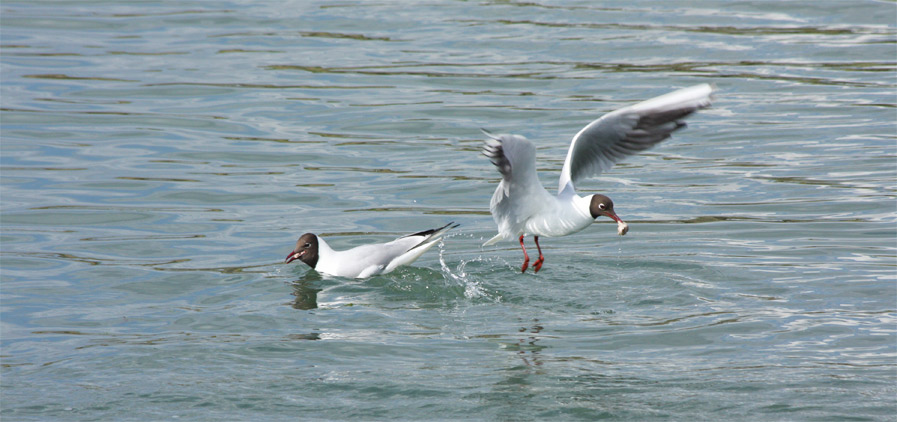
Gulls can be both perpetrators and victims of kleptoparasitism. Heermann's Gulls and Laughing Gulls are known to steal fish from Brown Pelicans, snatching anything that escapes from the pelican's bill as it surfaces from a hunt. Gulls may chase others of their own species in order to steal freshly caught prey or found food items.

stealing a meal
Photo by Mike Sutton (CC BY 2.0)

Chasing down deep diving fish hunters is a way for non-diving gulls to obtain food not otherwise available.

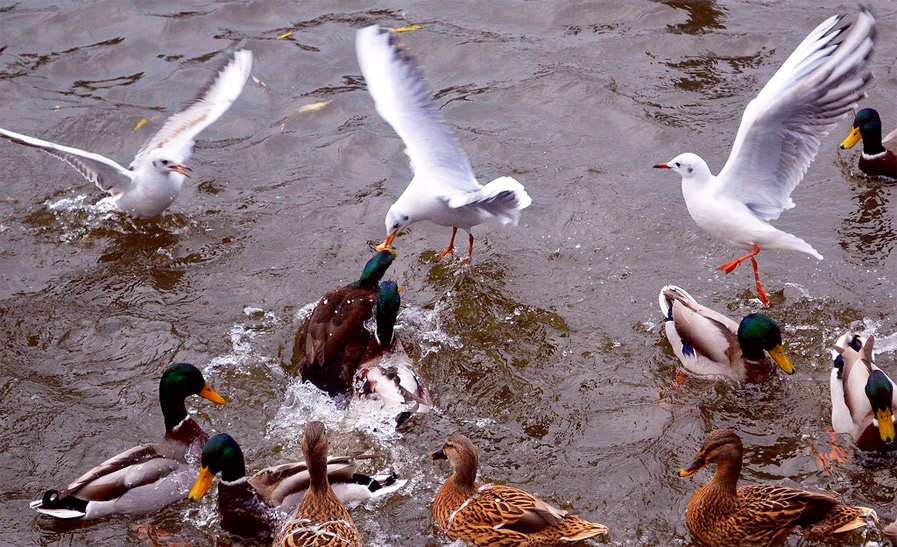
Stealing from the Mallard
Photo by Micolo J (CC BY 2.0)

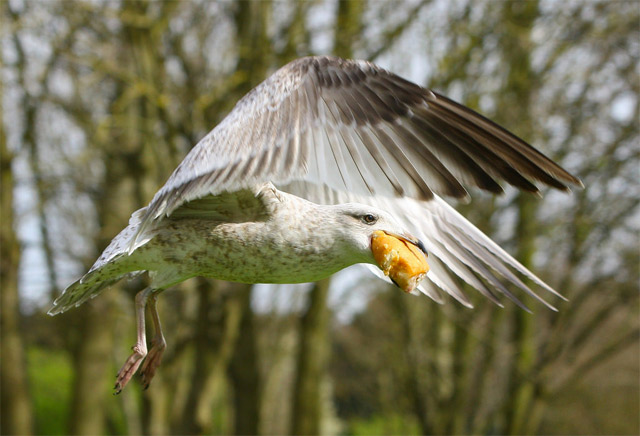
Gulls have also been known to steal food from humans! Has this ever happened to you?

Donut thief
Photo by Funk Dooby (CC BY-SA 2.0)
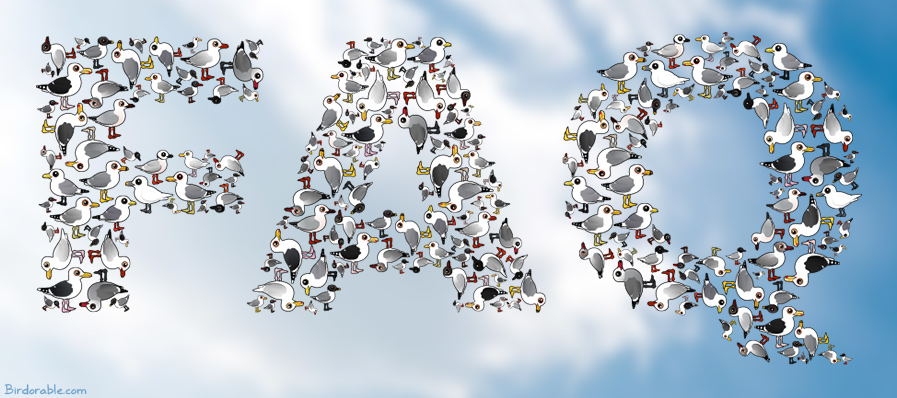
Large FAQ made of gulls

When we had our first Gull Week in 2015, we answered some Frequently Asked Questions About Gulls. Today we're going to answer a few more fun FAQs about the species in this family of seabirds!

What do gulls eat? Are gulls carnivores? What do gulls drink?
Gulls tend to be opportunistic omnivores. They'll take every chance to eat almost anything! Gulls feed on fish and other marine animals. They will eat insects, worms, eggs, and small land animals. Gulls may also feed on carrion and garbage, other birds, and plant matter like seeds and fruit. As far as drinking, gulls are able to drink sea water. A special gland helps them excrete the salt before it reaches the kidneys.

What do gulls do in winter? When do gulls migrate?
Most gulls migrate between wintering grounds and breeding territory. After mating season is complete, they move to warmer climates. The specific timing of this depends on their breeding calendar. Migration distances range from the Franklin's Gull's yearly trek from Canada to South America, to species that simply disperse to the coast from more inland breeding grounds.

What are baby gulls like?
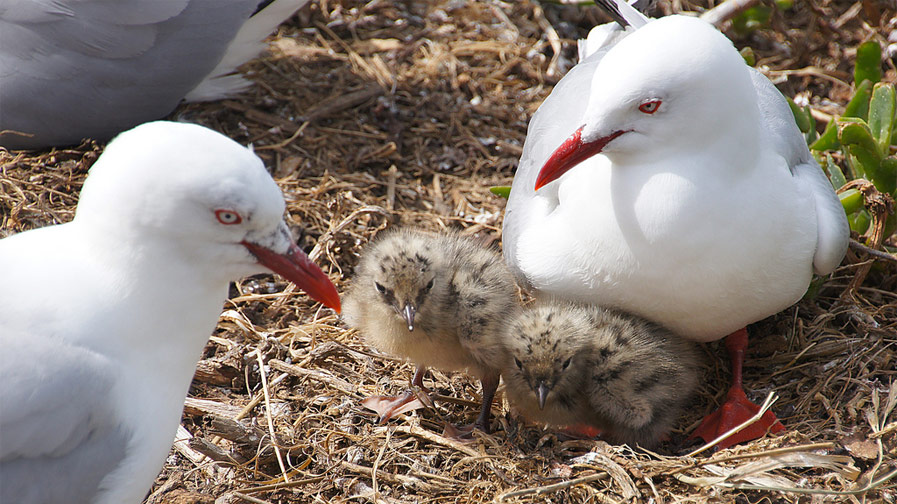
Most baby gulls have downy feathers when they hatch. In most gull species, chicks are precocial (or semi-precocial), meaning that they are relatively mobile and can leave the nesting site within a short time of hatching. Ring-billed Gulls fully leave their nest by 4 days of age. Baby Herring Gulls remain close to their nest site for the first week of life. Young gulls are typically dependent on their parents or other adult gulls for food until they fully fledge.

Red-billed Gulls with Chicks
Red-billed Gulls and Chicks by Bernard Spragg, NZ

Where do gulls go at night?
Most species of gull are diurnal, meaning they are awake during the day and at rest during the night. Gulls typically like to roost either on the water, or along beaches, dunes, or offshore islands. Sleeping on the water is only preferred when the water is calm. The exception to this is the Swallow-tailed Gull, the world's only nocturnal gull species. Instead of resting at night, they are on the hunt for food.

How can you tell how old a gull is?
This is a great part of the challenge of gull identification. There is no simple answer that covers all gull species. Gulls go through different plumages as they reach adulthood and they also go through two yearly molts.

The number of years it takes a gull to reach its full adult plumage ranges from two years for smaller gulls to three or four years for larger birds. Gulls of different ages will have different plumages.

Gulls also go through molts each spring (to "alternate plumage") and fall (to "basic plumage"). During a molt, which may take place over several weeks, the bird may appear to be in between two plumages.

In addition to the changes in a gull's feather appearance, there are changes that may occur to their legs and bills. These may change color as they age or molt!

When you know the specifics of how a species of gull ages and molts, you may be able to tell if a gull is one, two, or three years old, or an adult aged four or older.

Are gulls protected?
Sometimes gulls are considered to be nuisance birds. Their level of protection varies from place to place. In the United States, native gulls are protected under the Migratory Bird Treaty Act. In the United Kingdom, they are protected under the Wildlife and Countryside Act 1981 and the Wildlife Order 1985 (Northern Ireland).

Do gulls sing?
In general, gulls are not known for their melodious voices. Their vocalizations are often brash and loud, part of the soundtrack of the beach in many locations. Their vocalizations are typically referred to as calls, with each species utilizing a variety of different calls for communicating things like finding (or begging for) food, warning off intruders, sounding a predator alarm to the colony, and other reasons. Different calls will also be used for pair-bonding and even during copulation. Chicks have different call sounds than adults.

See our previous post for more frequently asked questions about gulls.

Birdorable Gull T-Shirts

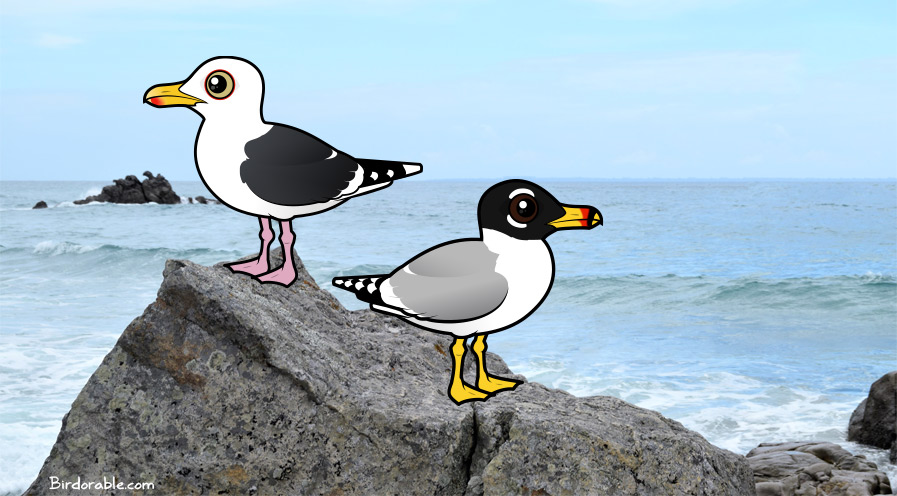
Birdorable Western Gull and Pallas's Gull

Two new birds in the gull family Laridae join Birdorable this week! We've added the Pallas's Gull and the Western Gull to our cute cartoon bird family.

The Pallas's Gull is one of the largest species of gull in the world. It is a so-called "black-headed" gull because it is one of several species of gull that develops a fully black head during breeding season. An alternative name for this bird is the Great Black-headed Gull. They can weigh over four and a half pounds as full adults! Only the Great Black-backed Gull and Glaucous Gull average larger.

This bird is named after the prolific naturalist Peter Simon Pallas, who has several other species named in his honor, including Pallas's Cat, Pallas's Squirrel, and Pallas's Tube-nosed Bat.

The Western Gull is another large species of gull -- they can weigh in at three pounds or more. This is a "white-headed" gull found along the Pacific coast of North America. Western Gulls feed on the ocean, taking prey like squid, fish, and jellyfish on the surface since they are unable to dive. Western Gulls will also feed on carcasses of large marine mammals like sea lions, and opportunistically take food items like snails and starfish in intertidal habitats.

The San Francisco Giants have experienced problems with flocks of Western Gulls visiting their stadium in the late innings of baseball games. They presumably come to feed on refuse left in the stands by fans, but before the game is over flocks visiting the park poop on fans and swarm the playing field. The native birds are protected by federal law, although the Giants could get the gulls to disperse with the help of a falconer.

Pallas's and Western Gull Gifts

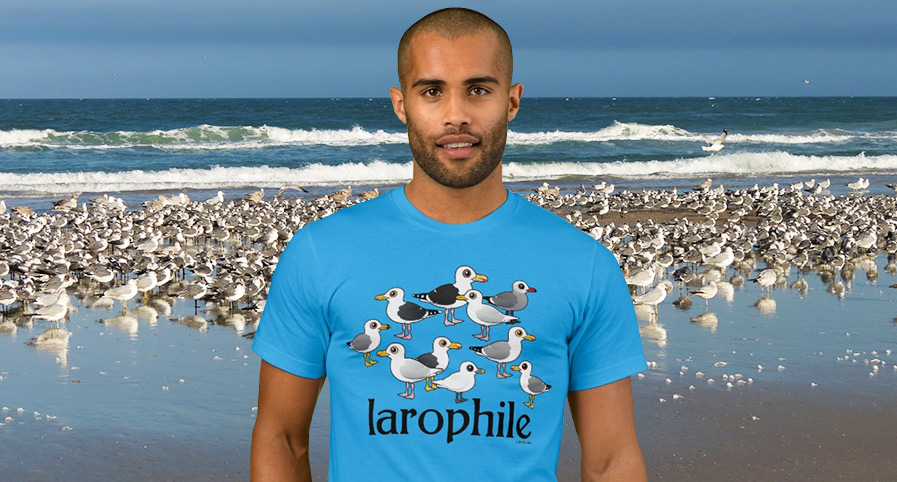
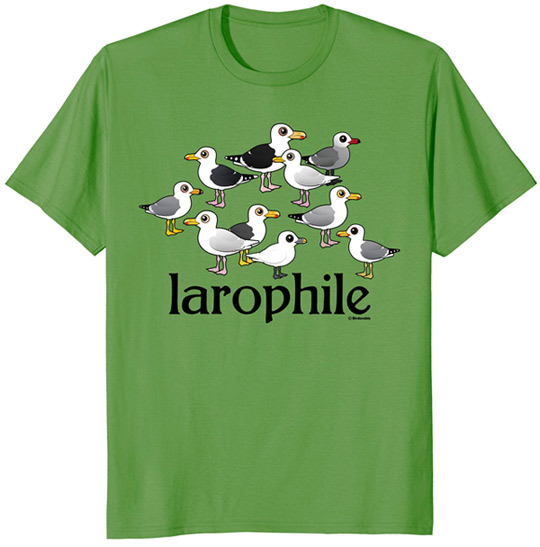
Birdorable Larophile t-shirt

We're celebrating gulls this week, so for T-Shirt Tuesday we're featuring a new t-shirt design made for people who love seagulls!

Larophile is shown here on a Men's Basic American Apparel T-Shirt, which is available in over 30 different colors. The design features nine of our cute cartoon gulls, each illustrated in our unique cartoon style. The birds are: Heermann's Gull; Herring Gull; Great Black-backed Gull; Lesser Black-backed Gull; California Gull; Ring-billed Gull; Ivory Gull; Iceland Gull; and a new species we'll formally introduce later this week -- the Western Gull.

Larophile is available via our Zazzle shop on many different t-shirt styles and colors for men, women and children. You can see a selection of the apparel and other gift items available with this design at the bottom of this post, or click here to see them all.

Larophile is also available on t-shirts via Amazon. You can find it on t-shirts for men, women, and kids. Click here for our Larophile shirt on Amazon.

Birdorable Larophile t-shirt on Amazon

More Larophile T-Shirts

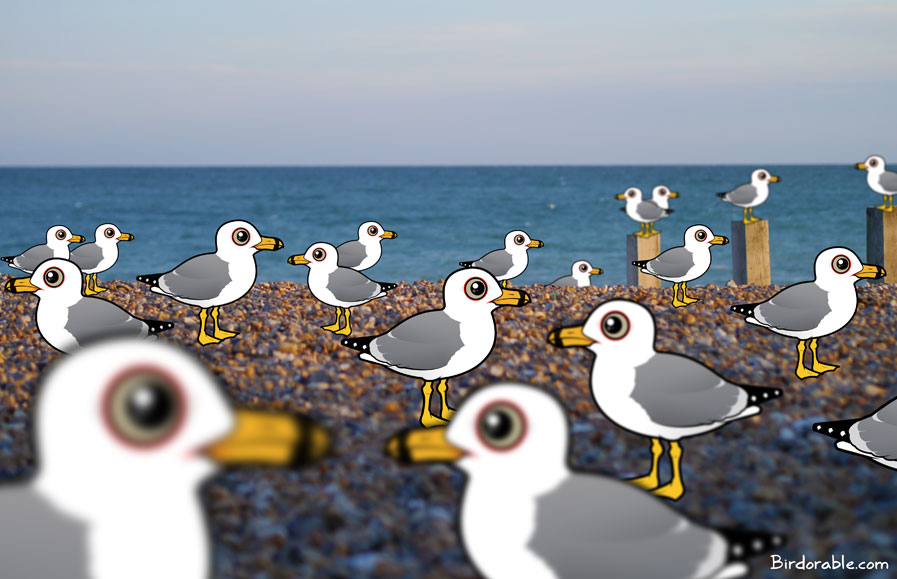
This week, we're celebrating gulls! There are about 55 widely recognized species of gull in the world. We'd like to share some of the extreme facts and interesting statistics found within this diverse family.

Smallest Gull Species
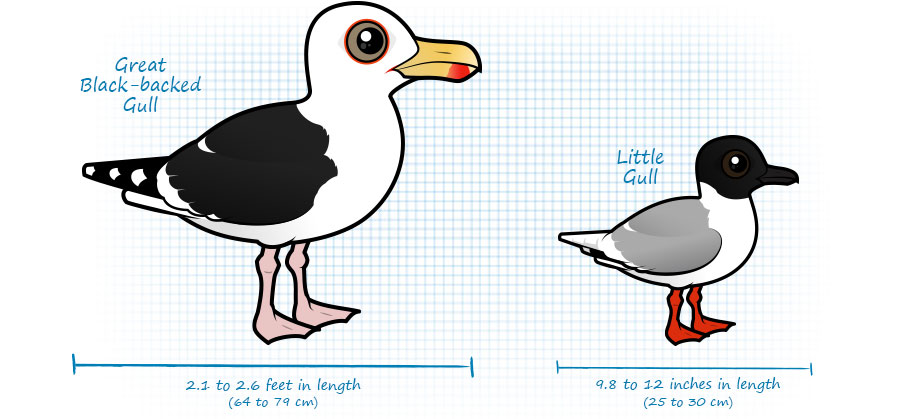
The Little Gull, weighing in at around 4.2 ounces (120 grams), is the smallest species of gull. Its length is  9.8 to 12 inches (25 to 30 cm).

Largest Gull Species
The largest gull species in the world is the Great Black-backed Gull, which weighs in at around 62 ounces (1750 grams), almost 15 times as heavy as the Little Gull. It's length is 2.1 to 2.6 feet (64 to 79 cm). 

Compare sizes of Great Black-backed Gull and Little Gull

The Longest Living Gulls
Gulls, particularly the large "white-headed" gulls, can be long-lived. The longevity record for the European Herring Gull is 49 years! The longest-lived wild Great Black-backed Gull was over 27 years old.

Cross-Species Parenting
The Black-headed Duck of South America is known to be a brood parasite of the Brown-hooded Gull. The duck lays eggs in nests of other birds (including other ducks and other gulls) and lets the nest-owners do the incubating! The ducklings are able to leave the nest just hours after hatching, making their escape without otherwise disturbing the nest. The Brown-hooded Gull or other nesting adult will continue to care for its own eggs and chicks.

Tale of the Tails
Most species of gull have a rounded tail. There are only three exceptions: the Sabine's Gull and Swallow-tailed Gull have forked tails, and the Ross's Gull has a wedge-shaped tail.

Longest Migration
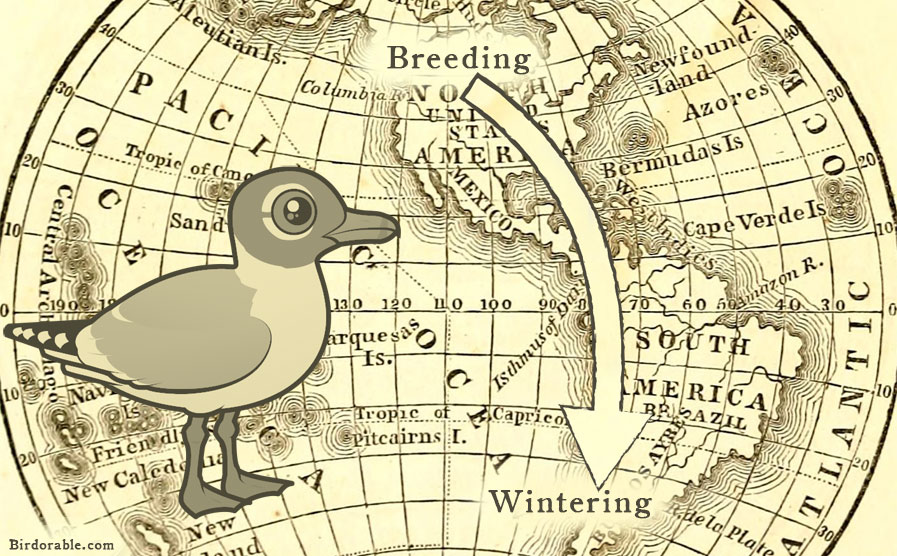
Many species of gull are migratory. The Franklin's Gull may have the longest migration of all the gulls. They breed as far north as central Canada, and spend the winter as far south as Chile and Argentina.

Franklin's Gull Migration Map

Rare Gulls & Threatened Species
The Lava Gull of the Galapagos Islands is considered to be Vulnerable to extinction. The small population of less than 400 pairs is relatively stable but the species is probably the rarest of all the gulls.

The Black-billed Gull of New Zealand is considered to be Endangered. The population has been on a rapid decline since the introduction of invasive predators to New Zealand, like weasels and cats.

Other species considered to be Vulnerable to extinction are the Relict Gull of central Asia, the Saunders's Gull of eastern Asia, and the both the Red-legged Kittiwake and the Black-legged Kittiwake.

Most Abundant
The Ring-billed Gull was once hunted for its feathers. With protection the species has rebounded and is likely the most common species of gull in North America.

Birdorable Flock of Ring-billed Gulls

Night Vision
The Swallow-tailed Gull is a "black-headed" gull found in the Galapagos Islands. They are the only completely nocturnal gulls in the world! They feed on squid and fish that only come to the water's surface at night. In order to be able to see in the dark, the Swallow-tailed Gull has very large eyes -- larger than any other gull species!

Gull Week 2018: Introduction

Join us in the following days as we celebrate all things gulls with our second Gull Week! Our first Gull Week was back in 2015. Gulls are part of a widespread family of social and intelligent seabirds.

Birdorable has 23 species of gull so far, out of the approximately 55 recognized species of gull in the world. We'll add a couple more this week to make it a cool 25!

To kick off the week, let's take a look back at how we've featured gulls here at Birdorable in the past:

Since our first Gull Week, we've added a couple of new species to the family. Check out our Grey-hooded Gull and Iceland Gull. We hope you'll join us this week as we celebrate gulls on the Birdorable blog!

Cute Birdorable Gull Apparel

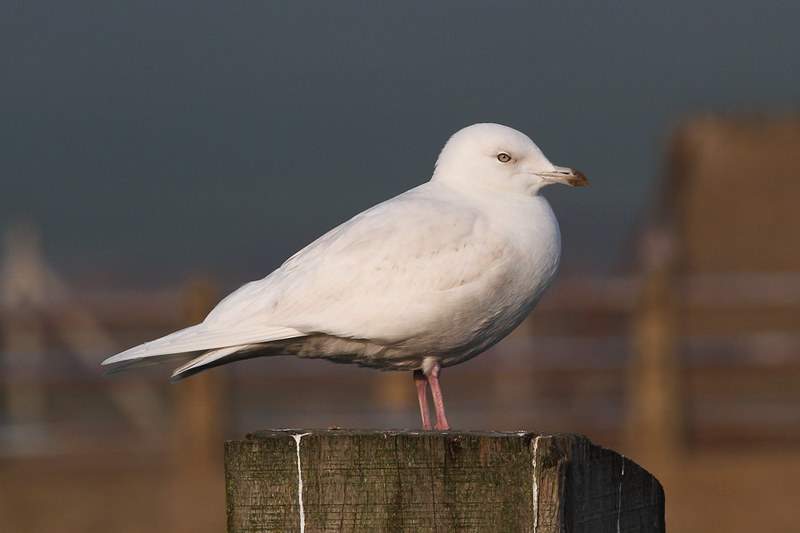
Birdorable Iceland Gull

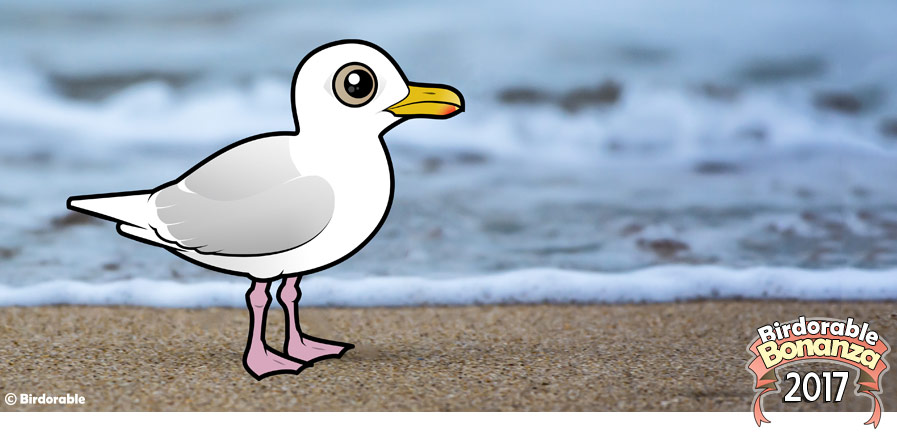
Today our 2017 Birdorable Bonanza continues with the Iceland Gull!

The Iceland Gull is a medium-sized gull that breeds in the Arctic. The species is migratory; many birds spend the winter between the Great Lakes and the northeast of the United States.

Iceland Gulls are colonial breeders, using rocky cliffs for nesting. They feed on fish, often taken on the wing, as well as other marine animals. Outside of breeding season they may also be found foraging for food in other places like beaches and trash dumps.

Iceland Gulls have three recognized subspecies. The nominate subspecies is joined by Thayer's and Kumilien's. Thayer's was considered a separate species until 2017.

Iceland Gull (Larus glaucoides)
Iceland Gull (Larus glaucoides) by Ron Knight

Tomorrow's new species will join our Birdorable macaw family. It is a relatively small species named for the color of its head. Can you guess the bird?

Cute Iceland Gull Gifts

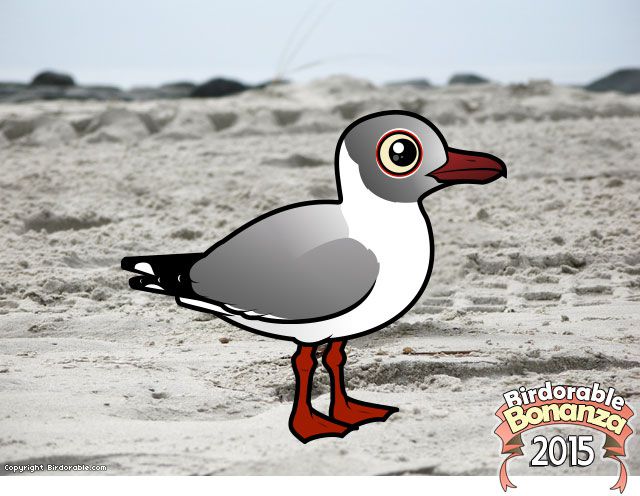
Our Birdorable Bonanza: 2015 Advent Edition continues today with a gull found on two continents: the Gray-hooded Gull!

Birdorable Grey-hooded Gull

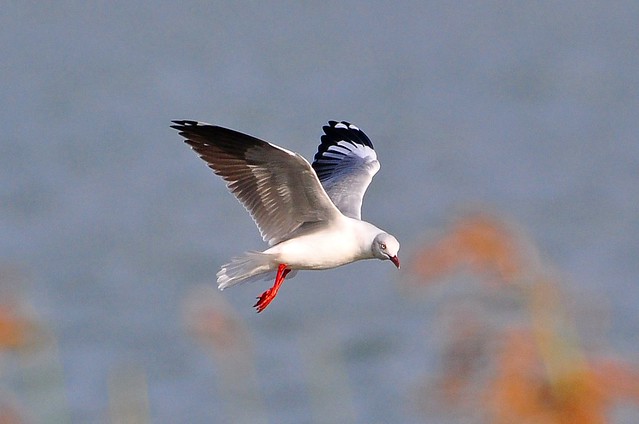
The Gray-hooded Gull, also known as the Grey-headed Gull, is a small species of gull found across parts of South America and sub-Saharan Africa. These birds breed in both coastal areas as well as around inland freshwater bodies.

Gray-hooded Gulls take two to three years to reach full maturity and adult plumage. Breeding adult birds are grey around the face with a faint darker outline. Wings appear grey with black primary feathers, while the underparts and neck are white.

In 2011 a vagrant Gray-hooded Gull was found by birders on Coney Island in New York. That bird may be the northernmost recorded bird of its species. You can read about this interesting sighting on Amar Ayyash's North American Birding article The Coney Island Gray-hooded Gull.

Grey-headed gull
Grey-headed gull by Bob Adams (CC BY-SA 2.0)
Grey-headed Gull  (Chroicocephalus cirrocephalus)
Grey-headed gull by Ian White (CC BY-ND 2.0)

The Gray-hooded Gull is our 628th Birdorable bird. Be sure to check out our collection of apparel and gifts featuring the Birdorable Gray-hooded Gull!

Our Bonanza continues tomorrow with an Old World pied flycatcher. Can you guess tomorrow's species?