Monday, September 1st will mark the 100 year anniversary of the death of Martha, the last of her species, the Passenger Pigeon. With her death our planet lost another species forever to extinction. This week we'd like to share some of the commemorative events and educational opportunities that are taking place to mark this important centenary.

A new documentary about Passenger Pigeons was created to coincide with this anniversary. From Billions to None: The Passenger Pigeon's Flight to Extinction follows the amazing demise of what was probably the most abundant bird species on earth. It also notes the threats facing species today and what we can do to avoid the human-driven loss of more species. Here is a long trailer for the documentary created for its fund-raising campaign.

From Billions To None is now complete and recently had its world premiere screening in Chicago. Soon the documentary will air on PBS channels across the United States. The program is scheduled to air tonight on WNPT in Nashville, and later this month on public broadcasting stations in Indianapolis, Kentucky, and Chicago. A partial list of airings can be found here; follow the From Billions to None on Facebook to learn of more airings and/or check your local listings.

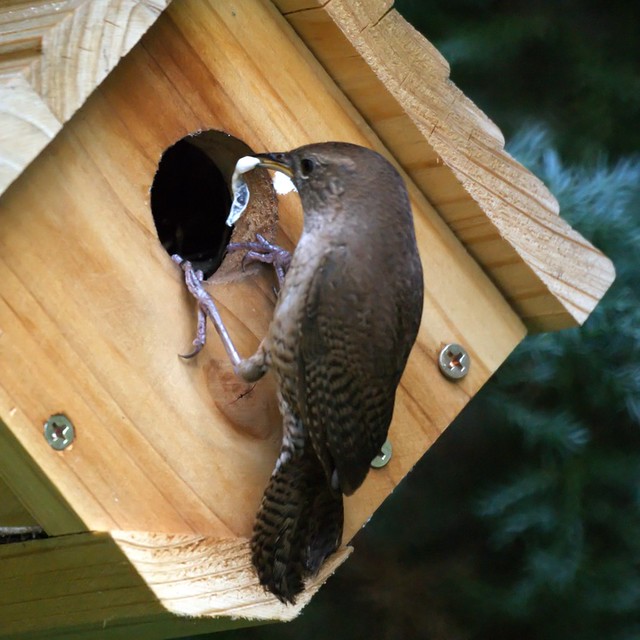
Birds don't wear diapers. But in some songbirds, babies expel their waste in a membrane-filled sac, which is then removed from the nest by a parent.

House Wren with Fecal Sac (Cleaning the nest)
Fecal sac removal by House Wren; photo by Mike's Birds

Keeping the nest clean isn't just about good hygiene. Removal of waste reduces the chances that predators will find (by scent) the vulnerable nestlings. It may also help to prevent illnesses developing in the baby birds. Fecal sacs are removed from the nest, sometimes right as they are being produced! Some baby birds give a 'signal' to indicate they are about to eliminate (poop). The below video shows a baby American Robin shifting around in its nest to expose its backside. The adult waits for the sac and then removes it immediately.
Parent
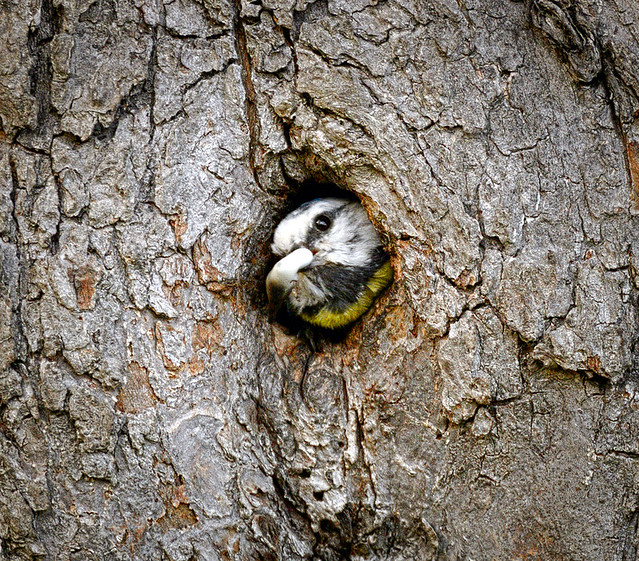
Blue Tit carrying fecal sac away by hedera.baltica

Some baby birds leave their fecal sacs along the outer edge of the nest for later removal, as can be seen in this video of a Carolina Wren nest, though the adult happens to remove the sac immediately in the clip. Sometimes the need to eliminate comes immediately after feeding, which can be seen in clearly in this video. Most people aren't even aware that this amazing baby bird "diaper service" exists. But if you live among Common Grackles, and you happen to have a swimming pool, you just might be painfully aware of fecal sacs. Grackles are naturally inclined to deposit fecal sacs in water - streams, ponds or rivers, traditionally. However, if a swimming pool is convenient, it might just end up being a favorite "sewer service" for neighborhood grackles!

Earlier this month, scientists named the 100 most unusual and endangered birds in the world. The species on the list were taken from the world's approximately 10,000 bird species, and ranked by their evolutionarily distinctiveness and conservation status. Here at Birdorable we like to highlight both unusual birds as well as species that need conservation help.

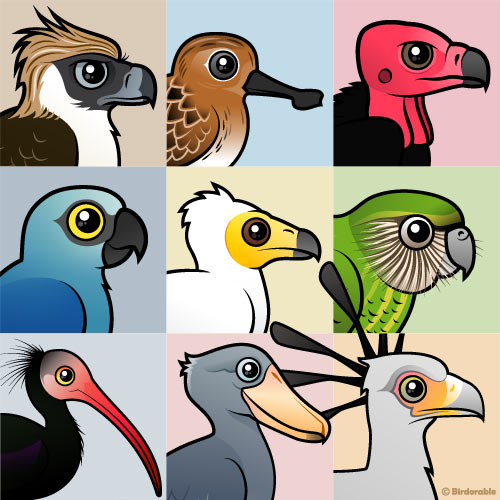
top-unusual-birds

Eleven of the birds on the top 100 list can be found here in our unique cute cartoon style. Birds on the list include the iconic California Condor, struggling back from the brink of extinction thanks to dedicated scientists and conservationists, and the unusual Shoebill, which is also known as Whalehead or Shoe-billed Stork.

Return of the California Condor

The list of endangered and unusual birds also includes species in the parrot family, like the nocturnal and non-flighted Kakapo, endemic to New Zealand, and the Spix's Macaw of Brazil. Other Birdorable birds on the list: Philippine Eagle; Spoon-billed Sandpiper; Northern Bald Ibis; Red-headed Vulture; Secretary Bird; Egyptian Vulture; Kokako.

These birds and all of the others on the list are in conservation trouble, just like the Passenger Pigeon was over 100 years ago. This year marks the 100th anniversary of the final loss of this species. In September 1914, the last Passenger Pigeon died, and the species was lost forever. If you can, please support groups working hard to save species by conserving habitat, enacting regulations that help the environment, and other heroic deeds to help our fellow creatures of Earth. Share your love of birds and the environment so that others may share your passion and work to save those in trouble, too!

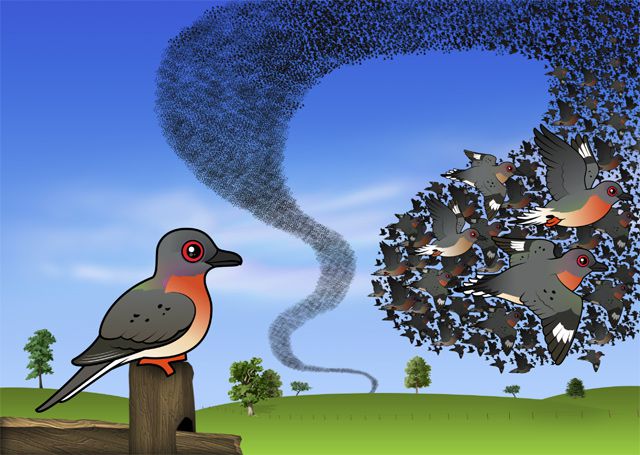
Billions of Passenger Pigeons

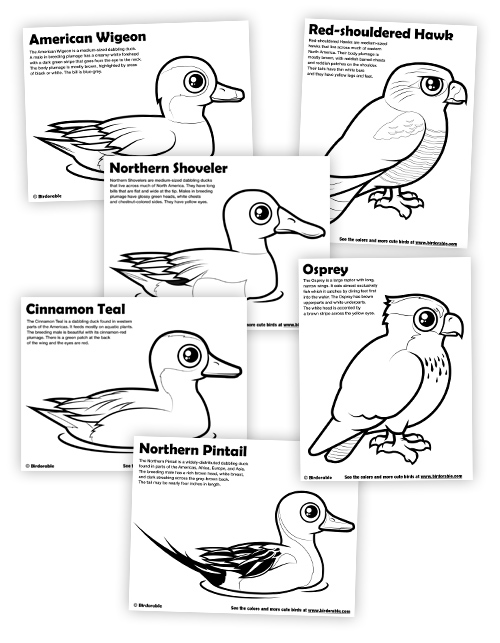
We added six brand-new coloring pages with some great ducks and birds of prey:

Birdorable Coloring Pages

Check here for more coloring pages. Subscribe to the Birdorable Blog by RSS feed or by email to get notified when new downloads like this are added. Have you used our coloring pages at home, in your classroom, or at an event? We’d love to hear about it! Send us photos of the pages in action, or the final result – we may showcase them on our blog!

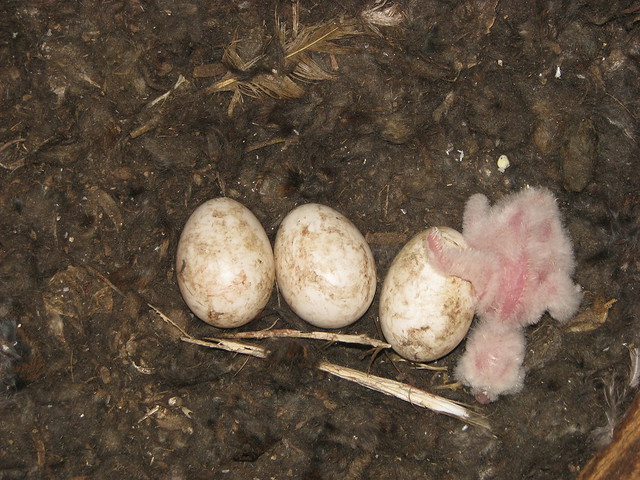
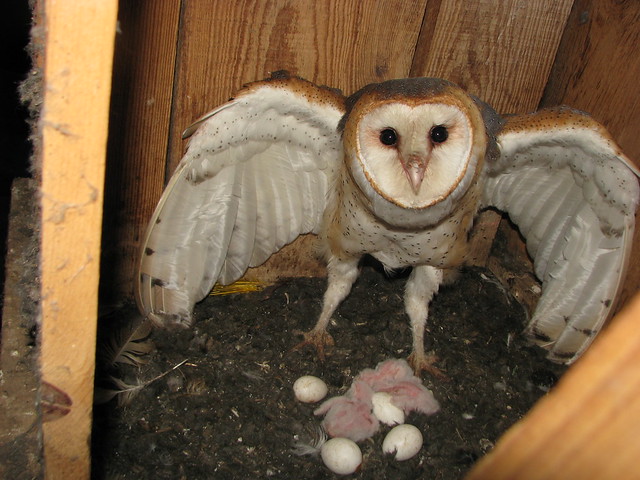
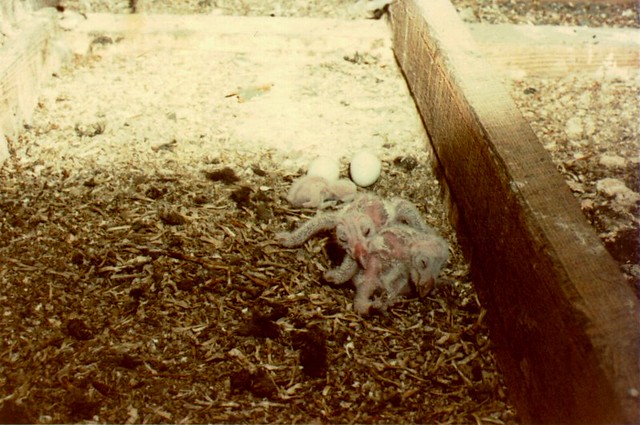
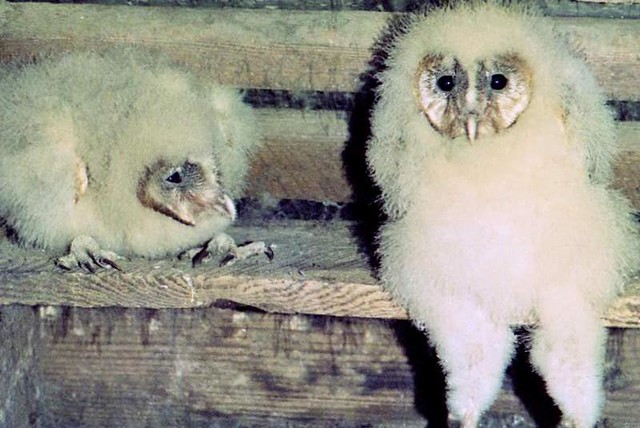
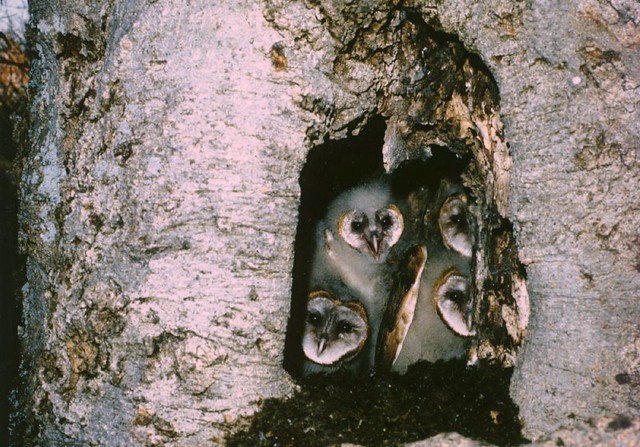
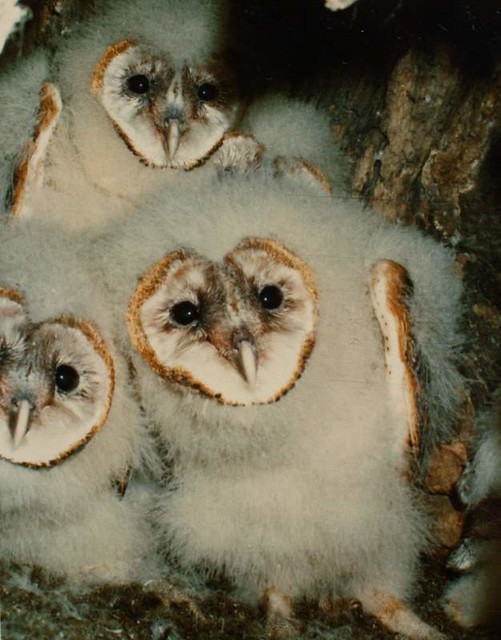
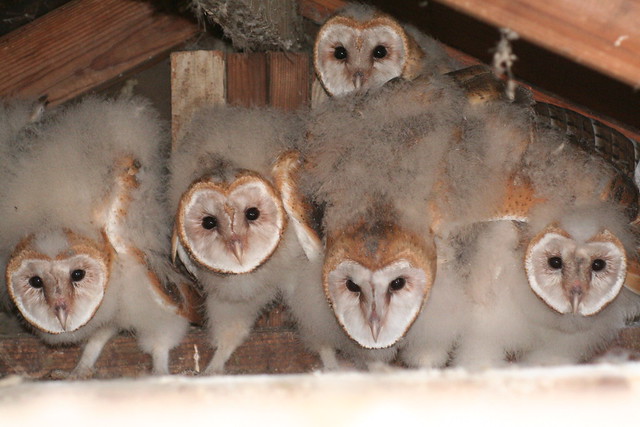
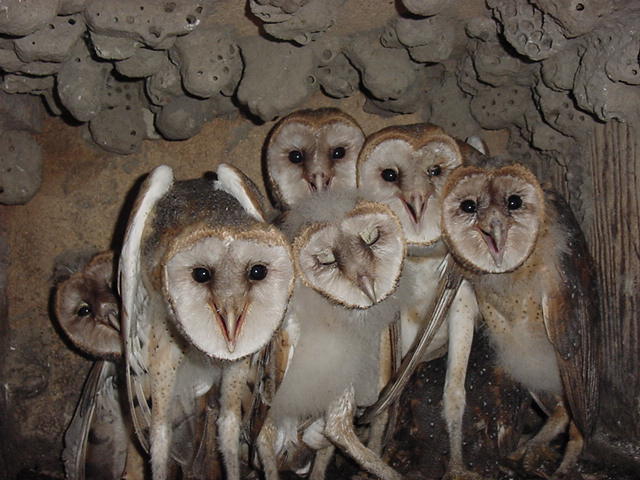
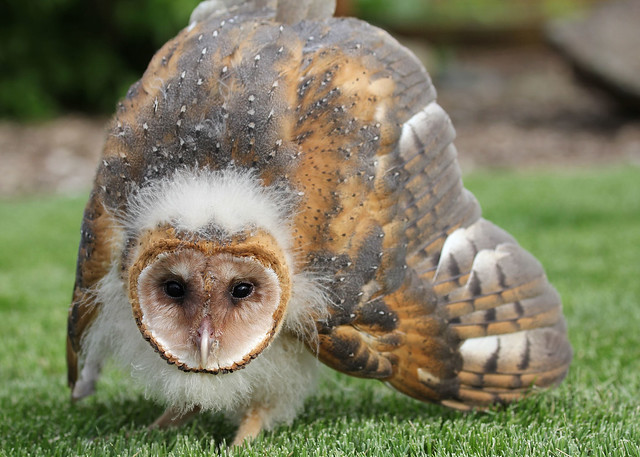
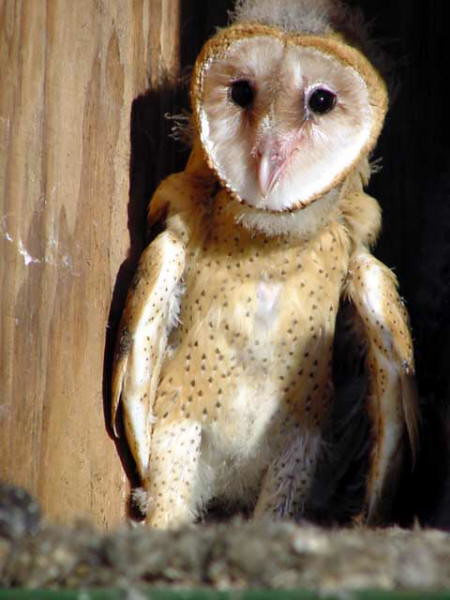
If you think our Birdorable birds are cute as adults, what about when they are babies? Below are some baby photos (shared via Flickr Creative Commons) of the Barn Owl. Barn Owls are cavity nesters. They use a variety of structures, including natural sites like tree cavities, cliffs, rocky outcrops, as well as a huge range of man-made structures. Barn Owls will use nest boxes, too. There are some popular nestcams set up in established Barn Owl nests, including Owl Channel, Mel & Sydney, and Audubon Starr Ranch Barn Owls. With their heart-shaped faces and their super-fluffy appearance, baby Barn Owls may look a bit goofy, but we think they are cute, too! What do you think?

Day old hatchling with peeping eggs
Day old hatchling with peeping eggs by rebonnett
Protecting angel, we all have one.
Protecting angel, we all have one. by rebonnett
Owl Hatchlings and Eggs in Attic of Abandoned House (1981)
Barn Owl Nest with Young in Abandoned House (1981) by Hunter-Desportes
Young Barn Owls in Attic of House (1981)
Young Barn Owls in Attic of House (1981) by Hunter-Desportes
Young Barn Owls in Tree Nest (1981)
Young Barn Owls in Tree Nest (1981) by Hunter-Desportes
Young Barn Owls in Tree Nest (1981)
Young Barn Owls in Tree Nest (1981) by Hunter-Desportes
Owlets
Owlets by chdwckvnstrsslhm
Barn Owl
Barn Owl by USFWS Mountain Prairie
001_barn_owl_chick_myatt_odfw
Barn Owl Chick by Oregon Department of Fish & Wildlife
Baby Barn Owl
Baby Barn Owl by sanangeloinsurance

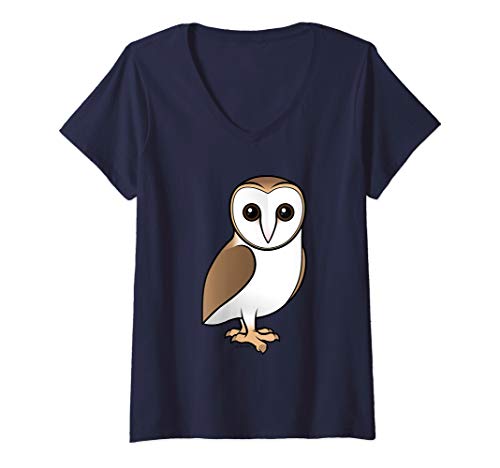
Pretty cute, right? Be sure to check out our Birdorable Barn Owl t-shirts and gifts!

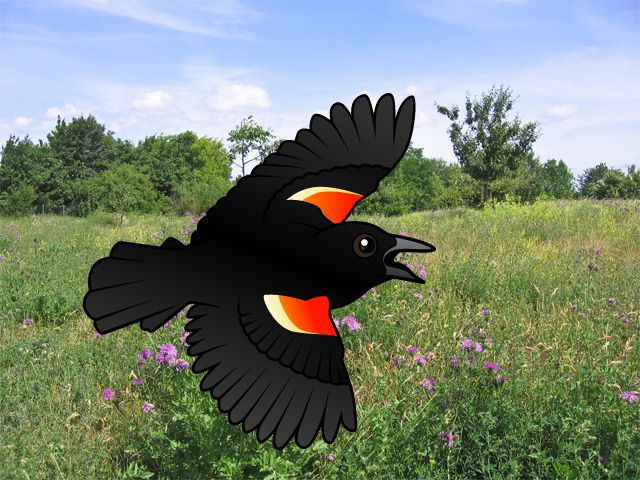
Red-winged Blackbirds range across much of North America, from parts of Alaska and the Northwest Territories of Canada, down through Mexico and into parts of Central America. Though a good portion of the population remains resident year-round, throughout northern parts of their range, they are considered a harbinger of spring. That first "KonkaREE!" heard in the late winter can be music to a birder's ear. Here are some interesting facts about the Red-winged Blackbird.

1) In several Ojibwa language dialects, the species is called memiskondinimaanganeshiinh, which means roughly "a bird with a very red shoulder-blade"

2) There are at least 22 subspecies of Red-winged Blackbird, most of which look virtually alike

3) The Red-winged Blackbird is in the Icteridae family of birds, which also includes Brown-headed Cowbirds, Grackles, and Orioles

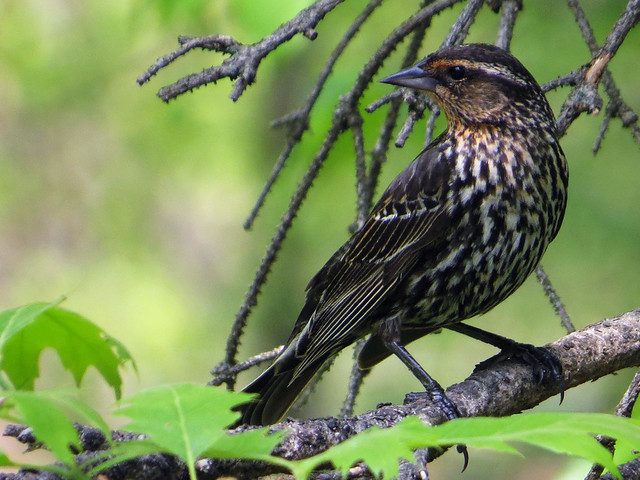
4) While male Red-winged Blackbirds are unmistakeable in the field, sometimes female or juvenile birds pose an identification puzzle. Their streaky bodies resemble some species of sparrow

Red-winged Blackbird

5) The diet of Red-winged Blackbirds varies; they will eat both insects (more often in the summer) and seeds (more often in the winter). At feeders they will dine on suet and other bird seed; one of their favorites is sunflower seeds

6) Male Red-winged Blackbirds like to play the field. One male may have up to 15 different females nesting in his territory...

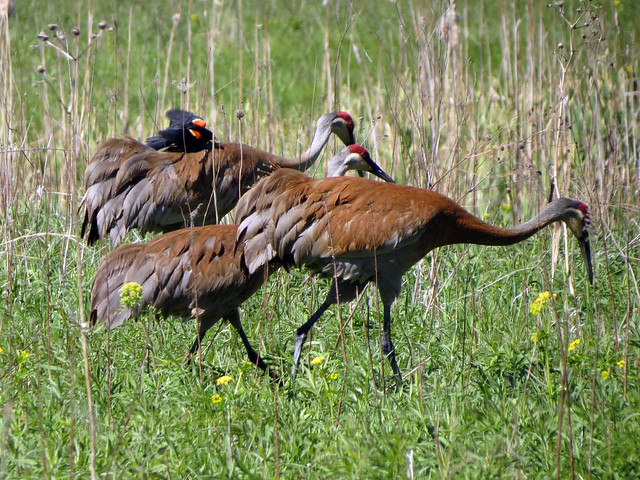
7) ... which he fiercely defends from intruders. Here a Red-winged Blackbird, weighing no more than 3 ounces, takes on three Sandhill Cranes, which can weigh 10 lbs or more!

apulets
Red-winged Blackbird attacks Sandhill Cranes

8) The longevity record for the Red-winged Blackbird is 15 years and 9 months; this is known from bird banding efforts

9) In flight, Red-winged Blackbirds may reach speeds up to 30 miles per hour!!

10) The Red-winged Blackbird is one of the most abundant species found in North America. Their conservation status is Least Concern as of 2012

Big Year Excitement!

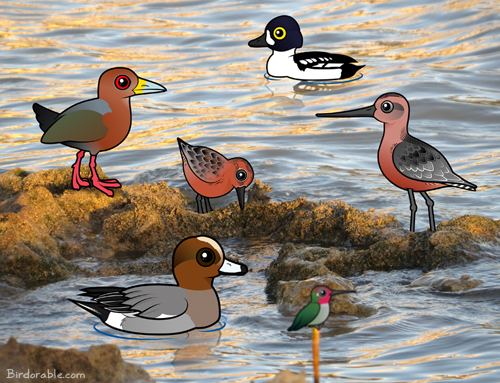
Do you know what all of the birds in this picture have in common?

Big Year Birds

Left to right: Rufous-necked Wood-Rail; Eurasian Wigeon; Red Knot; Barrow's Goldeneye; Anna's Hummingbird; and Bar-tailed Godwit.

You're not likely to find them all in the same spot, that's for sure! But these species were all seen in North America this year by Neil Hayward, a birder doing a North American Big Year. As of this afternoon, Hayward has seen a total 744 species in 2013, with 3 additional "provisional" species. That puts him in a very good position to break the record set by Sandy Komito, who saw 745 (+3 "provisional") species in 1998.

Komito had serious competition from two other birders during that big year. The adventures of all three became the basis for a popular book and the big screen film "The Big Year" starring Steve Martin, Owen Wilson, and Jack Black. Hayward is maintaining a very entertaining blog of his year at Accidental Big Year 2013.

Have a look -- the next two weeks will probably see him zipping from state to state and he could very well blow the record out of the water!

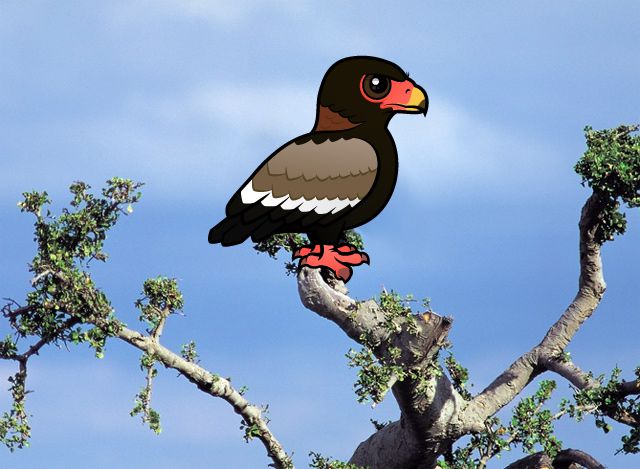
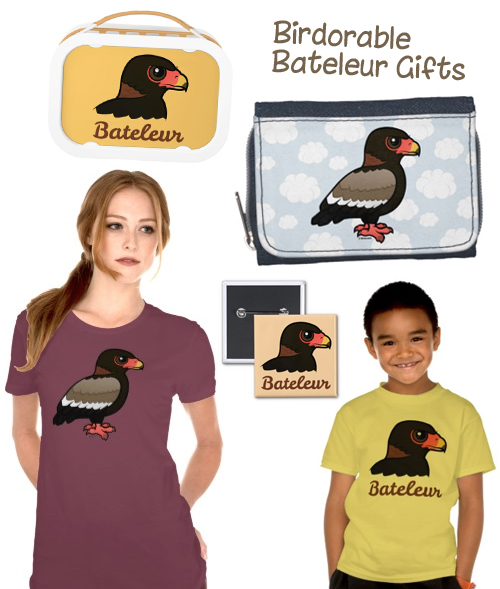
The Bateleur is a beautiful and rather colorful species of eagle found in parts of Sub-Saharan Africa and Arabia.

Birdorable Bateleur

The name Bateleur means "Street Performer" in French. The bird is so named particularly after tight-rope walkers, because of its habit of rocking while soaring or gliding, as if keeping its balance. Adult Bateleurs are notable for their extremely short tails, especially when compared to other birds of prey.

It takes seven or more years for a Bateleur to reach full adult maturity; before that time their tails are actually longer than those of full-grown adults! Juvenile wing feathers are longer as well; as young birds learn to fly, they use the longer feathers to keep stable in the air. During each molt from hatching to adulthood, the wing and tail feathers grow in shorter and shorter.

The Bateleur is thought to be the species represented by stone-carved Zimbabwe Bird sculptures. The carvings, found in the ruined city of Great Zimbabwe, were created in the 11th century and later. The country is named for the ancient city and the Zimbabwe Bird is the national emblem of modern Zimbabwe.

We recently added the Bateleur to Birdorable. If you can't get enough of this very interesting and colorful bird of prey, be sure to check out our collection of cute cartoon Bateleur gifts!

Birdorable Bateleur Gifts

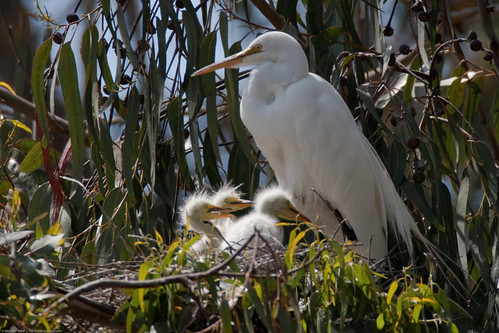
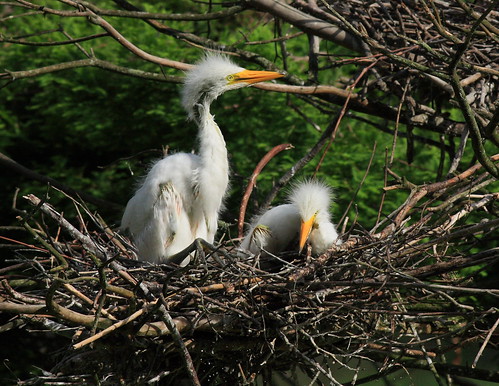
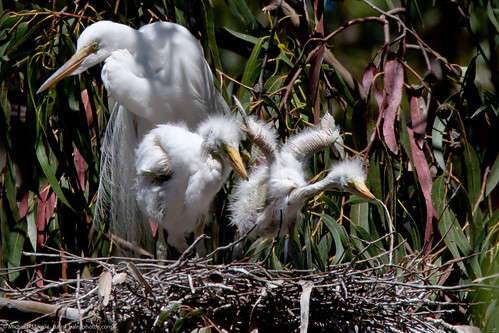
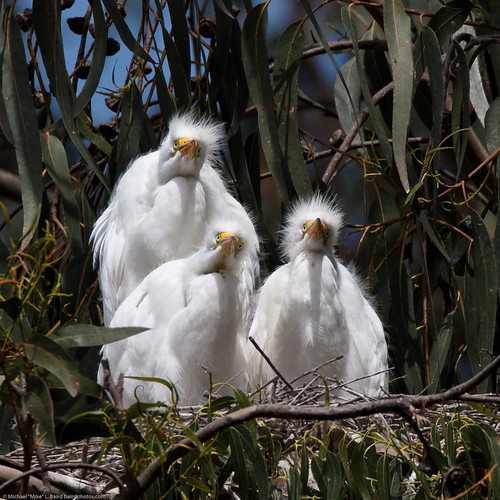
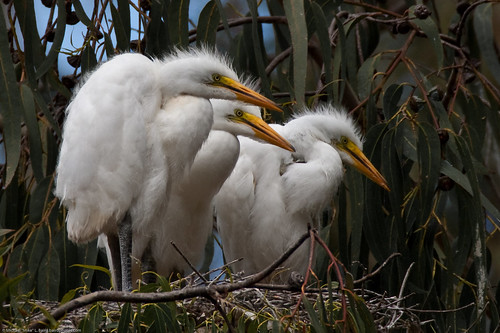
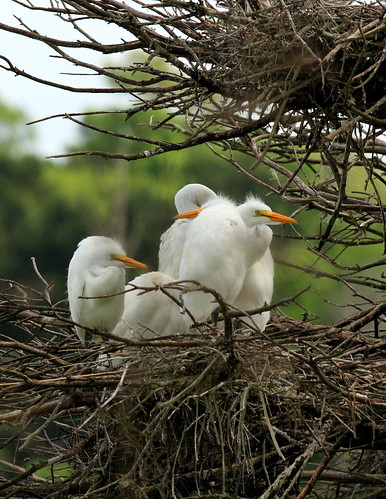
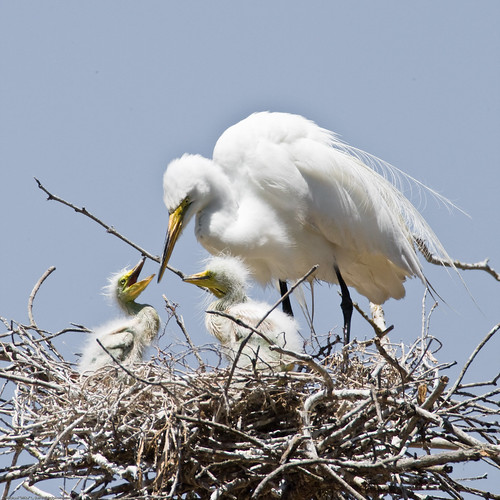
If you think our Birdorable birds are cute as adults, what about when they are babies? Below are some baby photos (shared via Flickr Creative Commons) of the Great Egret. Great Egrets nest in a large colony group, which is known as a rookery or a heronry. In North America, the average clutch size (number of eggs laid) is about three. Incubation takes 23-27 days. Young chicks have a sort of prehistoric look to them, but they get progressively cuter as they age:

Great Egret (Ardea alba) nest with three chicks at the in the Morro Bay Heron Rookery 21 May 2009
Great Egret (Ardea alba) nest with three chicks at the in the Morro Bay Heron Rookery 21 May 2009 by mikebaird
Great Egret Chick
Great Egret Chick by Andrea Westmoreland
(4 of 9) Great Egret Chicks in Nest w/ Parent
(4 of 9) Great Egret Chicks in Nest w/ Parent by mikebaird
great egret chick pair woody
great egret chick pair woody by JKD Atlanta
2 of 3 Great Egret Nest with Adult and Two Chicks, Heron Rookery, Morro Bay, CA 27 May 2010
2 of 3 Great Egret Nest with Adult and Two Chicks, Heron Rookery, Morro Bay, CA 27 May 2010 by mikebaird
5 of 6 Great Egret (Ardea alba) nest with three chicks at the Morro Bay Heron Rookery
5 of 6 Great Egret (Ardea alba) nest with three chicks at the Morro Bay Heron Rookery by mikebaird
2 of 6 Great Egret (Ardea alba) nest with three chicks at the Morro Bay Heron Rookery
2 of 6 Great Egret (Ardea alba) nest with three chicks at the Morro Bay Heron Rookery by mikebaird
great egret chicks woody nest
great egret chicks woody nest by JKD Atlanta

Pretty cute, right? Be sure to check out our Birdorable Great Egret t-shirts and gifts!

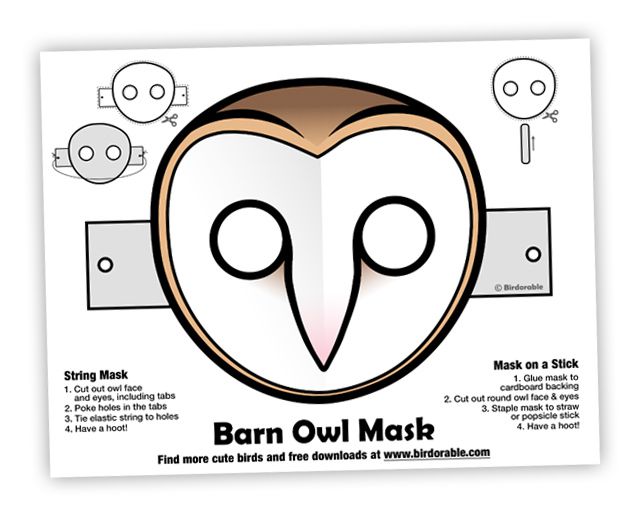
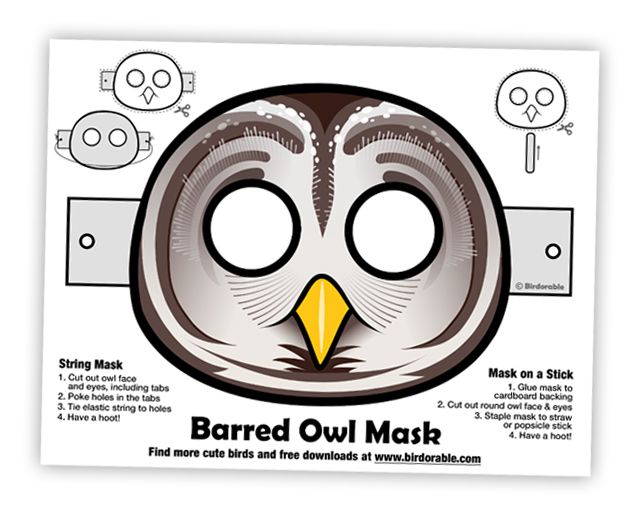
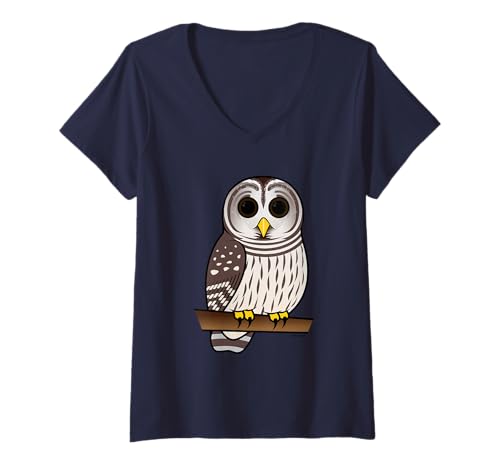
Halloween is just a couple of days away! If you're in desperate need of a costume then we may have the solution for you. Check out these two printable Birdorable owl masks! The faces of our cute Barred Owl and Barn Owl are here in larger-than-life full color, ready to print out and wear for Halloween or your next bird-themed fancy dress party! The masks can be made to wear, with the simple addition of some string, or made masquerade-style, stuck on a stick. Just click on a mask thumbnail to download the PDF:

Printable Barn Owl Mark
Fun Barred Owl Mask

Have you used any of our free printable downloads at home, in your classroom, or at an event? We’d love to hear about it! Send us photos of the pages in action, or the final result – we may showcase them on our blog!